Elliott Wave Analysis by EWF

Lam Research Corporation (LRCX) designs, manufactures, markets, refurbishes & services semiconductor processing equipment used in the fabrication of integrated circuits in the US, China, Korea, Taiwan, Japan, Southeast Asia & Europe. It comes in Technology Semiconductor sector & trades as “LCRX” at Nasdaq.

LRCX favors bullish impulse rally in weekly in I of (III) started from April-2025 low. It favors upside in ((5)) of I towards $262.90 - $280.83 area, while dips remain above 2.05.2026 low. The chasing longs at the moment can be risky as it may ended the I at last peak, if breaks below February-2026 low. We like to buy the pullback in clear 3, 7 or 11 swings in II sequence at extreme area.

In weekly, it ended (I) of ((III)) at $113 high in July-2024 & (II) at $56.36 low in April-2025 within the rally from October-2022. Above $56.36 low, it favors rally in I of (III) & showing 13 swings from April-2025 low. It expects two more highs, while pullback holds above 2.05.2026 low to end I into $262.90 - $280.83. In daily, it placed ((1)) of I at $167.15 high, ((2)) at $135.50 low, ((3)) at $251.87 high & ((4)) at $204.57 low. Within ((1)), it ended (1) at $108.02 high, (2) at $94.11 low, (3) at $153.69 high, (4) at $131.02 low & $167.15 high. Within ((3)), it placed (1) at $169.69 high, (2) at $153.60 low, (3) at $236.10 high, (4) at $213.87 low & (5) at $251.87 high.

LRCX-D1.jpg

Above ((4)) low of $204.57, it ended (1) at $256.68 high & favors pullback in (2). It should find support soon to extend higher in (3), which will confirm above $256.68 high. Once it breaks above (1) high, it should expect two or more highs to end ((5)) into $262.90 - $280.83 area as wave I. Alternatively, if it breaks below $204.57 low, it should be correcting in ((A)) of II, while called I ended at $256.68 high. We like to buy the pullback in II in 3, 7 or 11 swings at extreme area against April-2025 low.

Source: https://elliottwave-forecast.com/stock-market/lam-lrcx-favors-final-push-to-262-9-280-8/
 
Recent price action in CRWD suggested the stock was entering a deeper corrective phase. If the prior move completed a Leading Diagonal, the market typically responded with a sharp retracement. This retracement often targeted the 0.618 level of the entire advance. As a result, we anticipated increased volatility during this phase. Moreover, corrective waves usually produced failed bounces and weaker momentum. Consequently, the market adopted a more defensive tone before resetting the structure.
However, once the correction completed, CRWD positioned itself for a stronger trend leg. A Leading Diagonal often preceded a powerful wave 3 advance. Therefore, the broader outlook remained constructive despite short-term weakness. In the near term, corrective pressure dominated the environment. After the pullback exhausted, the stock had the potential to resume a stronger bullish phase.

Elliott Wave Outlook: CrowdStrike CRWD September 2025 Weekly Chart

Elliott Wave Outlook: CrowdStrike CRWD September 2025 Weekly Chart
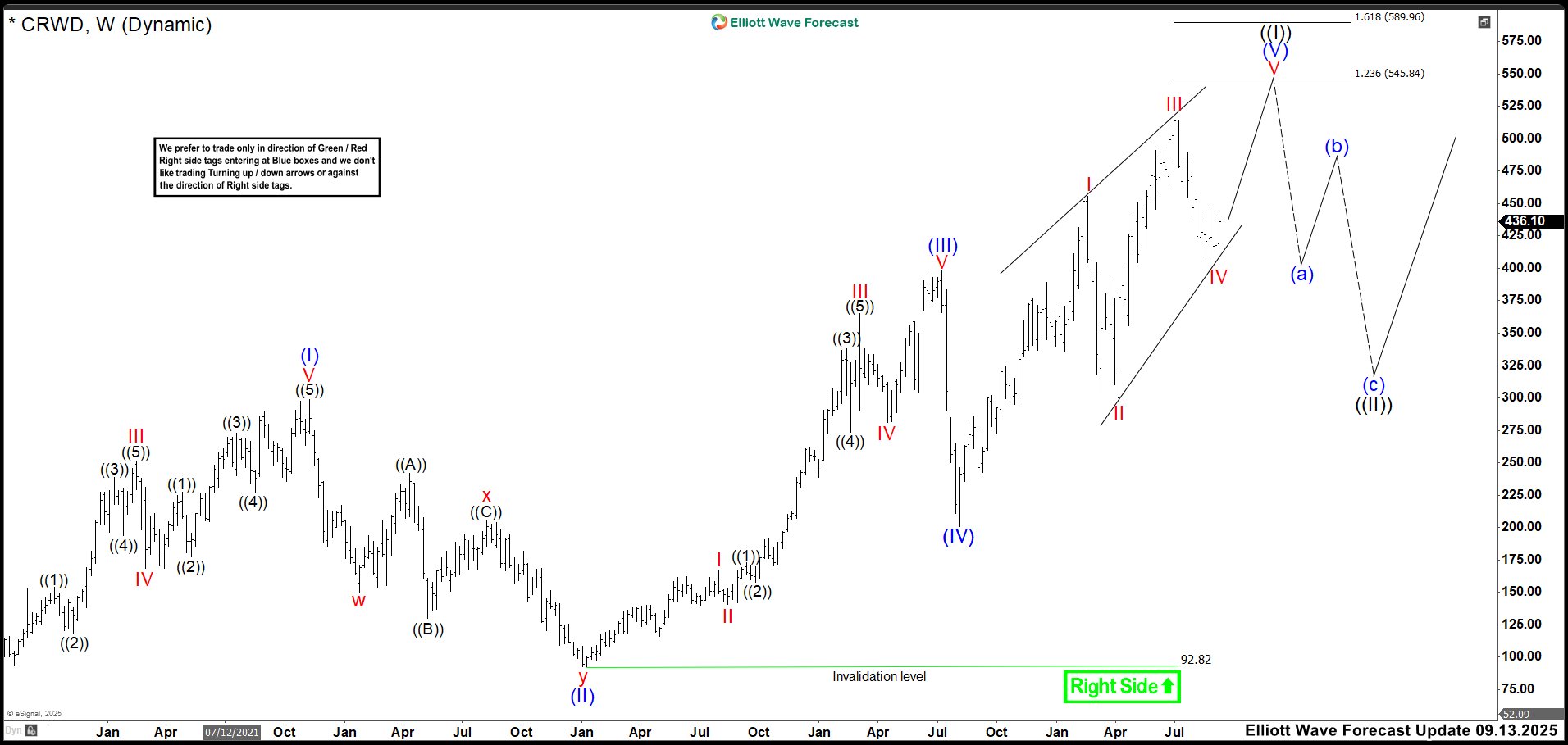
In the latest CRWD update, we tracked a leading diagonal structure built by impulsive price action. The pattern later evolved toward a potential ending diagonal. We clearly identified waves (I) and (II) early in the structure. The market then advanced strongly within wave (III). Wave (III) formed a clean five-wave impulse labeled I, II, III, IV, and V. However, wave (IV) retraced deeply and overlapped wave (I). This overlap invalidated the standard impulse structure. Consequently, the pattern transformed into a leading diagonal. Despite this change, price continued moving higher.
Furthermore, price broke above wave I and confirmed the extension scenario. Wave III ended near the 517 zone. After that, wave IV started its corrective phase. Since wave IV entered wave I’s territory again, the structure shifted. We then expected an ending diagonal to complete wave (V) of ((I)). For confirmation, price needed to rise toward the 545.84–589.96 resistance zone. A strong bearish reaction was likely in that area. If price reacted sharply, it likely marked cycle completion. This reaction also suggested that a broader correction had begun.

Elliott Wave Principle Behind the Market Structure​

Impulse

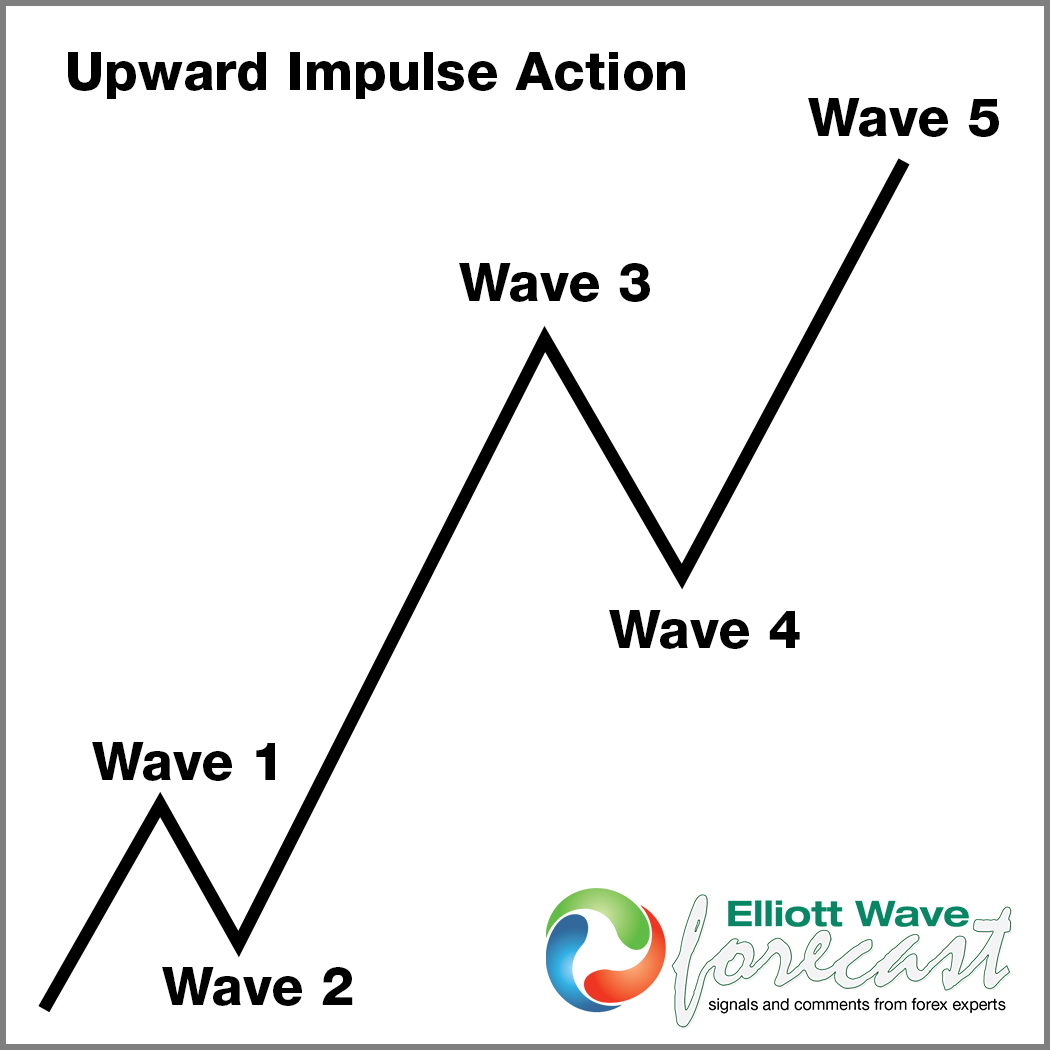
An impulse is a clean 5‑wave pattern that drives the trend forward.
  • Waves 1‑3‑5 are strong and directional.
  • No overlap between waves 1 and 4.
  • Wave 3 is usually the strongest.
  • Structure is clear, with increasing momentum.

ChatGPT-Image-3-mar-2026-07_24_10-a.m.png

Leading Diagonal

A Leading Diagonal appears at the start of a new trend and moves more slowly and contractively.
  • Waves 1 and 4 can overlap.
  • Impulsive waves often look like zigzags.
  • Each leg loses momentum.
  • Forms a wedge that usually leads to a deep correction.

ChatGPT-Image-3-mar-2026-07_28_27-a.m.png

In summary:
  • Impulse = established trend, clean and strong movement.
  • Leading Diagonal = early trend, choppy and corrective structure

Elliott Wave Outlook: CrowdStrike CRWD March 2026 Weekly Chart

CRWD-Weekly-2.png

As expected, the market reached the projected zone and reacted sharply to the downside. Price completed the ending diagonal as wave (V). In addition, it finalized the larger leading diagonal as wave ((I)). Immediately after, the correction began. This move confirmed that our structure was correct. It also respected the projected Elliott Wave levels.
Now, we simply need to wait for the next buying opportunity. CRWD started correcting a Grand Super Cycle structure. Therefore, the pullback could become deep and extended. The typical target area sits near 216. However, price could drop below 200 before stabilizing. This zone may offer a strong long-term buying opportunity. From there, price could eventually advance toward 1000. For now, we will let the market develop further. After one quarter, we will reassess the structure and evaluate new buy signals.
Source: https://elliottwave-forecast.com/stock-market/crwd-simple-coincidence-reaction/
 
Hello everyone! In today’s article, we’ll review the recent performance of Amazon.com Inc ($AMZN) through the lens of Elliott Wave Theory. We’ll look at how the pullback from all-time highs unfolded as a textbook 7-swing correction and discuss what could come next. Let’s explore the structure and the expectations for this stock.

5 Wave Impulse + 7 Swing WXY correction​

$NVDA

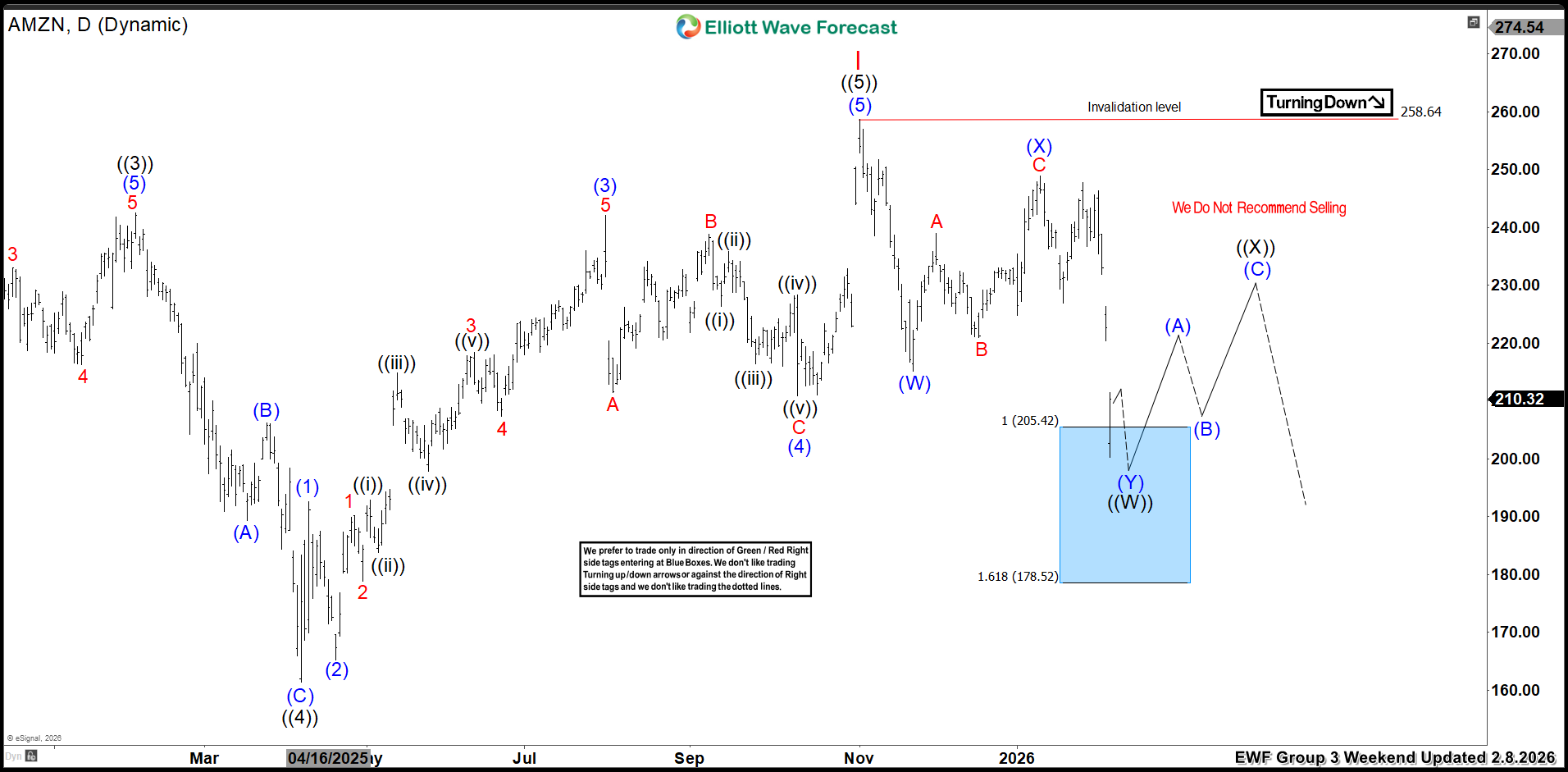
$AMZN Daily Elliott Wave Chart 2.08.2026:​

$AMZN

In the daily Elliott Wave count from Feb 08, 2026, we saw that $AMZN completed a 5-wave impulsive cycle from Apr 2025 low at red I. We anticipated this pullback to unfold in 7 swings, likely finding buyers in the blue box area between $205.42 and $178.52.

This setup aligns with a typical Elliott Wave correction pattern (WXY), in which the market pauses briefly before resuming its primary trend.

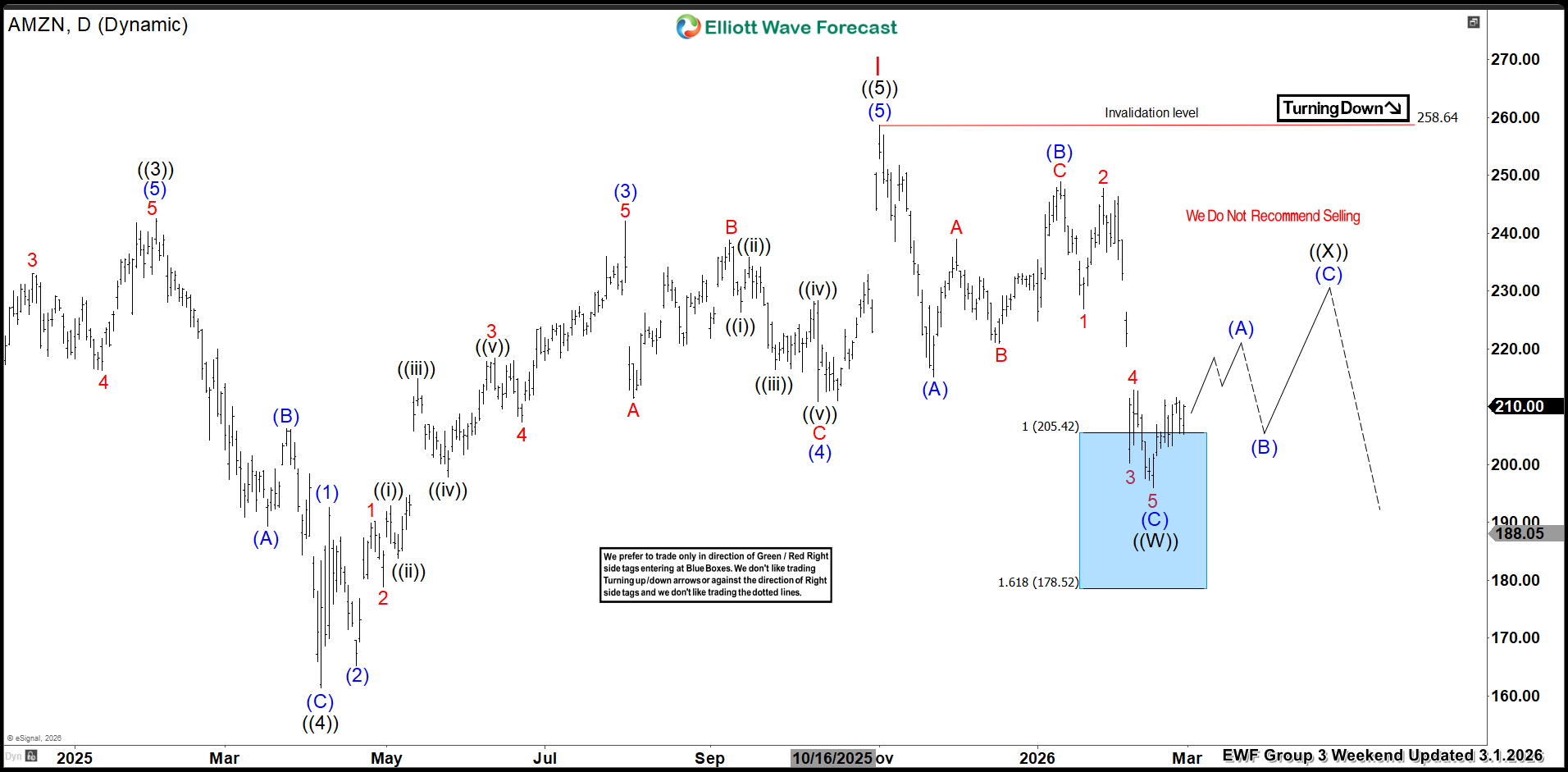
$AMZN Daily Elliott Wave Chart 3.01.2026:​

$AMZN

The latest daily update, from Mar 01, 2026, shows that the stock bounced as expected allowing traders to get risk free. Currently, it is trading higher in wave (A) of ((X)), a 3 swing bounce (ABC), to correct the decline from Nov 2025 peak before continuing lower in wave ((Y)) of II .

Conclusion

To conclude, our Elliott Wave analysis of Amazon.com Inc ($AMZN) suggests that it remains supported in the near term for at least 3 swings up against recent Feb 2026 lows. Thus, traders that bought the blue box should get risk free by booking half profits and moving the stop loss to the recent low. Additionally, keep an eye out for any corrective pullbacks that may offer entry opportunities.

By applying Elliott Wave Theory, traders can better anticipate the structure of upcoming moves and enhance risk management in volatile markets.

Source: https://elliottwave-forecast.com/vi...-blue-box-area-offering-a-buying-opportunity/
 
Platinum (PL) broke to new all-time highs late last year, signaling the potential start of a secular bullish market in the years ahead. In this article, we examine the long-term outlook for the metal and its evolving Elliott Wave structure.

Platinum (PL) Monthly Elliott Wave Chart​

Platinum-Monthly20260305153914.jpg


The monthly Platinum chart shows the metal has broken out to new all-time highs, reinforcing a bullish outlook. Platinum remains in a multi-year secular uptrend. The rally from January 1992 to the March 2008 peak completed wave ((I)) at 2308.8. This was followed by a corrective zigzag decline to 563, marking the end of wave ((II)). From that low, the metal resumed higher and has now broken into fresh highs with an impulsive internal structure.

From wave ((II)), wave (I) ended at 1348.2, while the subsequent pullback in wave (II) bottomed at 796.8. Platinum then advanced within wave (III), which is expected to extend one more leg before completion. As long as the metal holds above 563.8, corrective dips should continue to find support in three- or seven-swing structures, setting the stage for further upside.

Platinum (PL) Daily Elliott Wave Chart​

Platinum-Daily20260305153959.jpg


The daily Platinum chart shows that the rally to 2925 completed wave ((3)). The subsequent pullback in wave ((4)) is proposed to have ended at 1806. However, the metal must break above the wave ((3)) high to rule out the possibility of a double correction. In the near term, as long as the pivot at the 891 low remains intact, the outlook stays bullish with dips expected to hold in three- or seven-swing corrections. If Platinum fails and breaks below 1806, the next support zone in a potential double correction lies between 662 and 1344, where buyers are anticipated to re-emerge.

Source: https://elliottwave-forecast.com/video-blog/platinum-surges-to-record-high/
 
For Q2 2026, SMH may show mixed behavior as momentum cools. However, the sector still holds a strong long‑term trend. Current conditions suggest slower gains, yet buyers may defend key supports. As a result, the market could stabilize before attempting another advance.

Even so, rising volatility may pressure short‑term swings. Therefore, traders should expect sharper pullbacks and faster rotations. If demand strengthens, SMH could resume its impulsive path. If not, the sector may enter a broader consolidation phase. Discipline and tactical awareness remain essential.

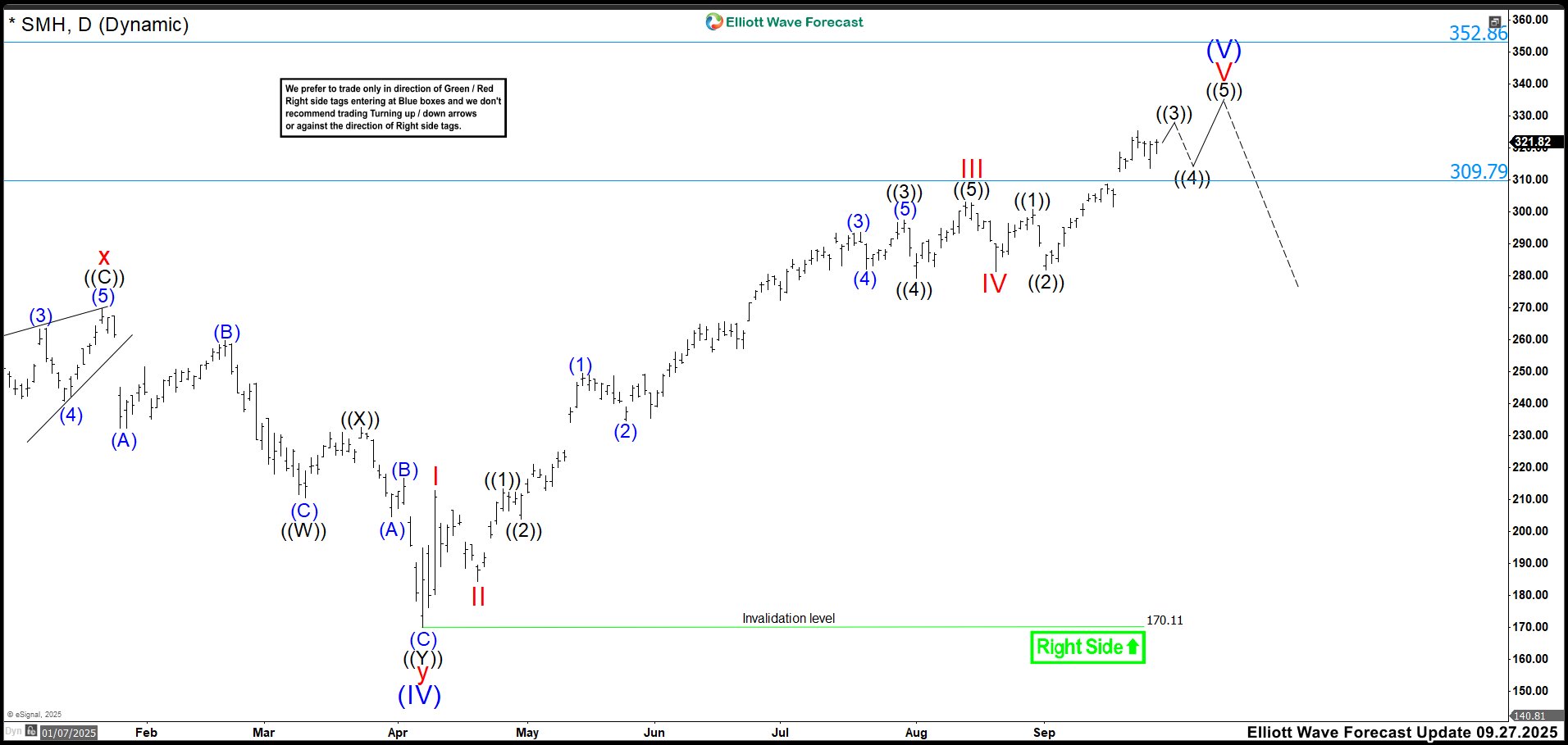
Elliott Wave Outlook: SMH Daily Chart September 27th, 2025

Elliott Wave Outlook: SMH Daily Chart September 27th

Last year, SMH showed a strong impulsive structure. Moreover, all signals suggested that wave V was already in progress. The weekly chart also hinted that wave III was still unfolding, but we adopted a conservative stance. The structure from the 170.11 low stayed intact. Bullish momentum controlled the market unless evidence showed otherwise.

We expected wave ((3)) to peak by late September. Then, we projected a quick wave ((4)) correction through October. If the pattern held, November and December were likely to deliver a final rally. After that, we anticipated a broader reset in early 2026.

SMH traded inside the 309.83–353.03 zone. This area often marked exhaustion and possible reversals. Therefore, we urged traders to stay alert and act with precision. The wave V structure looked clean and actionable. Our strategy remained simple: buy dips after corrections in 3, 7, or 11 swings. Momentum favored the bulls, but risk increased inside that zone. A sharp correction could appear at any moment. We watched for topping signs and failed breakouts. Discipline guided every decision. We rode the impulse while it lasted and stayed ready to pivot.

Elliott Wave Principle Behind the Market Structure​

Impulse

An impulse is a clean 5‑wave pattern that drives the trend forward.

  • Waves 1‑3‑5 are strong and directional.
  • No overlap between waves 1 and 4.
  • Wave 3 is usually the strongest.
  • Structure is clear, with increasing momentum.

ChatGPT-Image-3-mar-2026-07_24_10-a.m.png

Wave Extensions


Extensions occur when one impulsive wave becomes significantly longer and more powerful than the others.

Most commonly, wave 3 extends, creating the longest and most explosive leg.
An extended wave subdivides into a clear, elongated 5‑wave pattern.
The other two impulsive waves remain shorter and more proportional.
Extensions highlight where the market’s strongest momentum is concentrated.

EXTENsION3.jpg


Elliott Wave Outlook: SMH Daily Chart March 8th, 2026

SMH-Daily.jpg


In this update of SMH, the market breaks above 152 and signals an extended impulse. This moves forces us to adjust the count and include the extension. Wave ((1)) ends at the April high of 212.81. Wave ((2)) ends at the low of 184.40, and the rally continues. Next, we see the extension inside wave ((3)). We can clearly identify waves (1), (2), (3), (4), and (5). Inside wave (1), the market forms another extension with waves 1, 2, 3, 4, and 5. This behavior shows why we always trade with the trend. Extensions can appear at any moment.

Wave ((3)) ends at the October high. Wave ((4)) ends at the November low. From tHere, we expect one more high to complete wave ((5)) and finish wave I. We shift from wave (V) to wave I as we confirm each correction. For now, we expect a correction of the cycle that began in April 2025. After that, we will evaluate if the pullback can continue.

Wave ((5)) not only creates a new high but also forms an ending diagonal. This pattern suggests the cycle may end soon. The market already breaks below the diagonal, and we expect bearish acceleration to confirm the structure. If the structure confirms, wave II may retrace toward the 329.32–268.42 area before the bullish trend resumes.

Source: https://elliottwave-forecast.com/stock-market/the-april-2025-smh-cycle-looks-officially-complete/
 
The market remains under pressure, and that weakness drags AXP lower. However, the company shows strong operating momentum and steady premium‑client spending. Moreover, its revenue growth outlook for Q2 2026 stays firm. AXP shows strong fundamentals, but Elliott Wave signals a completed cycle and risk of a drop below 200.

Still, the current price ignores that strength. The stock reflects fear, not fundamentals. Yet the projected Q2 2026 numbers point to solid expansion and healthy margins. Therefore, AXP’s valuation looks disconnected from its real performance.

Elliott Wave Outlook:


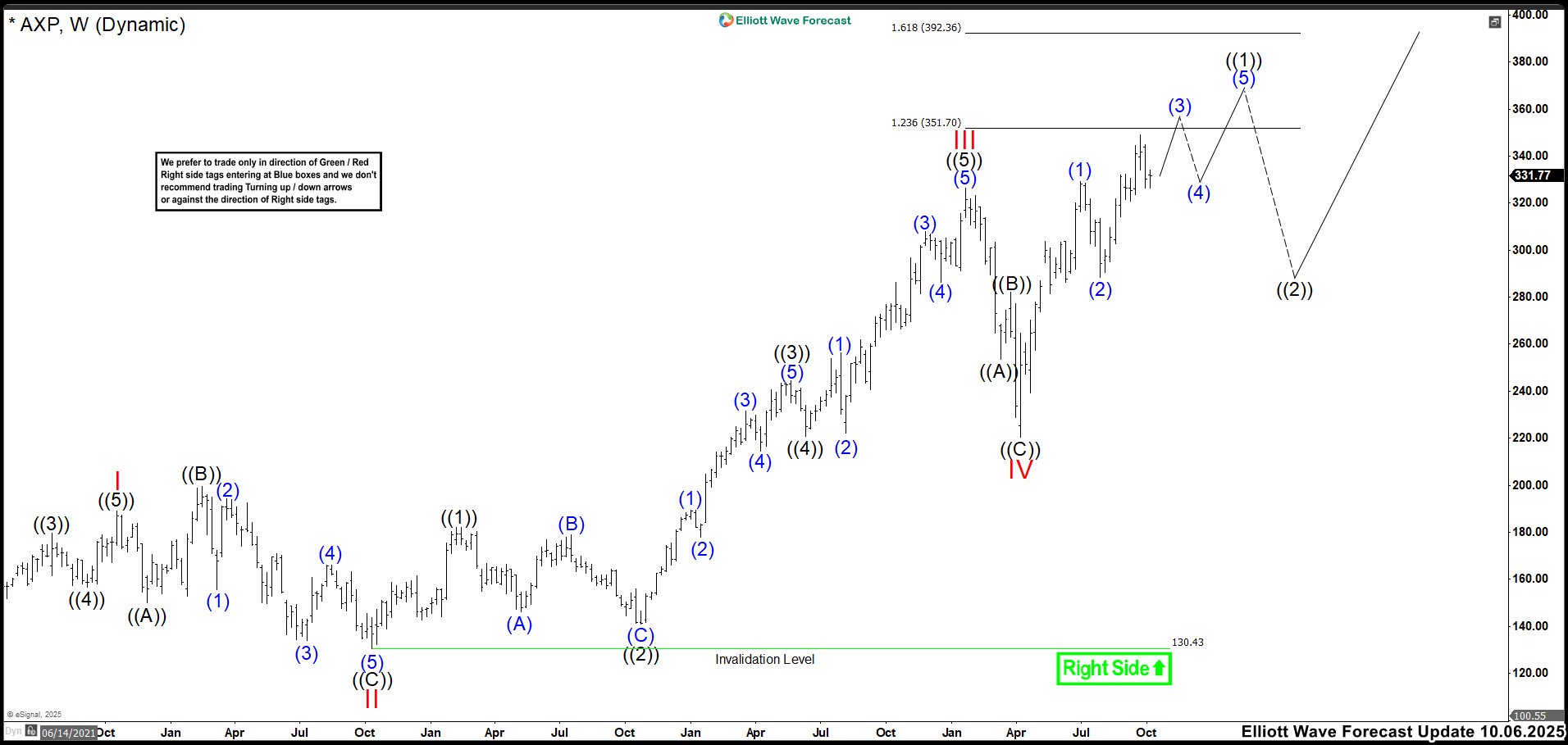
AXP continued rising after completing wave IV and broke above the wave III high. This confirms wave IV likely ended. Now, the market appeared to be unfolding wave ((1)) of V, showing bullish momentum. We expected an impulsive structure to complete the cycle soon. If the move was impulsive, the chart should reflect a clear five-wave pattern. However, if it was a leading diagonal, wave (3) may have ended, and wave (4) could be underway. Either way, we anticipated more upside toward the 351.70–392.36 zone. The key was identifying the Elliott structure that would offer the best exit before correction begins.

Elliott Wave Principle Behind the Market Structure​

Impulse

An impulse is a clean 5‑wave pattern that drives the trend forward.

  • Waves 1‑3‑5 are strong and directional.
  • No overlap between waves 1 and 4.
  • Wave 3 is usually the strongest.
  • Structure is clear, with increasing momentum.

ChatGPT-Image-3-mar-2026-07_24_10-a.m.png

Elliott Wave Outlook:

Elliott Wave Outlook: AXP Weekly Chart March 08th, 2026


In this AXP update, we see the market completing an impulse from April 2025. At first, we viewed this impulse as wave ((1)) and expected an extension. However, the reaction from the extreme zone signals the 2020 cycle has ended.

Now we watch for a strong rebound that confirms wave “a” has finished. Then we expect that rebound to fail and continue the decline. Therefore, we must stay alert because AXP shares could drop below 200 dollars.

Source: https://elliottwave-forecast.com/st...-reality-elliott-wave-warns-of-a-bigger-move/
 
Amid the war in the Middle East, oil prices have broken to the upside, trading at their highest levels since June 2022. As a result, oil-traded ETFs are also at multi-month highs. So, what price action should traders expect for USO in the coming weeks?

USO (United States Oil Fund) is an exchange-traded fund (ETF) designed to track the daily price movements of West Texas Intermediate (WTI) crude oil. Instead of holding physical oil, the fund primarily invests in near-term WTI crude oil futures contracts traded on the NYMEX.

USO Monthly Elliott Wave Analysis and Forecast

uso


USO completed a long term bearish cycle from July 2008 at the low of April 2020 identified as wave (II). There are two possibilities

  1. The decline from the top of July 2008 is an impulse wave sequence starting from July 2008 and ended in April 2020. The entire decline could then be (I) of (a) and the resultant bounce from April 2020 is (II) or (b) targeting $380-$608 before wave III of (c) follows to fresh low.
  2. The entire decline from July 2008 is corrective and ending (II) with a new cycle (III) emerging targeting new record highs in the years to come.
Meanwhile, the price action in oil suggests the second scenario is more probable. WTI rallied from the Covid lows with a strong 5-wave sequence, peaking in March 2022. Subsequently, a corrective pullback formed a 7-swing structure, bottoming in December 2025. The Middle-East war's escalation led to the biggest oil price gains since Covid.

On the USO monthly chart above, the price is in wave ((3)) of I of (III), which could target $181 or higher in the coming days.

USO Weekly Elliott Wave Analysis and Forecast

USO


The weekly chart above shows the current sub-waves of ((3)). Price has completed waves 1 and 2 of (1) of ((3)). Wave 3 started from the low of April 2025 and is currently in its 3rd sub-wave, i.e., wave ((iii)) of 3, with a target likely to extend to 2.618 of wave ((i)) from ((ii)) at $127. Therefore, with this breakout, traders are not advised to sell. Conversely, traders are advised to buy the dips. Elliottwave-Forecast provides blue boxes for members to trade from.

Source: https://elliottwave-forecast.com/stock-market/uso-analysis-points-higher-targets/
 
Hello traders, welcome to this new blog post where we discuss blue boxes. This time, we'll focus on USDCHF, which reacted as expected from the blue box, putting our members in profit. Let me walk you through the setup.

On the weekly chart, a long-term corrective 4th wave concluded in December 2016, marking wave (IV). Since that peak, the currency pair has exhibited a consistent bearish trend, characterized by a sequence of lower lows and lower highs over the past decade. Waves ((1)) and ((2)) of I of (V) concluded at the low of December 2023 and the peak of April 2024, respectively.

Following the high of April 2024, the pair has sharply declined to new lows, even breaching the low of ((1)) to initiate wave ((3)), with targets ranging from 0.6969 to 0.6270. Given this outlook, traders should anticipate further price declines in the near future. In such established bearish sequences, we focus on selling the rebounds from the blue box. Traders have successfully profited from the blue boxes shared for this pair in recent months. The most recent blue box was shared on February 23, 2026, as illustrated in the chart below.

USDCHF Blue Box Sell Setup - 2/23/2026

usdchf


On 23rd February, 2026 we identified a corrective bounce against the long term bearish sequence. This is our typical 'bread and butter' setup. Thus, we shared the chart above with members showing the blue box where they can go short on this pair. We didn't just alert members with this chart, we also discussed the setup in the live trading room and added the trade to our journal. This way traders can monitor the setup from trigger to exit.

USDCHF Blue Box Sell Setup - 3/08/2026

usdchf


After nearly two weeks, the trade was triggered at the blue box. The pair swiftly declined, reaching the first target of over 100 pips. Traders took partial profits at the first target and are now holding the second part of the trade with the stop loss adjusted to the top of the blue box. This allows the trade to run risk-free, enabling traders to anticipate further profits while utilizing the risk on this trade elsewhere.

You can get similar analysis and blue boxes across all time frames on the 78 instruments we currently cover.

Source: https://elliottwave-forecast.com/forex/usdchf-delivers-profit-bearish-sequence/
 
The Global X Silver Miners ETF (SIL) provides investors with diversified exposure to leading silver mining companies across the globe. Since its launch in 2010, the fund has tracked the Solactive Global Silver Miners Total Return Index, offering a straightforward way to participate in the sector through a single trade. In the discussion that follows, we examine the ETF’s Elliott Wave technical outlook.

SIL (Silver Miners ETF) Monthly Elliott Wave Chart​

SIL-Monthly20260309091716.jpg


The monthly Elliott Wave chart of the Silver Miners ETF (SIL) suggests the ETF is nesting higher after completing the wave ((II)) pullback at $14.94. From that low, wave I advanced to $54.34, followed by a wave II correction down to $16. The ETF then nested higher, with wave ((1)) peaking at $52.87 and wave ((2)) retracing to $21.26.

Subsequently, wave ((3)) is proposed complete at $119.24, and the current wave ((4)) pullback is unfolding to correct the cycle from the September 2022 low before resuming higher. As long as the $16 pivot remains intact, SIL is expected to attract buyers and extend the bullish sequence.

Silver Miners ETF Daily Elliott Wave Chart​

SIL-Daily20260309092446-1.jpg


The daily Elliott Wave chart of the Silver Miners ETF (SIL) indicates that the rally to $119.24 completed wave ((3)). The ETF is now correcting the cycle from the September 2022 low in wave ((4)). The pullback is unfolding as a zigzag structure, with wave (A) ending at $91.31 and wave (B) at $118.85. Currently, wave (C) is progressing lower toward the inflection zone of $74–$91.10. Wave ((4)) is expected to complete at this area before the broader uptrend resumes.

Source: https://elliottwave-forecast.com/stock-market/silver-miners-sil-identifying-the-next-support-zone/
 
Carvana Co (NYSE: CVNA) soared over 13,000% in three years, capturing the market's attention. However, financial markets never move in straight lines. In this article, we delve into the Elliott Wave analysis. Our study uncovers the current pullback and the next potential investment opportunity.

Elliott Wave Analysis

Despite its 98% correction in 2022, CVNA recovered fully and broke to new all-time highs. The stock created an impulsive five-wave advance from the wave ((II)) low of $3.62. This rally surged over 13,000%, completing wave (I) at $486. Most importantly, CVNA established a bullish sequence. It shows three swings into new highs since its IPO. This confirms strong bullish momentum.

Subsequently, CVNA now needs to correct this entire rally within wave (I). Therefore, the stock should pull back toward the $245 - $188 Fibonacci zone. This area represents the 50% - 61.8% retracement. A higher low should form there. Then, wave (III) will begin its next advance.

This current correction will attract long-term investors. It will unfold as a 3, 7, or 11-swing pattern, depending on the daily structure.

CVNA Weekly Chart 3.9.2026

CVNA Weekly 3.9.2026

Conclusion​

The long term bullish cycle for CVNA remains in progress, presenting opportunities to buy the current weekly pullback using our Elliott Wave strategy. The preferred approach is to enter positions after the stock completes a 3, 7, or 11 swing sequence from its peak.

Source: https://elliottwave-forecast.com/stock-market/carvana-cvna-bearish-case/
 
Palantir (PLTR) continues to attract investor attention as its stock trades near key technical levels. Recently, the company benefited from strong demand for artificial intelligence platforms and government contracts. As a result, analysts expect solid revenue momentum into the second quarter. However, expectations remain mixed because the stock already reflects significant optimism after its strong rally.

Meanwhile, geopolitical tensions in the Middle East are shaping the broader market environment. In particular, defense spending and intelligence demand often rise during periods of instability. Therefore, analysts see potential upside for companies like Palantir that provide data analytics to governments and defense agencies. Still, investors remain cautious as volatility in global markets could influence short-term price action.

Elliott Wave Outlook: PLTR Daily Chart Analysis October 26, 2025

Elliott Wave Outlook: PLTR Daily Chart Analysis October 26, 2025

Months ago, PLTR extended in wave (V), showing continued bullish momentum. Wave III pushed up to $190.00 before sharply pulling back to $142.34, marking wave IV. Although the price rallied from that low, it did not break above the wave III high. Therefore, we expected more upside to complete wave V of (V). This structure suggested that wave V was likely to extend, and we looked for the price to move higher as the impulse unfolded.

The market targeted the $201.49–$219.79 zone, where a bearish reaction could signal the completion of wave V. If no reaction occurred, prices could continue climbing to even higher levels. We thought the reaction would likely revisit the $142.34 level at minimum, with a possible retracement toward $100 per share.

Elliott Wave Principle Behind the Market Structure​

Impulse

An impulse is a clean 5‑wave pattern that drives the trend forward.

  • Waves 1‑3‑5 are strong and directional.
  • No overlap between waves 1 and 4.
  • Wave 3 is usually the strongest.
  • Structure is clear, with increasing momentum.

Impulse

Wave Extensions


Extensions occur when one impulsive wave becomes significantly longer and more powerful than the others.

Most commonly, wave 3 extends, creating the longest and most explosive leg.
An extended wave subdivides into a clear, elongated 5‑wave pattern.
The other two impulsive waves remain shorter and more proportional.
Extensions highlight where the market’s strongest momentum is concentrated.

Wave Extensions


Elliott Wave Outlook: PLTR Daily Chart Analysis March 09, 2026

PLTR-Daily.jpg


As we can see, the impulse we expected ended in the projected zone. In addition, both wave (III) and wave (V) extended. The structure is not ideal because wave IV retraced deeply. Nevertheless, it still follows all Elliott Wave impulse rules.

Because of the sharp correction in the stock, we now believe a Grand Super Cycle has completed. However, the current market structure does not provide clear trading opportunities. The stock has retraced enough to suggest the correction may already be finished. Therefore, prices could resume the bullish trend from current levels.

However, we cannot rule out further downside in the correction. Two possible scenarios could still unfold. First, the stock could rally to retest recent highs before falling below 126.23. If that happens, prices could decline toward the $104-$80 zone. This move would likely complete wave ((II)) before the bullish trend resumes.

Alternatively, wave (b) may have already ended. In that case, the stock could continue moving lower from current levels. Therefore, the current structure still limits new trading decisions. For now, investors should watch whether price breaks below the 126.23 level of wave (a). If that occurs, potential buying opportunities could emerge between $104-$80 area.

Source: https://elliottwave-forecast.com/stock-market/palantir-pltr-elliott-wave-cycle-complete/
 
In this Elliott Wave update, we take a look at the latest structure in Apple Inc. ($AAPL). The stock completed a bullish cycle from the April 2025 low and has now turned lower in what appears to be a larger corrective sequence. As a result, the current decline is unfolding as a 7 swing correction, with the next important reaction area coming at the blue box reversal zone.

5 Wave Impulse + 7 Swing WXY correction​

$AAPL

$AAPL Daily Elliott Wave View March 8th 2026​

$AAPL

Looking at the daily chart, $AAPL ended the advance from the April 2025 low in a completed impulsive sequence. After that, the stock failed to extend higher and instead started to correct the entire cycle. Consequently, price action shifted from a bullish trending structure into a complex corrective pattern.

At this stage, we do not view the decline as a simple three-wave pullback. Instead, the structure points to a 7 swing correction, which Elliott Wave traders often label as W-X-Y. In other words, the market is still working through a broader corrective phase rather than preparing for an immediate resumption of the larger upside trend.

7 Swing Correction Taking Place​

The correction from the peak is unfolding in a sequence that remains incomplete. Therefore, while short-term bounces can appear along the way, the broader structure still points to additional downside before the correction ends.

This is important because many traders often mistake the first bounce during a correction as the start of a new bullish leg. However, in a 7 swing structure, temporary rebounds are common and usually act as part of the overall correction. For that reason, the current view continues to favor more downside pressure after the next reaction higher.

Blue Box Reversal Zone Is the Key Area​

Most importantly, traders should watch the blue box, which comes between 235.80 and 207.87. This area marks the next high-frequency reversal zone, where the current leg lower should find support.

Typically, when price reaches the blue box, sellers begin to take profit while buyers look for a reaction higher. As a result, a $AAPL should produce a relief bounce from this area. However, that bounce should stay corrective and should not begin a new impulsive rally.

In fact, the preferred scenario remains that $AAPL bounces from the blue box and then turns lower again to continue or complete the broader correction.

Short-Term View​

As long as $AAPL remains within this corrective structure, traders should be careful not to chase upside strength too early. Although the stock can produce a notable rebound from the blue box area, the larger pattern still suggests that rallies should remain capped before another leg lower unfolds.

Meanwhile, the chart also shows that the broader bullish risk remains valid above the long-term invalidation level. Even so, in the near term, the path still favors corrective price action rather than immediate trend continuation to the upside.

Trading Strategy​

From a trading perspective, the main focus is on how price reacts once $AAPL reaches the blue box area. If buyers respond there as expected, the stock can deliver a tradable recovery. However, traders should keep in mind that this bounce is expected to be a relief rally, not necessarily a completed low.

Therefore, the preferred strategy is to respect the reaction from the blue box but also remain aware that the market can turn lower again afterward as part of the 7 swing correction.

Technical Summary​

To summarize, $AAPL has likely completed its cycle from the April 2025 low, and a 7 swing correction is now taking place. Furthermore, the blue box area at 235.80–207.87 is the next important reversal zone, where a relief bounce is expected before lower again.

Accordingly, traders should continue to monitor the current decline closely. While a bounce looks likely from the blue box, the overall structure still favors another move lower before the correction is fully complete.

Source: https://elliottwave-forecast.com/vi...rection-underway-after-april-2025-cycle-ends/
 
CoreWeave, Inc., (CRWV) operates as a cloud infrastructure technology company in the United States. It offers CoreWeave Cloud platform that comprises proprietary software & cloud services that deliver the automation & efficiency needed to manage complex artificial intelligence (AI) infrastructure at scale. It also offers storage & data solution. It comes in Technology sector & trades as “CRWV” ticker at Nasdaq.

The CRWV favors double three correction in daily from June-2025 & expect downside against 1.28.2026 high. It favors weakness to extend into $51.55 or lower to correct April-2025 low. Sellers should remain active, while bounce fail below 2.25.2026 high.

In daily, since inception, it made ATL of $33.52 in April-2025 & ATH at $187 in June-2025. Within rally, it ended ((1)) at $130.76 high, ((2)) at $104.90 low, ((3)) at $166.63 high, ((4)) at $132.80 low & ((5)) as I at $187 high. Below $187 high, it favors double three correction as 7 swing moves, correcting April-2025 low. Within II pullback, it ended ((W)) at $85.26 low, ((X)) at $153.20 high & favors downside in (C) of ((Y)). It ended (A) of ((W)) at $100.80 low, (B) at $148.80 high & (C) at $85.26 low. It ended (W) of ((X)) at $124.90 high, (X) at $104.07 low & (Y) at $153.20 high. The ((W)) was zigzag correction, ((X)) was double correction & ((Y)) favors zigzag again.

CRWV - Elliott Wave Latest Daily View:​

CRWV-D1.jpg

Below ((X)) high, it ended (A) of ((Y)) at $63.80 low & (B) at $114.45 high. Currently, it favors downside in 3 of (C), while ended 1 at $74.00 low & 2 at $103.44 high. It expects two more swings lower to end the (C) in 5 swing move towards $51.55 or lower. Sellers can sell the bounce in 3, 7 or 11 swings, while below $103.44 high for targeting $51.55 as extreme area. Until the price reaching extreme area, buyers should stay sideline. The price should fail below down-trending trendline to extend lower.

Source: https://elliottwave-forecast.com/stock-market/crwv-sellers-remain-active-targeting-51-55/
 
In this technical blog, we will look at the past performance of the 1-hour Elliott Wave Charts of Doge Coin ticker symbol: DOGEUSD. In which, the decline from 9.13.2025 high unfolded in a corrective sequence. But showed a lower low sequence favored more downside extension to take place. Therefore, we advised members not to buy the pair & sell the bounces in 3, 7, or 11 swings at the blue box areas. We will explain the structure & forecast below:

DOGEUSD 1-Hour Elliott Wave Chart From 2.13.2026​

DOGEUSD Faces Downside After Blue Box Reaction


Here’s the 1-hour Elliott wave chart from the 2.13.2026 Asia update. In which, the decline to $$0.0803 low ended the cycle from 1.06.2026 high in wave ((a)). Up from there, the DOGEUSD made a bounce in wave ((b)) to correct that cycle. The internals of that pullback unfolded as Elliott wave double three structure where wave (w) ended at $0.1020 high. Wave (x) bounce ended at $0.088 low and wave (y) managed to reach the blue box area at $0.1098- $0.1234. From there, sellers were expected to appear looking for the next leg lower or do a 3 waves back minimum.

DOGEUSD Latest 1-Hour Elliott Wave Chart From 3.10.2026​

DOGEUSD Faces Downside After Blue Box Reaction


This is the latest 1-hour Elliott wave Chart from the 3.10.2026 Asia update. In which the DOGEUSD is showing a reaction lower taking place, right after ending the correction within the blue box area. Allowed members to create a risk-free position shortly after taking the short position at the blue box area. However, a break below $0.0803 low is needed to confirm the next leg lower towards $0.053- $0.028 target area.

Source: https://elliottwave-forecast.com/bluebox-wins/dogeusd-faces-downside-after-blue-box-reaction/
 
Chevron Corporation (NYSE: CVX) is one of the world’s largest multinational energy companies. Headquartered in San Ramon, California, Chevron operates in more than 180 countries. It participates in nearly every aspect of the oil and gas industry, including exploration, production, refining, transportation, and marketing. As one of the major global oil “supermajors,” Chevron plays a critical role in supplying energy to the world.

Chevron’s operations are typically divided into two primary segments: upstream and downstream. The upstream segment focuses on the exploration and production of crude oil and natural gas. Meanwhile, the downstream segment includes refining petroleum into fuels, producing petrochemicals, and marketing products such as gasoline and lubricants. Through these activities, Chevron maintains a strong presence in international energy markets.

From a financial market perspective, Chevron’s stock (CVX) is closely followed by investors and traders because it is a major component of both the energy sector and the Dow Jones Industrial Average. In addition to fundamental analysis, many market participants rely on technical analysis to evaluate potential price movements.

One widely used technical approach is Elliott Wave Theory. It suggests that market prices move in recurring wave patterns driven by collective investor psychology. According to this framework, Chevron’s stock appears to be forming an Elliott Wave impulse structure that began from the lows on April 4, 2025. An impulse wave consists of five waves moving in the direction of the primary trend.

Based on the current structure, the stock appears to be progressing within wave ((3)), which could potentially reach a level around $195.69. After the completion of wave ((3)), a corrective wave ((4)) is expected, followed by wave ((5)), which could push the price toward a projected target near $203.75.

Chevron (CVX) Daily Elliott Wave Chart​

CVX-Chevron20260309193604-1024x508.jpg


From a larger perspective, Chevron appears to have completed three waves into new all-time highs within the Grand Supercycle. In Elliott Wave theory, a trend generally cannot end with only three waves when those waves are moving in the direction of the main trend. Therefore, this structure suggests that the long-term cycle may still be incomplete, implying the potential for further upside.

The current interpretation proposes that the stock may be nesting within a larger Grand Supercycle structure, consisting of multiple degrees of waves such as ((I)), ((II)), (I), (II), and smaller subwaves within them. This type of nested structure often precedes strong accelerations in price as higher-degree impulse waves unfold.

Chevron (CVX) Weekly Elliott Wave Chart​

CVX-Chevron-Weekly20260309193539-1024x508.jpg


Although some analysts may anticipate a potential crash after visible five waves at higher degrees, the broader market context—particularly the strength of the Dow Jones Industrial Average and the energy sector—does not strongly support an immediate bearish scenario. Instead, the preferred interpretation is that the structure represents a nested bullish pattern, suggesting continued upside potential.

Overall, Chevron’s price action remains bullish, with an incomplete sequence developing since July 4, 2025. The presence of multiple impulse waves within the Grand Supercycle structure indicates that higher prices may still lie ahead, not only for Chevron but potentially for the broader energy sector as well.

Source: https://elliottwave-forecast.com/vi...lse-since-04-07-2025-with-a-target-at-203-75/
 

AUBANK completes a rare expanding triangle in wave (4), suggesting the next impulsive rally could target the 1138–1322 region as the broader bullish cycle continues.​

AU Small Finance Bank Ltd. (AUBANK) appears to have completed its cycle degree correction in wave II at 477.75. The stock then turned higher and started a new bullish cycle in wave III. This move suggests that the market has entered a fresh impulsive phase with strong long-term potential. From the 477.75 low, the stock formed an initial three-wave advance. After that rally, price entered a corrective phase labeled blue wave (4). This pullback unfolded as an expanding triangle, which is a rare Elliott Wave pattern. Such triangles usually appear before a strong continuation of the trend.

AUBANK_2026-03-11_06-19-14-scaled.png

Expanding Triangle Indicates Trend Continuation​

The triangle pattern appears to have completed near 895.05. This completion suggests the consolidation phase has likely ended. As a result, AUBANK may now begin the next impulsive leg higher. Expanding triangles often build pressure before a breakout. In this case, the structure supports the view that the next move should occur in wave 5. This wave should complete black wave ((1)) of the larger bullish sequence.

Using Fibonacci extensions, the next upside target comes near 1138.75. This level represents the 0.618 extension of wave (3). It acts as the minimum expected target for the current bullish move. However, Elliott Wave rules also define an upper boundary. Since wave (3) is already shorter than wave (1), wave 5 should remain below 1322.35. A move above this level would violate the rule that the third wave cannot be the shortest.

Pullback Could Offer Buying Opportunity​

After the rally reaches the 1138.75–1322.35 region, the market may enter a correction in wave ((2)). This pullback could unfold in 3, 7, or 11 swings, which are common corrective structures. As long as price stays above 477.75, the long-term bullish outlook remains valid. The current structure suggests that AUBANK may continue higher in the near term. Traders should watch pullbacks for potential buying opportunities within the broader uptrend.

Source: https://elliottwave-forecast.com/st...-analysis-expanding-triangle-bullish-outlook/
 

After completing wave ((1)) of wave V,​

The long-term chart of IndusInd Bank indicates a strong bullish structure from an Elliott Wave perspective. The stock appears to have completed a powerful five-wave impulse within red wave III of cycle degree, highlighting the strength of the long-term uptrend. Within this advance, wave ((1)) extended, which is typical in strong trending markets.

After completing the major impulse wave III, the stock entered a sharp and deep corrective phase in wave IV. This correction retraced close to 50% of the prior wave III advance, bottoming near 227.47 before buyers stepped back in. Such a retracement level is typical for fourth waves following an extended third wave and often sets the stage for the final bullish leg in the cycle.

INDUSINDBK_2026-03-12_22-22-22-scaled.png

Wave V Progress and Current Market Structure​

After completing wave IV, IndusInd Bank started the next bullish phase in wave V. Within this advance, the stock already formed five waves higher in black wave ((1)). This structure confirms the beginning of a new impulsive cycle.The market is now pulling back to correct this advance in wave ((2)). A closer look at the internal structure shows that wave (A) ended a clear five-wave decline near the 606 level. After that decline, the stock started bouncing in wave (B). The current bounce appears mature and may end soon below the peak of wave ((1)).

Once wave (B) finishes, the market could start wave (C). This move would complete a three-swing correction within wave ((2)). We expect this pullback to stay above the low of wave IV. Holding above that level will keep the broader bullish structure intact and support the long-term Elliott Wave outlook.

Alternate Scenario: Early Start of Wave ((3))​

However, if IndusInd Bank breaks above the wave ((1)) high, it would suggest the pullback in wave ((2)) has already ended. In that case, the market may have started the powerful wave ((3)) rally earlier than expected.

Long-Term Target Remains Strong​

From a broader perspective, the next major upside target lies near 3264, which corresponds to the 1.236 external retracement of wave IV. This level also aligns with the equal-legs projection of wave I, a common target when wave III is extended.

Overall, the long-term Elliott Wave outlook for IndusInd Bank remains strongly bullish, and the current pullback is viewed as a potential opportunity before the next major upside phase begins.

Source: https://elliottwave-forecast.com/stock-market/indusind-bank-elliott-wave-analysis-wave-v-outlook/
 

Long-Term Elliott Wave Structure Remains Strong​

The long-term technical outlook for Intuitive Surgical (ISRG) remains bullish based on the Elliott Wave structure shown on the chart. The stock has developed a strong impulsive trend over the past several years, confirming a healthy long-term uptrend. From a higher-degree perspective, the stock completed red wave IV near the 180 area, which now acts as an important invalidation level for the bullish outlook.

After completing red wave IV, Intuitive Surgical turned higher and started the next bullish phase in red wave V. Within this advance, the market completed blue wave (I) at the recent high before entering a corrective pullback in wave (II). This correction unfolded as a three-wave structure labeled a, b, and c, eventually finding support above the key invalidation level. Following the completion of wave (II), the stock resumed its upward momentum and started the next impulsive advance in blue wave (III).

ISRG_2026-03-13_06-05-56-scaled.png

Current Wave Structure and Market Position​

Within the larger wave I advance of blue (III), the stock appears to have completed the first impulsive leg in back wave ((1)), followed by a pullback in wave ((2)) now counting higher in wave ((3)). Within this move, we have already completed 3 swings represented in blue followed by a sharp correction in wave (4).

Recently, the market formed a pullback in wave (4) after a sharp rally. This correction appears to be part of the normal Elliott Wave sequence before the next potential bullish leg higher. As long as the structure continues to hold above the invalidation level, the broader trend should remain positive. The next expected move is wave (5), which could push the stock to new highs and complete wave ((3)) of the larger degree structure.

Price Targets and Future Outlook​

Based on Elliott Wave projections, the next upside target lies near 662, which corresponds to the 1.236 Fibonacci extension of the prior structure. Reaching this level would complete the impulsive sequence within wave ((3)).

After this rally, the stock may experience another pullback in wave ((4)), which would likely provide a buying opportunity in 3, 7 or 11 swings before the next major bullish leg.

Technical Outlook​

Overall, Intuitive Surgical remains in a strong bullish trend, and the Elliott Wave structure suggests that the stock still has room to move higher. Short-term pullbacks are likely to occur as part of the wave sequence, but these dips could offer opportunities as long as the broader bullish structure stays intact.

Source: https://elliottwave-forecast.com/stock-market/isrg-bullish-trend-points-toward-higher-highs/
 
CHFJPY currency pair is poised for more upside despite recent decline and choppy price action. How further can the long term bullish cycle continue before the next big pullback?

Yen pairs have demonstrated significant bullish trends since the COVID-19 pandemic emerged. Following a bearish cycle in 2016, these pairs experienced a surge throughout 2017 and into 2018, although they subsequently retraced until January 2019. This robust bullish trend, which emerged after a sell-off between January 2015 and June 2016, is largely attributed to the Bank of Japan's persistent implementation of ultra-loose monetary policies, in contrast to the monetary policy tightening observed in other major banks in the post-COVID-19 era. As a result of the weakened JPY, the CHFJPY has reached record highs.

CHFJPY Long term View

From our Elliott wave perspective, we shared the long term view on the weekly charts. There, we reckoned the low of January 2019 to depict the end of the grand supercycle degree ((II)). From that low, price completed sub-waves (I), (II), (III) and (IV) of ((III)) and now in (V). From the low of September 2024 where wave (IV) ended, we reckoned price had completed waves ((1)), ((2)), ((3)) and ((4)) of I of (IV) of ((III)). Thus, price is in the wave ((5)) which started from the low of February 2026.

Therefore, the most recent significant bullish cycle on this pair started in February and its end will most likely mark the end of the broader bullish cycle from September 2024. Thus, a big corrective pullback of the September 2024 cycle may not be that far away. However, Elliott wave theory shows wave ((5)) is not yet over and short-term traders can still buy the dips. Let's now check the smaller cycles.

CHFJPY Elliott Wave Analysis - 1st Scenario

eurjpy


As the H4 chart shows, wave ((5)) appears to be in its early stages. Following the completion of waves (1) and (2) of ((5)), wave (3) began on March 3rd and could extend to the 208.33-210.79 region. The current pullback is anticipated as wave 2 of (3), correcting the previous 5-wave advance that surpassed the prior peak. Wave 2 is expected to end above the March 3rd low, likely between 201.76 and 201.15. From this zone, a new short-term bullish cycle should emerge for wave 3 of (3). As it establishes a new high, traders can look to buy the dips, as wave (3) is still a distance away. However, if this zone is breached and the price reaches the low of (2), the second scenario below should unfold.

CHFJPY Elliott Wave Analysis - 2nd Scenario

chfjpy


If the pullback extends below the low of wave (2) in the first scenario, a deeper wave (2) with an irregular flat structure could form. The flat could be contained between 200.42 and [#######], where new support might emerge. From this support level, or slightly below, we could see a new wave (3) emerge. Traders should wait for a break of the previous high to confirm the count, then look to buy the dips. Overall, the bullish run should continue as long as the pair trades above the 197.60 pivot.

Source: https://elliottwave-forecast.com/fo...e-analysis-favors-upside-amid-choppy-actions/
 
Following the breakout in early February, PepsiCo is currently correcting but remains poised to continue higher, potentially improving upon the recovery from May 2025. With a generally bullish outlook, this blog post outlines two likely scenarios and provides guidance for traders.

PepsiCo investors faced a significant downturn, with stock prices plummeting from around $197 in May 2023 to approximately $127 by June 2025 – a 35% drop. However, in our February 16, 2025, blog post, we presented a weekly chart suggesting a potential recovery. The chart indicates that investors may soon see positive returns, and new investors or traders should consider entering the market at a potentially advantageous price with limited downside risk.

Pepsico


At the blue box, we anticipated wave (IV) to bottom. From the expected low, wave (V) should initiate, with the potential to reach $213-$240 in the coming months. Investors who purchased the stock within that zone, as suggested, should already be profitable, as PepsiCo subsequently found support in the blue box, as the chart below demonstrates.

pepsico


From the blue box, the stock found a trough price of $127 and rallied sharply to $171, an over 34% gain from the low. The last blog update on this stock shared details of the forecast. Since then, the stock has been correcting the gains but remains poised to continue higher. However, there are two possible scenarios for how this could play out.

PepsiCo Elliott Wave Analysis (14th March, 2026 Update) - 1st Scenario

pepsico


The chart above shows the current pullback as wave (2) of ((3)) of I of (V). The pullback reached the extreme zone of 159.39-152.62 and is bouncing as expected. The bounce could develop into an impulse wave for wave 1 of (3), as shown in the chart, or a corrective ABC/WXY bounce to finish X before moving lower, as the 2nd scenario below illustrates.

2nd Scenario

pepsico


These zones should attract new buyers to join the bullish run. Long-term traders can buy now and set a stop-loss below 136. When the price breaks above the (1) high, they can adjust their position to break even. However, short to medium-term buyers can buy at the zone, but their stop-loss should be below 152.6. Once the price completes a 3-swing, with a potential break of ((a)), buyers can adjust their stop-loss to 57.7 and take partial profit. If the second scenario plays out, short to medium-term buyers can buy again with a stop-loss below 136. This approach allows traders to stay safe in the event of the second scenario or remain profitable if the first scenario unfolds. When wave (1)’s high is breached, traders can wait for the next dip to buy again. Check back for our stock updates or join the thousands of traders in our inner room.

Source: https://elliottwave-forecast.com/st...t-wave-analysis-new-trade-idea-targeting-240/