Elliott Wave Analysis by EWF

Hello fellow traders. In this technical article, we take a quick look at the Elliott Wave charts of IWM iShares Russell 2000 ETF published in members area of the website. The ETF has recently given us Double Three pull back and found buyers again precisely at the equal legs area as we expected. In the following sections, we’ll break down the Elliott Wave structure in detail and explain the setup.


IWM Elliott Wave 1 Hour Chart 06.01.2026​

The ETF is forming a 3-wave pullback, unfolding as a Double Three pattern. The structure suggests more weakness toward the Equal Legs area at 287.59-284.39. We expect at least a three-wave bounce from the Blue Box area. Once the price reaches the 50% Fibonacci retracement against the X red connector, we will make the position risk-free by moving the stop loss to breakeven and booking partial profits.

Official trading strategy on How to trade 3, 7, or 11 swing and equal leg is explained in details in Educational Video, available for members viewing inside the membership area.

90% of traders fail because they don’t understand market patterns. Are you in the top 10%? Test yourself with this advanced Elliott Wave Test

IWM


IWM Elliott Wave 1 Hour Chart 06.04.2026​

The ETF completed correction above the invalidation level and made a decent reaction higher from our buying zone. As long as price holds above the 286.34 low , further upside remains likely. However, a break below 286.34 low would open the way for additional downside within the wave (2) correction.

Our member chat rooms are open 24/7 and provide ongoing expert guidance on market trends and Elliott Wave analysis. Members are encouraged to ask questions about market structure and technical setups at any time.

IWM

Source: https://elliottwave-forecast.com/stock-market/iwm-a-new-trading-setup-shared-with-members/
 
Dell Technologies (NYSE: DELL) is a global leader in technology infrastructure, serving enterprises, governments, and consumers through its diversified portfolio of hardware, software, storage, networking, and cloud solutions. Founded by Michael Dell in 1984, the company has evolved from a personal computer manufacturer into one of the world's leading providers of enterprise technology infrastructure, positioning itself at the center of several long-term growth trends, including artificial intelligence, cloud computing, and data-center expansion.

The company operates through its Infrastructure Solutions Group (ISG) and Client Solutions Group (CSG). While Dell remains one of the world's largest PC manufacturers, its growing exposure to enterprise servers, storage systems, and AI-optimized infrastructure has become an increasingly important driver of revenue and profitability. The accelerating demand for AI computing power has created significant opportunities for Dell, particularly through its partnerships with companies such as NVIDIA and its expanding portfolio of AI server solutions.

Fundamentally, Dell benefits from a large global customer base, recurring enterprise demand, strong cash flow generation, and a growing presence in high-performance computing markets. As businesses continue investing in digital transformation and AI deployment, Dell is positioned to participate in what many analysts view as a multi-year infrastructure spending cycle.

Dell is currently trading around $423.64 after an impressive rally of more than $300 per share in 2026 alone. Despite the strong advance already seen this year, our Elliott Wave analysis suggests the stock remains within a larger bullish cycle that can support substantially higher prices over the coming months.

At ElliottWave-Forecast.com, we combine Elliott Wave Theory with several proprietary tools to forecast market direction. Our analysis incorporates market correlations, technical indicators, sequence analysis, and High-Frequency areas (Blue Boxes) to identify the highest-probability paths in the market.

Based on the current structure, Dell appears capable of reaching the $700.00 area sometime within the next year or so. The path toward those levels can develop in one of two ways. The first scenario is a traditional five-wave impulsive advance, while the second is a super nest structure, which is often associated with stronger momentum and can lead to even higher prices over time.

The charts below illustrate both Elliott Wave scenarios. The first chart reflects the more traditional five-wave advance. Under this view, Dell is currently proposed to be in wave IV, a corrective phase within the larger bullish cycle. As long as the stock remains supported above key levels, the structure continues to favor additional upside and ultimately a move toward the $700.00 target area. The following chart shows the symbol with the Elliott Wave labels. This first path reflects the natural five-wave advance where the stock is currently correcting in wave IV before resuming higher in wave (V).

DELL-Weekly20260604155445.jpg


The second chart presents the super nest scenario. In this case, Dell would be developing a series of nested impulsive structures that could generate an even stronger acceleration higher. This path would support not only the $700.00 target but potentially much higher levels over time as the bullish sequence continues to extend. The super nest structure can often produce faster and more powerful advances as buyers continue to step into corrective pullbacks.

DELL-Weekly-Nest20260604155458.jpg


The following video explains both scenarios in greater detail and highlights why our 3-7-11 buying strategy continues to place investors on the right side of the market. Rather than chasing strength, we prefer to identify corrective pullbacks into High-Frequency areas where risk can be defined and the larger trend can be traded with greater confidence. This methodology has allowed us to remain aligned with the larger bullish trend while identifying the areas where buyers are likely to return.

[video width="1280" height="720" mp4="[URL]https://elliottwave-forecast.com/wp-content/uploads/2026/06/DELL-.mp4[/URL]"][/video]

Until the market proves otherwise, the larger trend remains bullish, and Dell continues to favor higher prices in the months ahead, with the $700.00 area remaining a realistic target within the next year or so under both Elliott Wave scenarios.

Source: https://elliottwave-forecast.com/video-blog/dell-looking-higher-into-the-700-00-area/
 
The Magnificent Seven ETF (MAGS) tracks the performance of seven leading U.S. technology and growth companies. It offers investors concentrated exposure to some of the market’s most influential names. Since its launch, MAGS has exhibited strong directional moves that lend themselves well to Elliott Wave analysis. It has clear impulsive advances and corrective phases shaping its medium‑term trend structure.

MAGS Weekly Elliott Wave Chart​

Magnificent-7-Weekly20260608125447.jpg


The weekly Elliott Wave view of the Magnificent Seven ETF (MAGS) shows the initial advance from its all‑time low peaking in wave (I) at $58.69 in December 2024, a move shaped by a five‑wave impulse. That rise was followed by a corrective phase, with wave (II) bottoming at $39 in April 2025. From there, the ETF launched into wave (III) as a nested progression, carrying prices to $69.14 to complete wave I. The subsequent decline in wave II found support at $55.09, setting the stage for another leg higher in wave III. Within this advance, wave ((1)) of III topped at $71.16. A pullback in wave ((2)) is now expected, working off the cycle that began from the March 30, 2026 low, before the broader uptrend resumes.

MAGS Daily Elliott Wave Chart​

Magnificent-7-Daily20260608125922.jpg


On the daily Elliott Wave chart of the Magnificent Seven ETF (MAGS), the advance from the April 2025 low carried through to wave I at $69.14. The subsequent decline in wave II found support at $55.04, after which the ETF turned higher into wave III. Within this sequence, wave ((1)) of III peaked at $71.16. The current retreat in wave ((2)) of III is unfolding as a flat correction, working off the cycle that began from the March 30, 2026 low, before the broader upward trend resumes.

Source: https://elliottwave-forecast.com/st...vens-mags-ended-cycle-from-march-30-2026-low/
 
PANW hits a fresh high in July to continue the all-time bullish trend from the lows of the year 2013. Amid the current pullback, how can traders find opportunities?

Palo Alto Networks (NASDAQ: PANW) is a global cybersecurity leader providing advanced network security, cloud protection, and AI-driven threat detection solutions for enterprises and governments worldwide. The company helps organizations secure digital operations across cloud, hybrid, and on-premise environments through its integrated platforms and automation tools. PANW has remained one of the strongest names in the cybersecurity sector.

Palo Alto Networks (NASDAQ: PANW) demonstrates a powerful, long-term bullish trend since its inception, delivering gains exceeding 3700%. Despite this substantial growth over the past 13 years, the stock remains technically compelling from an Elliott Wave perspective. To illustrate our current outlook, let's review the chart from our last update on May 13, 2026.

PANW Elliott Wave Weekly Chart - 13th May, 2026​

panw


The weekly chart above illustrates an unrelenting, long-term bullish cycle. Without the application of Elliott Wave theory, accurately determining the current stage of the market cycle would be nearly impossible. Based on our previous update, we determined that the price is progressing through wave V of the cycle degree, which, by projection, could extend into the $500–$650 range. With wave III having concluded at the November 2025 peak and wave IV now complete, we identified that wave ((1)) of V is underway, with further extension expected to reach a new high. Consequently, we recommended that traders wait for resistance to be breached before looking to buy the dips.

PANW Elliott Wave Weekly Chart. Update: 8th June, 2026

Since our last update, PANW has continued its strong momentum, successfully reaching a new high as projected.

panw


Following the breakout, traders should look for buying opportunities on dips, anticipating further rallies until wave ((1)) completes at least five sub-waves. According to Elliott Wave theory, impulse waves are subdivided into 5, 9, 13, or 17 sub-waves. In a standard 5-wave sequence, wave 2 must not correct beyond the start of wave 1, wave 3 cannot be the shortest, and wave 4 must not overlap with the territory of wave 1. Additionally, one of the primary guidelines involves extensions in waves 1, 3, or 5. On the weekly chart, wave III was the extended wave, and wave ((1)) currently adheres to these rules, with the third sub-wave appearing to be the extended one. The daily chart below details the internal structure of wave ((1)). Given that the optimal strategy in a bullish sequence is to buy the dips, which specific sub-waves offer the best trading opportunities?

PANW Elliott Wave Daily Chart. Update: 8th June, 2026

PANW_2026-06-08_21-07-50_f20a1-1024x558.jpg


The daily chart indicates that price is currently within wave (3) of ((1)). The current pullback represents wave 4 of (3) of ((1)). Before the larger wave ((2)) decline occurs, traders can capitalize on buying opportunities by identifying 3, 7, or 11-swing corrections off wave 4 and wave (4) to capture the primary trend. At Elliott Wave Forecast, we define these high-probability reflection zones as our signature blue boxes. Members use these blue boxes to execute long positions within a bullish sequence. We will continue to monitor this stock and provide updated blue box projections in future posts. To receive these free analysis updates and blue box charts for this and many other instruments, please subscribe to our mailing list using the form above. In the meantime, we invite you to join thousands of active members and start trading the blue boxes on the 78 instruments we cover daily.

Source: https://elliottwave-forecast.com/stock-market/panw-elliott-wave-upside-potential/
 
The SPDR S&P 500 ETF Trust (SPY) is correcting the March 2026 cycle amid the long term bullish trend. Coming from a fresh record high, how can the current correction evolve and how should traders prepare?

The SPDR S&P 500 ETF Trust (SPY) is one of the most widely traded exchange-traded funds (ETFs) in the world. Designed to track the performance of the S&P 500 Index, SPY provides investors with exposure to 500 of the largest publicly traded companies in the United States across various sectors. As a benchmark for the broader U.S. equity market, SPY is closely watched by traders and investors seeking to gauge market sentiment, identify trends, and capitalize on opportunities in the world's largest economy.

The SPY remains in a strong long-term bullish cycle, currently tracking within the 5th grand supercycle degree wave that originated from the February 2009 low. This secular trend is expected to unfold over several years, if not decades. Our weekly analysis indicates that the supercycle degree wave (III) of ((V)) began at the October 2022 low, with the ETF successfully establishing a series of bullish nests. Specifically, wave I peaked in February 2025, followed by a corrective wave II that bottomed in April 2025. This subsequent bullish phase signals the commencement of wave III, which carries a potential target range of 912-1078, likely unfolding in an extended structure. Furthermore, the cycle initiated in April 2025 concluded in January 2026, marking the completion of wave ((1)). Following a corrective sequence for wave ((2)), a fresh bullish cycle for wave ((3)) emerged in March 2026, confirming the resumption of the primary uptrend.

Wave ((3)) extended above wave ((1)) as expected and has the potential to extend to 899-982. Meanwhile, the new bullish cycle from late March 2026 appears to have finished to complete wave (1) of ((3)). Thus, wave (2) pullback is in motion. In recent trades, we traded the extremes of waves II and ((2)) and would like to trade the extreme of wave (2) as well. In bullish sequences, we recommend to our members to go long from the blue box we provide. Meanwhile, as the wave (2) pullback evolves, here are two of the most likely way it could play out.

SPY Elliott Wave Analysis - wave (2) as a double zigzag - 7/swing structure

spy


The weekly chart above shows a double zigzag structure could be evolving for wave (2). However, it will require another leg higher to finish the wave X connector. After the connector, another 3-wave structure could emerge down to complete wave Y of (2). At the end, we like to buy from the blue box where wave (2) could finish. However it's important to note that the pullback could extend deeper into a 15-swing corrective sequence. However, there should be at least a 3-swing bounce to take book some profits for our members. On the other hand, if there is no more leg higher and price drops instead. In that case, the scenario below could play out.

SPY Elliott Wave Analysis - wave (2) as a simple zigzag - 7/swing structure

spy


From the top of wave (1), price has only completed 4 swings and currently on the 5th. However, the 5th swing could turn upside to extend the 4th swing. That fits the first scenario discussed above. However if the 5th swing pushes lower below the 4th swing, we can get a clear impulse wave structure for wave A. Afterwards, a correction for wave B and another 5-wave lower for wave C could follow to finish wave (2). This corrective scenario should be deeper than the first scenario. We also like to buy from the blue box as well.

Source: https://elliottwave-forecast.com/stock-market/spy-elliott-wave-analysis-key-scenarios-to-watch/
 
CrowdStrike (CRWD) enters June with momentum still shaped by its strong demand backdrop in cybersecurity and the broader rotation toward high‑quality growth. After its recent earnings beat, the market continues to price in elevated ARR growth and expanding margins, so the key expectation for June is whether buyers defend the current trend despite stretched valuations. Typically, post‑earnings digestion brings a period of consolidation, and June often becomes a “prove‑it” month where the stock either builds a base or extends higher if institutional flows remain supportive.

At the same time, June could bring more volatility as macro data, rate expectations, and tech‑sector sentiment shift week to week. CRWD tends to react strongly to changes in risk appetite, so any uptick in yields or rotation into value could temporarily pressure the stock. However, the underlying narrative, AI‑driven security demand, cloud migration, and enterprise spending resilience, remains intact. In short, expect a choppy but constructive month where the stock can stabilize its uptrend as long as broader tech conditions don’t deteriorate sharply.

Elliott Wave Outlook: CrowdStrike CRWD March 2026

CRWD-Weekly-2.png


Back in March, we noted that the market had reached our projected zone and reacted sharply to the downside. Price completed the ending diagonal as wave (V) and, at the same time, finished the larger leading diagonal as wave ((I)). The immediate correction that followed validated the entire structure and confirmed that the Elliott Wave levels we outlined were accurate.

At that time, we highlighted the need to wait for the next buying opportunity. Since CRWD began correcting a Grand Super Cycle structure, we anticipated a deep and extended pullback. Our ideal target sat near 216, with the possibility of price dipping below 200 before stabilizing. We viewed that region as a potential long‑term accumulation zone, with the broader structure allowing for an eventual advance toward the 1000 area. The plan was simple: let the market develop, allow the correction to mature, and reassess the structure after one quarter to identify new buy signals.

Elliott Wave Principle Behind the Market Structure​

Impulse

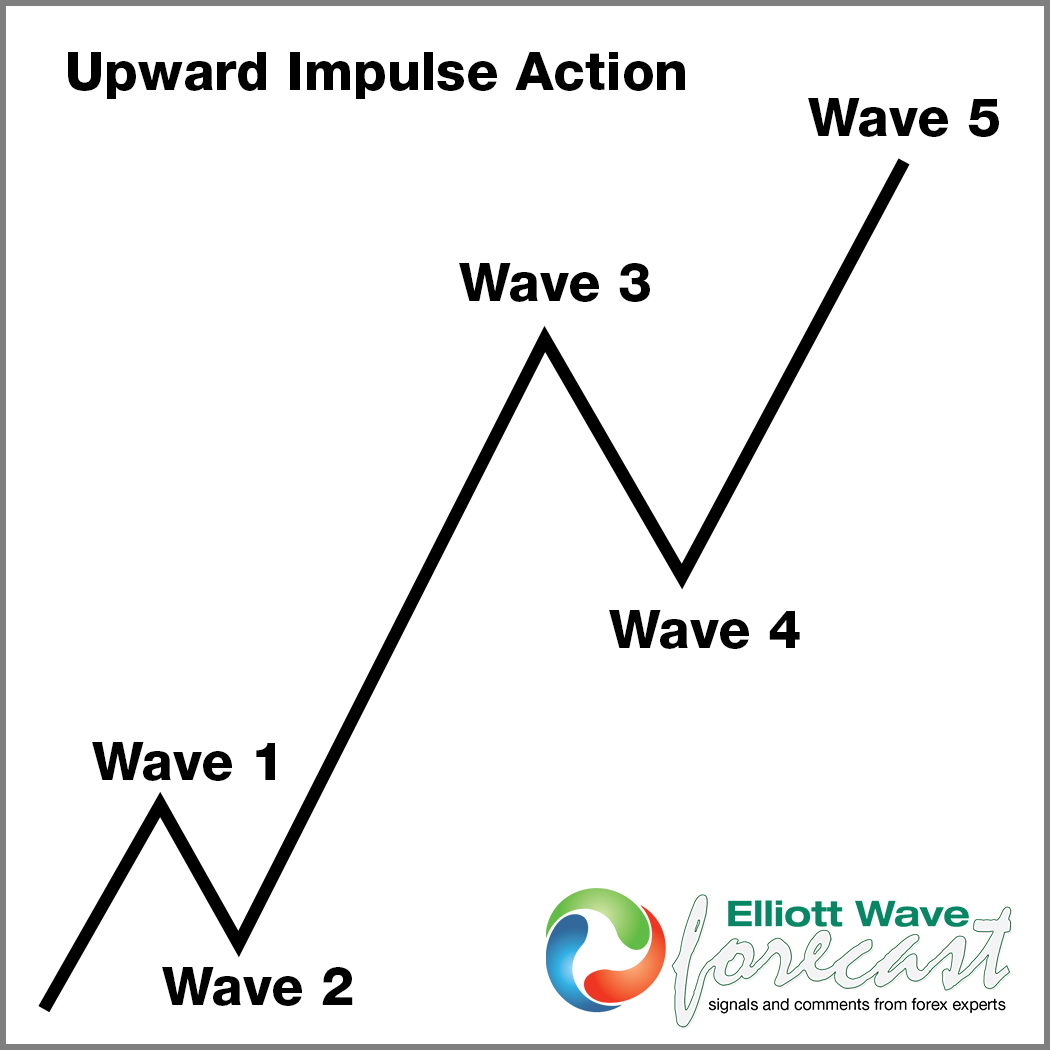
An impulse is a clean 5‑wave pattern that drives the trend forward.

  • Waves 1‑3‑5 are strong and directional.
  • No overlap between waves 1 and 4.
  • Wave 3 is usually the strongest.
  • Structure is clear, with increasing momentum.

ChatGPT-Image-3-mar-2026-07_24_10-a.m.png

Elliott Wave Outlook: CrowdStrike CRWD June 2026

CRWD-Weekly-ALT20260606194448.jpg


CRWD continues to trade within a constructive Elliott Wave structure on the weekly chart. The broader trend remains bullish while price holds above the 92.82 invalidation level. Recently, the stock appears to have completed wave (I) after a strong impulsive advance. Consequently, the current pullback may represent wave (II), unfolding as an A-B-C corrective structure. The preferred support zone stands between 616 and 511, where buyers may look to re-enter.

Looking ahead, this correction should create the foundation for the next major advance. If CRWD holds the 616–511 support area, wave (III) could begin from that region. That scenario would favor a continuation toward fresh all-time highs. Therefore, the strategy remains focused on buying corrective dips, rather than chasing strength near resistance. However, a break below 92.82 would invalidate the bullish Elliott Wave outlook.

Source: https://elliottwave-forecast.com/stock-market/crwd-correcting-bullish-cycle-started-2026/
 
Hello fellow traders. In this technical article we’re going to take a look at the Elliott Wave charts charts of XLI ETF published in members area of the website. As our members know SPDR Industrial ETF is bullish against the 156.14 pivot in first degree. Recently the ETF made a clear three-wave correction. The pull back completed as Elliott Wave Double Three pattern and made rally as expected.
In this discussion, we’ll break down the Elliott Wave pattern and forecast.

Elliott Wave Double Three Pattern

Double three is the common pattern in the market , also known as 7 swing structure. It’s a reliable pattern which is giving us good trading entries with clearly defined invalidation levels.
The picture below presents what Elliott Wave Double Three pattern looks like. It has (W),(X),(Y) labeling and 3,3,3 inner structure, which means all of these 3 legs are corrective sequences. Each (W) and (Y) are made of 3 swings , they’re having A,B,C structure in lower degree, or alternatively they can have W,X,Y labeling.

XLI

XLI Elliott Wave 1 Hour Chart 05.29.2026​

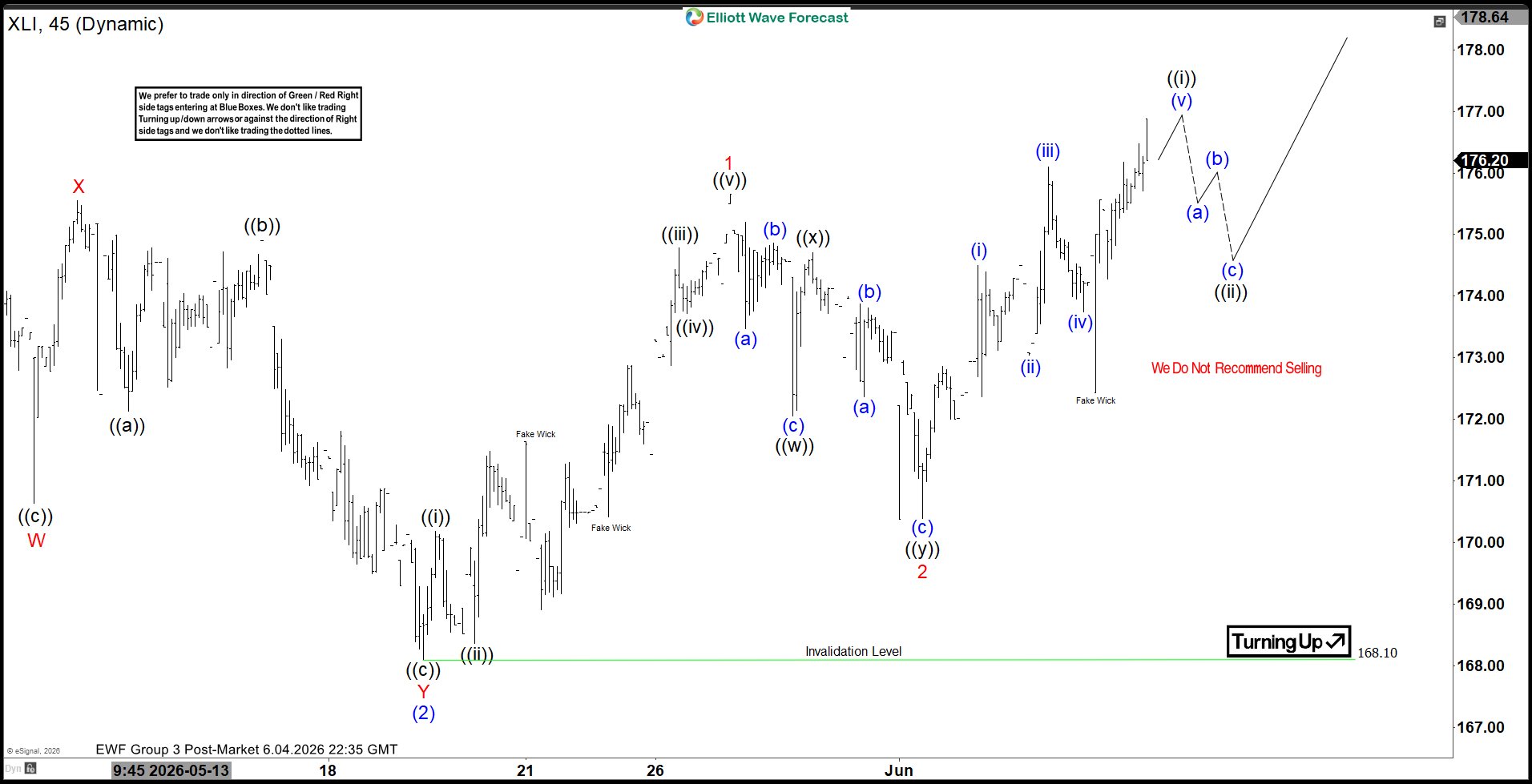
XLI is showing 5 waves up from the 168.1 low, suggesting that wave 1 (red), part of the next bullish cycle, has likely ended. Wave 2 (red) is currently in progress. Our analysis suggests that only the first leg of the pullback, wave ((w)) of wave 2 (red), has been completed, unfolding as a double three Elliott Wave pattern.

As our members know, we use the Equal Legs zone to identify the buyers’ area where Wave 2 should complete. We calculate this zone with the Fibonacci Extension tool by projecting the 1.0–1.236 extension of wave ((w)) relative to wave ((x)). In this case, Elliott Wave analysis points to a buyers’ zone around 171.35–170.56.

Did you know ? 90% of traders fail because they don’t understand market patterns. Are you in the top 10%? Test yourself with this advanced Elliott Wave Test

Official trading strategy on How to trade 3, 7, or 11 swing and equal leg is explained in details in Educational Video, available for members viewing inside the membership area.

XLI

XLI Elliott Wave 1 Hour Chart 06.04.2026​

The ETF found buyers as expected. XLI has reacted strongly and eventually we got a break toward new highs. Now, intraday pull backs should ideally keep finding buyers as far as 168.1 pivot holds.

Keep in mind that market is dynamic and presented view could have changed in the mean time. You can check most recent charts with target levels in the membership area of the site. Best instruments to trade are those having incomplete bullish or bearish swings sequences. We put them in Sequence Report and best among them are shown in the Live Trading Room


Source: https://elliottwave-forecast.com/el...ally-after-elliott-wave-double-three-pattern/
 
Cognizant Technology Solutions Corporation (CTSH) provides consulting, technology & outsourcing services in North America, Europe & Internationally. It operates through four segments: Financial services, Health services, Product & resources & Communications, Media & technology. It comes under Technology Sector & trades as “CTSH” ticker at Nasdaq.

CTSH ended ((I)) in monthly Impulse sequence from inception & now correcting in ((II)). Investors should enter between $48.56 - $22.46 area for multi-year rally. Short term, it expects choppy to lower to extend pullback against January-2026 peak.

CTSH - Elliott Wave Latest Weekly View:​

CTSH-W1.jpg

In monthly, it started Grand Super Cycle from 1998 low. It ended ((I)) at $93.47 high in March-2022. Within ((I)), it ended (I) at $21.34 high, (II) at $7.19 low, (III) at $85.10 high, (IV) at $40.01 low & (V) at $93.47 high. Within (III), it ended I at $41.74 high, II at $26.77 low, III at $69.35 high, IV at $45.44 low & V at $85.10 high. Below ((I)) peak, it is correcting lower in proposed zigzag correction & expect another push lower into blue box area. Buyers should step in between $48.56 - $22.46 area for next multi -year rally or at least 3 swing bounce.

CTSH - Elliott Wave Latest Monthly View:​

CTSH-M1.jpg

It ended (a) of ((II)) at $51.33 low & (b) as double three at $90.82 high in February-2025. Below $90.82 high, it ended I of (c) at $65.52 low, II as flat correction at $87.03 high & III at $45.48 low. Above there, it favors bounce in IV & expect sideways to higher to break above $57.65 high to end it. It is underperforming the $QQQ sector, so possibly it still can extend lower in V of (C) in primary view. But if it starts outperforming the $QQQ then it can be ended ((II)) in double three structure. Investors should get in below $45.48 for next rally with stop below $22.40. Do not like selling it in any pullback as it already reached extremes.

Source: https://elliottwave-forecast.com/st...g-support-setting-up-next-multi-year-advance/
 
In this technical post we review IONQ’s recent price action. The quantum computing firm, which develops and manufactures quantum machines, rallied after the September 2025 update. That advance unfolded as a five‑wave structure and has pulled back into the prior Wave I area, which helps validate the next phase. The latest forecast follows.

IONQ Latest Weekly Chart From 6.09.2026

IONQ Pullback Completes — Ready to Resume Bigger Nest?


This chart, updated on 09.06.2026, maps the larger Elliott wave sequence from the December 2022 low. The dominant cycle still reads as a three‑wave advance overall, while the rally that began at the December 2022 trough developed as a contracting diagonal composed of five sub-waves. In that sequence Wave I peaked near $21.60, Wave II retraced to about $6.22, Wave III extended to roughly $54.74, and Wave IV corrected down to near $17.88. From there the market pushed to a fresh high around $84.64, completing Wave V and thus the larger degree (I).

Following that top, the market underwent a three‑wave corrective decline that resolved the cycle from December 2022 as Wave (II), finishing at the March 2026 low near $25.89. Since that low, price has staged a strong rebound, yet it still needs to clear the October 2025 peak to validate the next impulsive leg higher. Until that breakout is confirmed, the structure remains constructive but incomplete.

Source: https://elliottwave-forecast.com/stock-market/ionq-pullback-completes-ready-to-resume-bigger-nest/
 
Elliott Wave Theory teaches us that markets don’t move in straight lines. Corrections are the pauses, consolidations, and retracements that balance impulsive trends. While simple corrections like Zigzags are straightforward, complex corrections demand deeper understanding. Let’s break down three of the most important: Triangles, Flats, and Double Threes.

Triangles

Definition:
A sideways corrective pattern made up of five overlapping waves (A‑B‑C‑D‑E). There are different types of triangles as shown below.

Graphic-34.jpg


Traits:

  • Typically form in Wave 4 or Wave B.
  • Contracting, expanding, or barrier shapes.
  • Price action narrows, reflecting indecision before a breakout.
Trading Insight: The completion of wave E often signals a sharp breakout in the direction of the larger trend. Patience is key traders wait for the structure to finish before positioning. Below is a live example of breakout in a triangle on EURNZD charts after completing wave ((b))

EURNZD-Triangle.jpg


Flats

Definition:
A three‑wave corrective structure labeled A‑B‑C, with a 3‑3‑5 subdivision. Traits:

  • Wave A and B are corrective (three swings each).
  • Wave C is impulsive (five swings).
  • Commonly appear in Wave 2 or Wave B.
Variations:

  • Regular Flat: Wave B retraces close to 100% of Wave A.
Regular-Flat.png


  • Expanded Flat: Wave B exceeds the start of Wave A, and Wave C breaks beyond Wave A’s end.
Expanded-Flat.png


  • Running Flat: Wave B is strong, but Wave C fails to move beyond Wave A’s end.
Running-Flat.png


Trading Insight: Flats often trap impatient traders. Recognizing the 3‑3‑5 structure helps avoid false entries before Wave C completes. See below live example on NATGAS chart.

NAT-G-Flat.jpg


Double Threes (W‑X‑Y)

Definition:
A combination of two corrective patterns linked by an intervening wave X. Traits:

  • Can mix Zigzags, Flats, or Triangles.
  • Creates a sideways, drawn‑out correction.
  • Seen when the market needs more time to consolidate before resuming trend.
See below examples

WXY-Structure.jpg


The above image is showing mix of 2 ZigZag patterns.

Graphic-39.jpg


The above image is showing a mix of Flat and a triangle

Trading Insight: Double threes test discipline. They remind traders that corrections can extend beyond simple A‑B‑C structures, requiring flexibility in analysis. Spotting this type of correction can deliver strong pip returns. Example below

IWM-1-hr-11-may-after.png


Key Takeaway

Complex corrections—Triangles, Flats, and Double Threes—are the market’s way of stretching time and shaking out weak hands. Mastering them sharpens patience, improves timing, and prevents costly missteps. For Elliott Wave traders, understanding these structures is essential to navigating the rhythm of markets with confidence.

Source: https://elliottwave-forecast.com/el...-triangles-flats-and-double-threes-explained/
 
Align Technology (NASDAQ: ALGN) continues to maintain a bullish Elliott Wave structure despite the sharp decline from its 2021 peak. The monthly chart suggests that the stock completed a major wave III advance near the 700 area before entering a large corrective phase. While the correction has lasted several years, the larger bullish cycle remains intact. Following the wave III peak, ALGN began a complex correction that appears to be unfolding as a double three structure. The decline has already completed wave ((W)) and a connecting wave ((X)), while the final leg, wave ((Y)), remains in progress.

The current Elliott Wave count suggests that wave IV is approaching an important support area. The projected blue box between 106.86 and 61.10 represents the 0.618–1.000 Fibonacci extension zone, which is a region where corrective structures often complete and buyers return. This area is considered a high-probability reversal zone. As the stock approaches this support region, we will be looking for signs that the correction is ending and a new bullish cycle is beginning.

ALGN_2026-06-10_07-21-53-scaled.png


From an Elliott Wave perspective, the ongoing decline appears to be the final phase of the larger wave IV correction. Once wave IV completes, the stock should begin wave V and resume the long-term uptrend. The projected path on the chart suggests a strong rally from the blue box area. We expect wave V to eventually break above the 2021 high and establish new all-time highs. This outlook aligns with the broader bullish structure that has been in place since the 2008 low.

As long as price remains above the long-term invalidation level at 4.88, the larger bullish count remains valid. We do not recommend selling and continue to favor buying pullbacks once the current correction reaches completion.

Conclusion​

Align Technology remains in a long-term bullish Elliott Wave cycle despite the ongoing correction. Wave IV appears to be approaching completion within the 106.86–61.10 blue box support area. Once the correction ends, we expect wave V to begin and eventually push the stock to new all-time highs.

Source: https://elliottwave-forecast.com/st...ogy-elliott-wave-blue-box-buying-opportunity/
 
Hello traders. In this technical article we’re going to look at the Elliott Wave charts of Bitcoin (BTCUSD) published in members area of the website. As our members know, we have been calling for the decline in BTCUSD since last year. The crypto market has continued to trade lower as expected. The main target area has not been reached yet, and we believe further downside may be seen in the coming days.
In this discussion, we will break down the Elliott Wave forecast and present the target zone.

BTCUSD Elliott Wave 1 Hour Chart 06.05.2026​

The current view suggests Bitcoin is developing impulsive bearish sequences, with wave ((v)) of wave 3 (red) nearing completion.
As our members know, the typical target area for wave ((v)) is projected using the 1.236–1.618 inverse Fibonacci extension of wave ((iv)). In this case, that zone comes in at 60,555–55,992. From this area, we expect a corrective three-wave bounce before the downside trend resumes.

Did you know ? 90% of traders fail because they don’t understand market patterns. Are you in the top 10%? Test yourself with this advanced Elliott Wave Test

Official trading strategy on How to trade 3, 7, or 11 swing and equal leg is explained in details in Educational Video, available for members viewing inside the membership area.


BTCUSD Elliott Wave 1 Hour Chart 06.10.2026​

Bitcoin found buyers in the 60,555–55,992 area and made a three-wave bounce as expected. The overall view remains unchanged, with only a minor adjustment in wave counting.
At this stage, we consider wave ((iv)) completed at 64,200. While price remains below that high, we expect further downside within wave ((v)).
We will use the same approach to project the wave ((v)) target zone, based on the 1.236–1.618 inverse Fibonacci extension of wave ((iv)), which comes in at 58,020–56,080.

Important note: Our analysis is not based on Elliott Wave in isolation. We perform detailed higher-time-frame cycle analysis, which shows an incomplete market structure. This is one of the key drivers of price action, along with correlation analysis and broader market context.

Source: https://elliottwave-forecast.com/cryptos/bitcoin-btcusd-elliott-wave-analysis-forecasting-the-path/
 
SMH starts June near critical support after a strong multi‑month rally. Buyers still control the broader trend, yet momentum shows signs of fatigue. Therefore, the next weeks may deliver sideways action while the sector resets. Still, the medium‑term structure favors upside if key levels hold and rotation stays healthy.

Looking into July and August, SMH may attempt a new bullish leg if demand strengthens. Moreover, mid‑summer seasonality often supports tech and boosts risk appetite. Earnings updates could also trigger sharp moves across semiconductor names. Consequently, traders should monitor SMH around its pivot zones because those reactions will shape the three‑month outlook.

Elliott Wave Outlook: SMH Daily Chart March 8th, 2026

SMH-Daily.jpg


SMH broke above 152 and confirmed an extended impulse. This move forced us to adjust the count and include the new extension. Wave ((1)) ended at the April high near 212.81, and wave ((2)) finished at 184.40 before the rally resumed. Then the market produced another extension inside wave ((3)), which strengthened the bullish cycle.

After that, we identified waves (1), (2), (3), (4), and (5) inside the extended leg. The market even formed a smaller extension inside wave (1), which reinforced the trend. This behavior highlighted why we always trade with the trend, since extensions can appear without warning.

Wave ((3)) ended at the October high, and wave ((4)) completed at the November low. From there, we expected one more high to complete wave ((5)) and finish wave I. We shifted the label from wave (V) to wave I as each correction confirmed the structure.

Wave ((5)) created a new high and formed an ending diagonal. This pattern suggested the cycle was near completion. The market then broke below the diagonal, which increased the risk of bearish acceleration. If the structure confirmed, wave II could retrace toward the 329.32–268.42 area before the bullish trend resumed.

Elliott Wave Principle Behind the Market Structure​

Impulse

An impulse is a clean 5‑wave pattern that drives the trend forward.

  • Waves 1‑3‑5 are strong and directional.
  • No overlap between waves 1 and 4.
  • Wave 3 is usually the strongest.
  • Structure is clear, with increasing momentum.

ChatGPT-Image-3-mar-2026-07_24_10-a.m.png

Wave Extensions


Extensions occur when one impulsive wave becomes significantly longer and more powerful than the others.

Most commonly, wave 3 extends, creating the longest and most explosive leg.
An extended wave subdivides into a clear, elongated 5‑wave pattern.
The other two impulsive waves remain shorter and more proportional.
Extensions highlight where the market’s strongest momentum is concentrated.

EXTENsION3.jpg


Elliott Wave Outlook: SMH Daily Chart June 13th, 2026

Elliott Wave Outlook: SMH Daily Chart June 13th, 2026


SMH completed a very strong impulsive cycle into the end of wave (III) and then developed a relatively shallow wave (IV), reflecting the exceptional bullish momentum in the market. In fact, the correction we expected in March as wave II, which should have reached at least the 329 area, never materialized. The market showed such strength that the decline was minimal, invalidating the expectation of a deeper correction typical of a higher‑degree wave II. This lack of depth confirmed that buying pressure continued to dominate and that the bullish cycle still had room to extend. From the wave (IV) low, the ETF has been advancing within wave (V), a final leg that usually shows slower acceleration and signs of exhaustion. The internal structure of the rally fits a mature fifth wave, and the natural target to complete the cycle remains the 665–700 cluster, where Fibonacci extensions and the final projection of the impulse converge.

Once wave (V) completes in that zone, the market will enter a decisive phase with two possible corrective paths. The first is the deeper scenario, shown by the black path, where the market develops a higher‑degree wave ((II)), correcting the entire cycle from the 2022 lows. This scenario would imply a more aggressive and prolonged decline. The second scenario is the orange path, where the market only corrects the cycle that began on June 9, producing a more moderate pullback in three or seven swings before resuming the bullish trend. The key to distinguishing between both outcomes will be the depth of the decline: a break below the wave (IV) low would be a clear signal that the market is entering the deeper correction of wave ((II)). As long as that level holds, the more moderate correction remains the preferred scenario.

Source: https://elliottwave-forecast.com/stock-market/smh-something-big-setting-these-levels/
 
Hello fellow traders. In this technical article we’re going to take a quick look at the Elliott Wave charts of OIL Futures CL_F published in members area of the website.

As our members know, understanding how to identify incomplete sequences in Elliott Wave analysis is crucial as they are a key driver of market direction. In this case, crude oil (CL_F) shows an incomplete sequence from the 109.67 high, which keeps the downside pressure in place. Recently, oil price rallied into our Blue Box selling zone. Sellers reacted right at that area, and price started to decline as expected.

In the following analysis, we explain the Elliott Wave forecast, the current oil market outlook, and the trading strategy behind selling rallies from the Blue Box.


OIL Elliott Wave H1 Chart 06.10.2026​

The commodity is giving us clear 3 waves correction , forming Elliott Wave Zig Zag Pattern. The price has already reached the extreme zone at 91.43-93.96 (Blue Box – sellers zone). We don’t recommend buying OIL and prefer the short side from the blue box zone. As the main trend is bearish, we expect to see at least 3 waves pullback from our selling zone. Once the decline reaches 50 Fibs against the b ( red) low, we will make the short position risk-free (put SL at BE) and take partial profits.

Quick reminder:

Our charts are easy to trade and understand:
Red bearish stamp+ blue box = Selling Setup
Green bullish stamp+ blue box = Buying Setup
Charts with Black stamps are not tradable.
1f6ab.svg


Did you know ? 90% of traders fail because they don’t understand market patterns. Are you in the top 10%? Test yourself with this advanced Elliott Wave Test

Official trading strategy on How to trade 3, 7, or 11 swing and equal leg is explained in details in Educational Video, available for members viewing inside the membership area.


OIL Elliott Wave H1 Chart 06.13.2026​

The commodity found sellers at the Blue Box area (91.43–93.96). Price reacted well from this selling zone and turned lower.

The decline pushed to new lows, confirming the bearish view. Members who took the short trade are now in profit and have secured risk-free positions.

Important note: Our analysis is not based on Elliott Wave in isolation. We perform detailed higher-time-frame cycle analysis, which shows an incomplete market structure. This is one of the key drivers of price action, along with correlation analysis and broader market context.

We also teach our members in live analysis sessions how to identify incomplete bullish and bearish sequences. Even a 14-day trial, is enough to noticeably improve your trading analysis and forecasting approach.

Keep in mind that market is dynamic and presented view could have changed in the mean time. You can check most recent charts with target levels in the membership area of the site. Best instruments to trade are those having incomplete bullish or bearish swings sequences. We put them in Sequence Report and best among them are shown in the Live Trading Room


Source: https://elliottwave-forecast.com/co...-probability-sell-setup-at-the-blue-box-area/
 
Hello traders. In this technical article we’re going to take a quick look at the Elliott Wave charts of Dow Jones Futures published in members area of the website.

As our members know, we have had many high-probability trading setups recently. YM_F is one of them.Dow Jones futures made a pullback that unfolded as an Elliott Wave Zig Zag pattern. Price completed a clear 3-wave move down from the June 5th peak and found support at the Equal Legs zone (Blue Box buying area).

In the following analysis, we explain the Elliott Wave pattern, the market outlook, and the trading setup.

YM_F Elliott Wave 1 Hour Chart 06.10.2026​

Dow Jones Futures (YM_F) shows a lower low structure from the peak, keeping the bearish sequence in place. The current price structure remains incomplete, which suggests more downside toward the 50107–49347 area. This zone is our Blue Box buying area. We do not recommend selling YM_F and prefer the long side from this zone.

Once price reaches the buying area, it can either rally to new highs or bounce in 3 waves. If the bounce reaches the 50% Fibonacci retracement against the (b) wave high, we will move stops to break-even and secure partial profits.

Our charts are easy to trade and understand:
Red bearish stamp+ blue box = Selling Setup
Green bullish stamp+ blue box = Buying Setup
Charts with Black stamps are not tradable.

Did you know ? 90% of traders fail because they don’t understand market patterns. Are you in the top 10%? Test yourself with this advanced Elliott Wave Test

Official trading strategy on How to trade 3, 7, or 11 swing and equal leg is explained in details in Educational Video, available for members viewing inside the membership area.


YM_F Elliott Wave 1 Hour Chart 06.13.2026​

Dow Jones Futures (YM_F) extended into our buying zone at 50107–49347 as expected. Price found buyers at the Blue Box and is showing a strong reaction from that area. As a result, long positions from the Equal Legs zone should now be risk free.As long as price stays above the 49859 low, we expect further strength in Dow Jones, with potential for a move toward new highs.

Important note: Our analysis is not based on Elliott Wave in isolation. We perform detailed higher-time-frame cycle analysis, which shows an incomplete market structure. This is one of the key drivers of price action, along with correlation analysis and broader market context.

We also teach our members in live analysis sessions how to identify incomplete bullish and bearish sequences. Even a 14-day trial, is enough to noticeably improve your trading analysis and forecasting approach.


Source: https://elliottwave-forecast.com/st...es-ym_f-elliott-wave-trading-setup-explained/
 
Coca-Cola Co (NYSE: KO) keeps reaching fresh all-time highs each week. As we explained in the previous article, a bullish Elliott Wave structure is leading this move. This article examines the weekly pattern further. We identify the ongoing breakout trajectory and primary upside objectives.

Elliott Wave Analysis

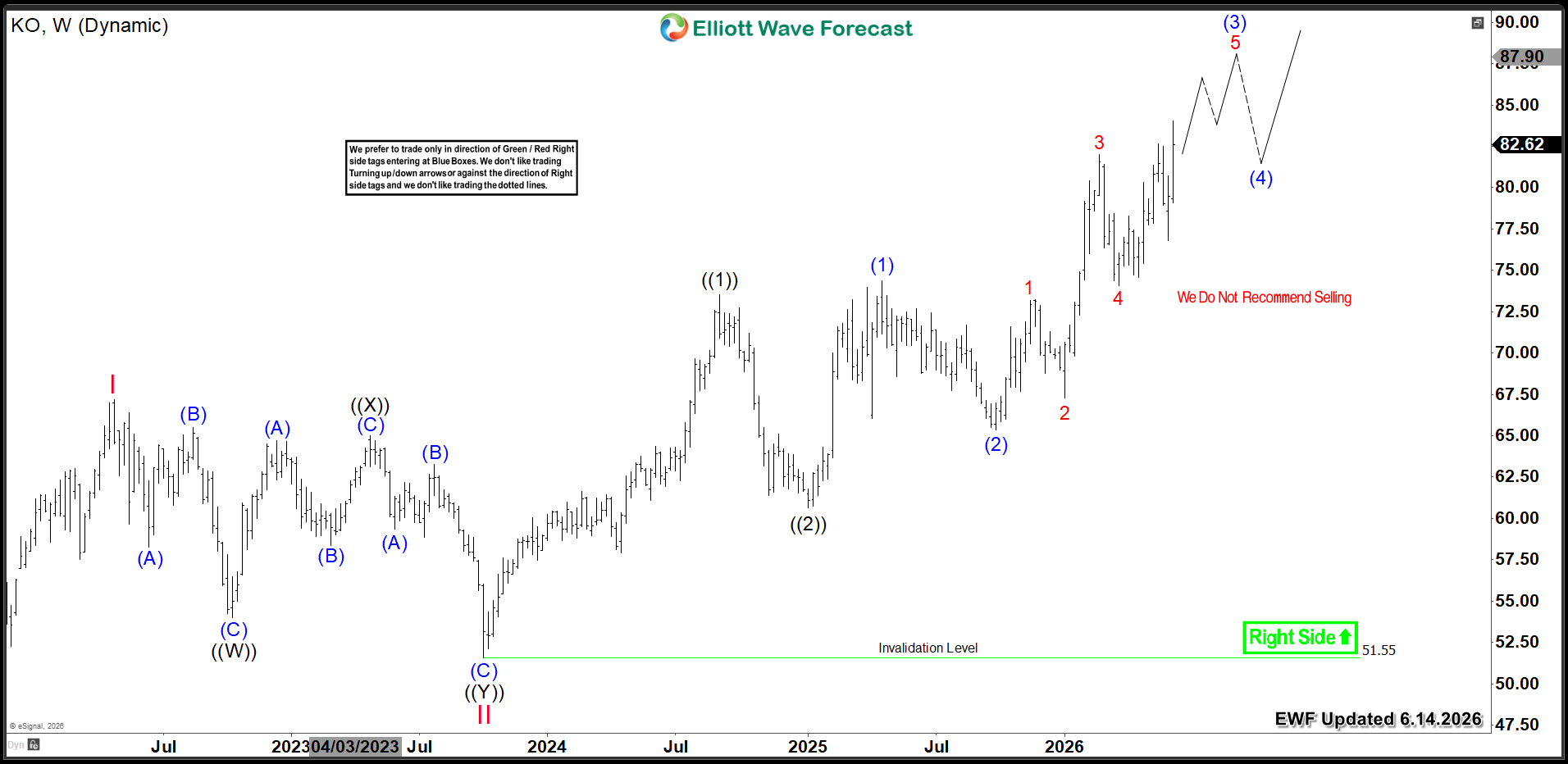
KO is accelerating higher within wave (3) of ((3)). The nesting structure from 2023 keeps extending. Currently, wave 5 of (3) seeks further upside toward the equal legs area $85 - $90 . From there, the stock can pullback in wave (4). This will present another daily buying opportunity. Then, the rally resumes in wave (5) of ((3)).

Furthermore, KO could extend higher within wave (3) if it erases the daily cycle divergence. This would suggest wave 3 remains in progress. Consequently, we do not recommend selling the stock. We expect the cycle to stay supported within the current bullish sequence and look for the monthly target above $100.

KO Weekly Chart 6.14.2026

Coca-Cola KO Weekly 6.14.2026

Conclusion​

Coca-Cola's weekly rally maintains powerful bullish momentum. Therefore, traders should focus on strategic entry points during corrective dips.

Source: https://elliottwave-forecast.com/stock-market/coca-cola-nyse-ko-targeting-100-milestone/
 
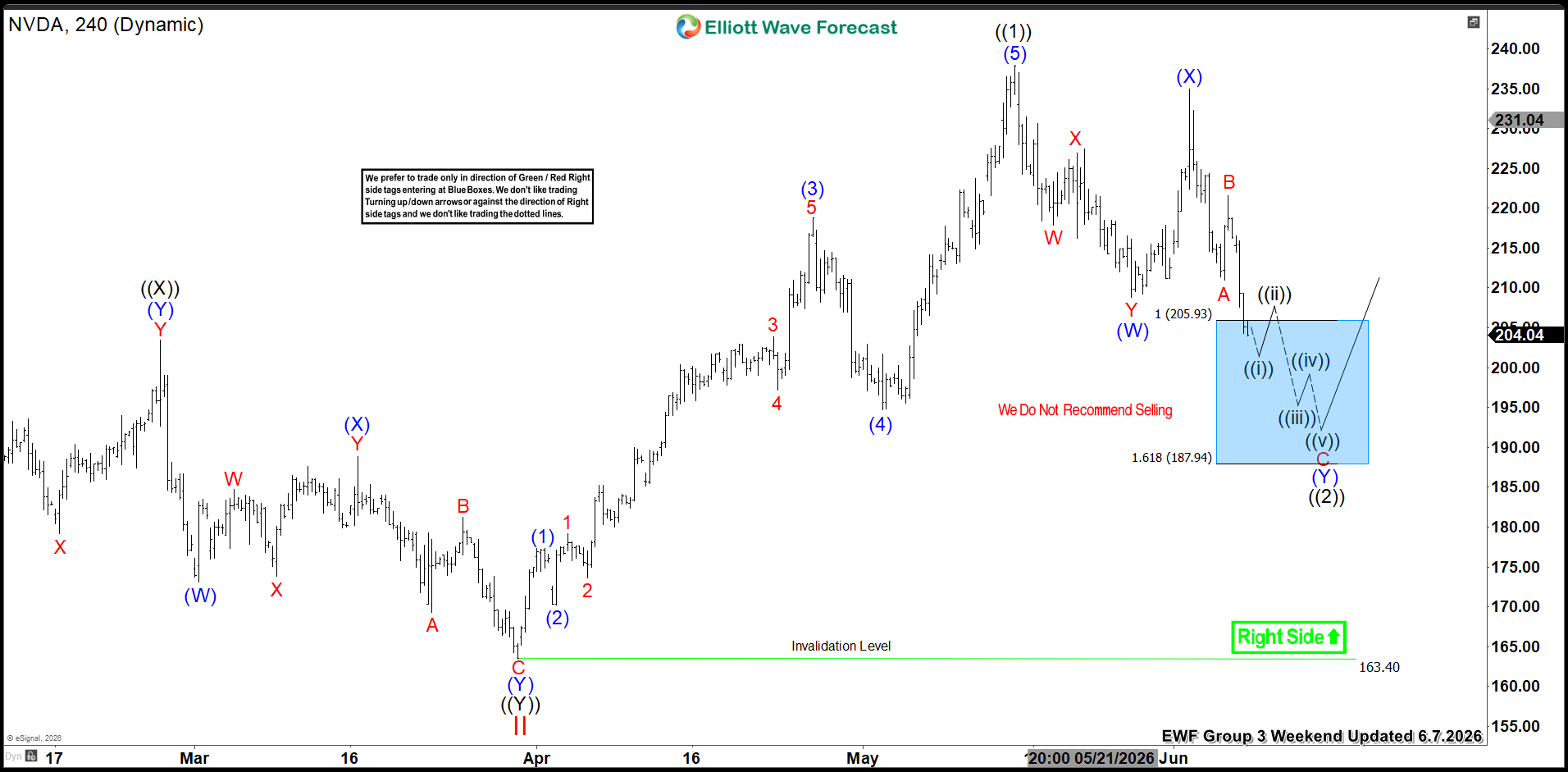
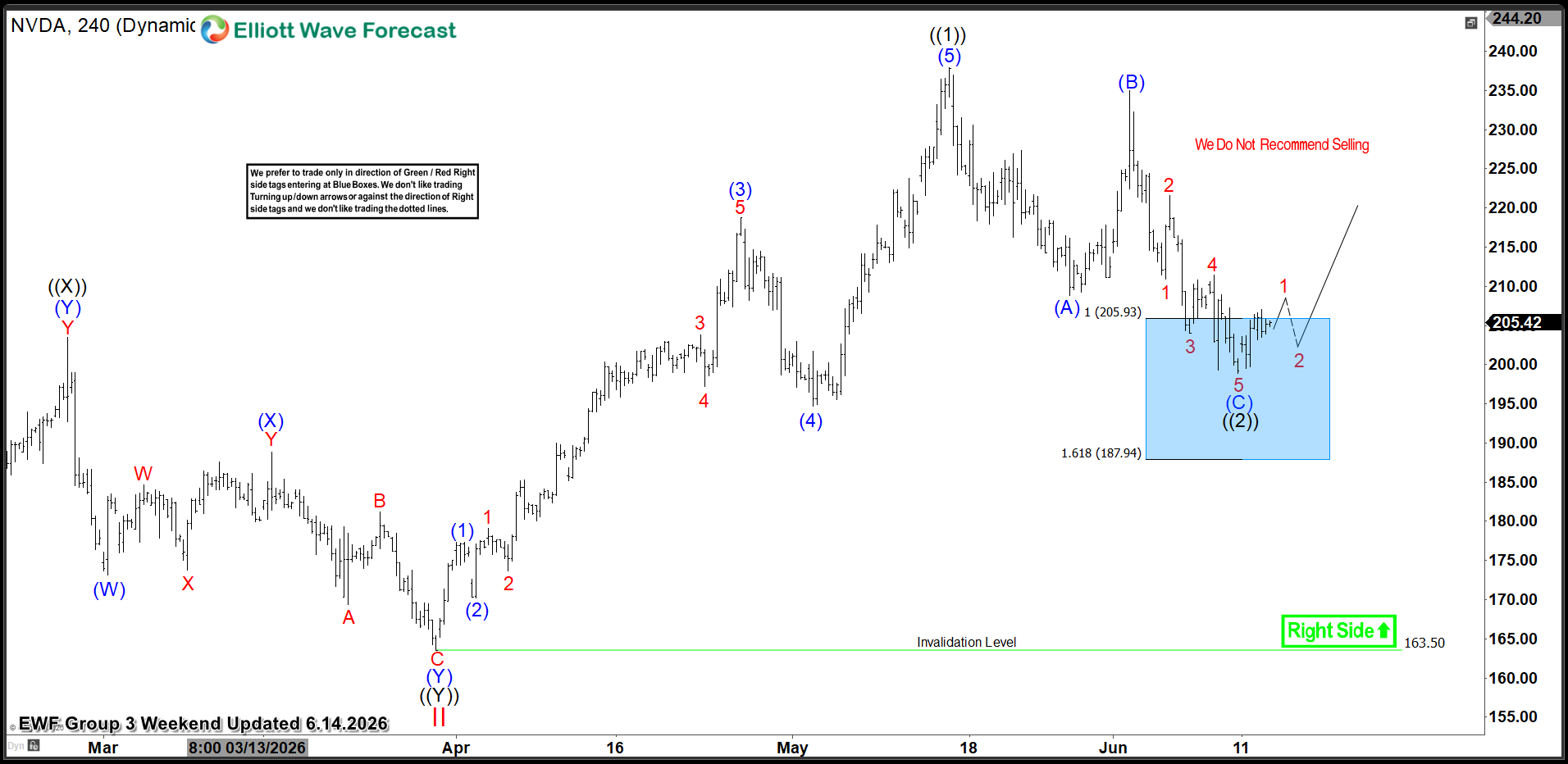
In this Elliott Wave update, we look at the latest structure in Nvidia Corp. ($NVDA). The stock pulled back in a 7-swing corrective structure and reached the blue box area at 205.93–187.94, where buyers were expected to appear. As anticipated, the stock reacted higher from that support zone. Therefore, buyers who entered in the blue box can now look to get risk free as the recovery continues to unfold.

5 Wave Impulse + 7 Swing WXY correction​

$NVDA

$NVDA Pulled Back in 7 Swings​

$NVDA

Looking at the 4-hour chart, $NVDA remained within a broader bullish sequence, but it needed a corrective pullback before the next leg higher could resume. That decline unfolded in a 7-swing structure, which is a common Elliott Wave correction and often ends in a high-frequency support zone.

Instead of showing a larger bearish breakdown, the stock developed a corrective move into the projected support area. As a result, the pullback was treated as a buying opportunity rather than a reason to chase the downside.

Blue Box Area Provided the Expected Support​

$NVDA

Most importantly, $NVDA reached the blue box area between 205.93 and 187.94, where sellers were expected to lose control and buyers were expected to step in. That reaction is beginning to happen now.

Buyers Entered and Are Looking to Get Risk Free​

Since the stock already reacted higher from the blue box, long positions from that area can now look to get risk free. In other words, traders can move stops to breakeven or reduce exposure while letting the position continue to develop.

This is one of the main advantages of the blue box strategy. Once the market delivers the expected reaction, risk can be reduced quickly while still allowing room for further upside.

Short-Term Outlook for $NVDA​

In the short term, $NVDA can continue to extend higher as the bounce from the blue box develops. The latest structure suggests the stock has already started building higher from the reaction zone, which keeps the bullish sequence supported.

As long as $NVDA stays above the broader 163.50 invalidation area, the right side remains higher. Accordingly, pullbacks should continue to find support while the stock works through the next leg higher.

Technical Summary​

To summarize, $NVDA pulled back in 7 swings and reached the blue box area at 205.93–187.94, where buyers entered as expected. The stock has started to react higher from that support zone, which means longs from the blue box can now look to get risk free.

As a result, the broader bullish sequence remains intact, and the market continues to respect the blue box as a high-probability buying area.

Source: https://elliottwave-forecast.com/st...-higher-from-blue-box-after-7-swing-pullback/
 
Platinum (PL) surged to fresh record highs in late January, marking a potential inflection point toward a long‑term secular bull market. This article explores the metal’s extended outlook and the evolving Elliott Wave framework that underpins its advance.

Platinum (PL) Monthly Elliott Wave Chart​

Platinum-Monthly20260615190728.jpg


The monthly Platinum chart highlights a decisive breakout into record territory, underscoring the strength of its long‑term bullish trend. The metal continues to track within a secular advance that began decades ago. The rally from January 1992 through the March 2008 peak established wave ((I)) at 2308.8, followed by a sharp zigzag correction down to 557, completing wave ((II)). From that base, Platinum resumed higher and has now extended into fresh highs with a clear impulsive profile.

From the wave ((II)) low, wave (I) terminated at 1348.2, while the subsequent retracement in wave (II) found support at 796.8. The advance in wave (III) unfolded into a five‑wave sequence of lesser degree. Within this structure, wave ((1)) topped at 1148.9, and the corrective dip in wave ((2)) ended at 843.1. Wave ((3)) is proposed complete at 2925. Current action reflects a pullback in wave ((4)), which still has room to extend lower before the broader uptrend resumes.

Platinum (PL) Daily Elliott Wave Chart​

Platinum-Daily20260615190716.jpg


On the daily Platinum chart, the advance to 2925 is identified as the completion of wave ((3)). The market has since turned lower, with wave ((4)) unfolding and still capable of pressing further into the 1072–1334 zone. This area represents the 100%–161.8% Fibonacci extension of wave (W). The primary expectation remains for additional downside toward this target.

An alternate view considers the possibility of truncation, which would negate further weakness. That scenario gains weight only if Platinum decisively breaks above the bearish trend line drawn from the wave ((3)) peak, signaling that the correction has already ended and the next leg higher is underway.

Source: https://elliottwave-forecast.com/co...tt-wave-view-double-three-correction-in-play/
 
“SpaceX (NASDAQ: SPCX) has emerged as a cornerstone of the modern space economy. Its Starlink constellation, now exceeding 9,000 satellites, delivers global internet coverage, while its launch vehicles accounted for more than 80% of all licensed U.S. space missions in 2025—underscoring its dominance in both connectivity and orbital transport.After weeks of anticipation, SpaceX’s initial public offering (IPO) took off on 12 June. SpaceX set a historic precedent by launching the largest IPO ever recorded. The company’s debut on the public markets concluded with an extraordinary $2 trillion market capitalization, establishing a new benchmark in financial history and signaling strong investor confidence in its long‑term trajectory. In this article, we will take a look at Elliott wave structure of the rally since IPO date of 12th June 2026, we will present two possible scenarios along with short-term targets for share holders.

SpaceX (SPCX) Targetting $198.69 - $224.25 Area​

Stock posted a strong rally to $176.52 on the opening day before a pull back to $157.43 before resuming the rally and breaking above $176.52 high to create a short-term bullish sequence opening extension higher toward $198.69 - $224.25 area. We can see wave (( i )) of 3 completed at $172.50, wave (( ii )) of 3 completed at $167.10 and wave (( iii )) of 3 in progress which could end somewhere between $198.69 - $208.45. After this, we expect a pull back in wave (( iv )) and one more high to complete wave 3. Following this, expect a pull back in wave 4 to correct the cycle from $157.43 low and then higher again to complete 5 waves up from the IPO low. Afterwards, we can see a pull back to correct the rally since IPO low in wave ( 2 ) in 3 or 7 swings and continue higher.

SpaceX Elliottwave structure of the rally since IPO


SPCX Elliott Wave View - Bullish Nest​

Chart below shows dip to $157.43 was a wave ( 2 ) and 5 waves up from there toward $198.69 - $208.45 area complete complete wave 1 of ( 3 ) resulting in a slightly bigger pull back to correct the rally from wave ( 2 ) low before accelerarting higher in wave 3 of ( 3 ).

SpaceX (SPCX) Elliott Wave Bullish Nest


Source: https://elliottwave-forecast.com/stock-market/spcx-ipo-elliott-wave-rally-extends-into-orbit/
 
Intel’s resurgence in the AI era is no longer a distant forecast—it’s unfolding in real time. After years of being overshadowed by GPU giants, Intel (NASDAQ: INTC) has transitioned from underdog to frontrunner, leveraging its Starlink‑scale infrastructure, foundry partnerships, and Elliott Wave‑validated rally structure. With massive gains already seen in 2026 and a rally looking to extend to new all time highs. Intel is not just participating in the AI revolution—it’s shaping it. This follow‑up builds on our earlier analysis of Intel’s “revenge” in the AI war, examining how its technical patterns and market dominance continue to align with long‑term bullish projections.

INTC Daily Chart Elliott Wave Analysis - 15 June 2026​

In our previous article, we expected a pull back in stock price in wave (4) before resumption of the rally in wave (5). Chart below shows, wave (4) unfolded as a double three Elliott wave structure in which wave W ended at $102.40, wave X completed at $126.64 and wave Y ended at $98.33 to complete wave (4) pull back. Stock price resumed the rally after this and even though it has not made a new high above wave (3) yet, impulsive structure of the rally suggests it will end up breaking higher. Break of wave (3) peak at $132.75 will confirm that wave (5) higher is in progress. Until then, a larger double correction lower in wave (4) can't be ruled out.

Targets for wave (5) range between $139.91 - $152.93 which is inverse 123.6 - 161.8% Fibonacci extension area of wave (4) pull back. We are very close to wave (3) peak and impulsive rally from wave (4) low is about to complete so we believe this would only complete wave 1 of (5) after which we could expect a pullback in wave 2 followed by extension higher in wave 3, 4 and 5 to complete wave (5). This should complete cycle from December 2025 low and result in another pull back in the form of wave ((4)) before continuation higher.


INTC Intel Resumed rally in wave 5


Source: https://elliottwave-forecast.com/stock-market/intel-intc-rockets-higher-after-wave-4-correction/
Post automatically merged:

The S&P500 SPX appears to have completed a short term bearish cycle that corrected the rallies from late March 2026. The short term path continues to favor more upside. What are the next targets to take note of. How should intraday and short-term traders approach it?

The SPX completed the intermediate degree wave (2) on March 30, 2026. Since hitting this low, the index has trended higher, consistently attracting fresh buying interest. The broader bullish wave ((3)) began in April 2025 and concluded in February 2026, with the February peak identified as wave (1) of ((3)). A subsequent wave (2) pullback completed a 7-swing structure within the 6508-6298 blue box zone in late March 2026. Members successfully entered long positions at this blue box and achieved all major targets. This post outlines the setup for educational purposes.

SPX Elliott Wave Analysis - Short term, 13th June Update

Starting from the March 2026 low, a new bullish cycle initiated for wave 1 of (3), which peaked in early June. Following this, we observed a pullback for wave 2 of (3). Although we typically anticipate a 3, 7, or 11-swing structure for such corrections, this particular pullback was shallow. We identified the end of this wave based on proprietary signals shared during our live sessions, allowing us to pivot and encourage members to enter long positions within our blue box zones—a strategy that proved successful, as seen in our setup for the Dow_100 ($YM_F) HERE. While the SPX wave 2 pullback did not reach the typical extreme, we chose not to force the count and instead shared the updated analysis with members on June 13, 2026.

spx


The 60-minute chart above confirms that wave 2 has concluded, signaling an expected bullish reversal. Consequently, we projected a five-wave rally from the 7239 pivot to complete wave (i) of ((i)) of 3. As the new week commenced, the market delivered the anticipated upside burst, which we have detailed in the chart below shared with our members.

SPX Elliott Wave Analysis - Short term, 16th June Update

spx


The latest chart indicates that the price is currently advancing within wave (iii) of ((i)), with the potential for wave ((i)) to establish a new high. Following this, we anticipate a pullback for wave ((ii)) before the broader bullish trend resumes. The target for wave 3 is set at a minimum of 8540, with an ideal range of 8846–9344. Once a new high is reached in June, we will look for 3, 7, or 11-swing pullbacks to identify long opportunities in the SPX, as well as in other US indices, the Nikkei, and various other markets we track. We will provide our members with updated "blue box" entry zones when the time is right. Furthermore, our daily technical videos, live analysis sessions, and 24-hour members-only chat room ensure that traders are kept informed of any market shifts and have direct access to our analysts for real-time support.

Source: https://elliottwave-forecast.com/stock-market/spx-short-term-forecast-bullish-path/
 
Last edited: