Elliott Wave Analysis by EWF

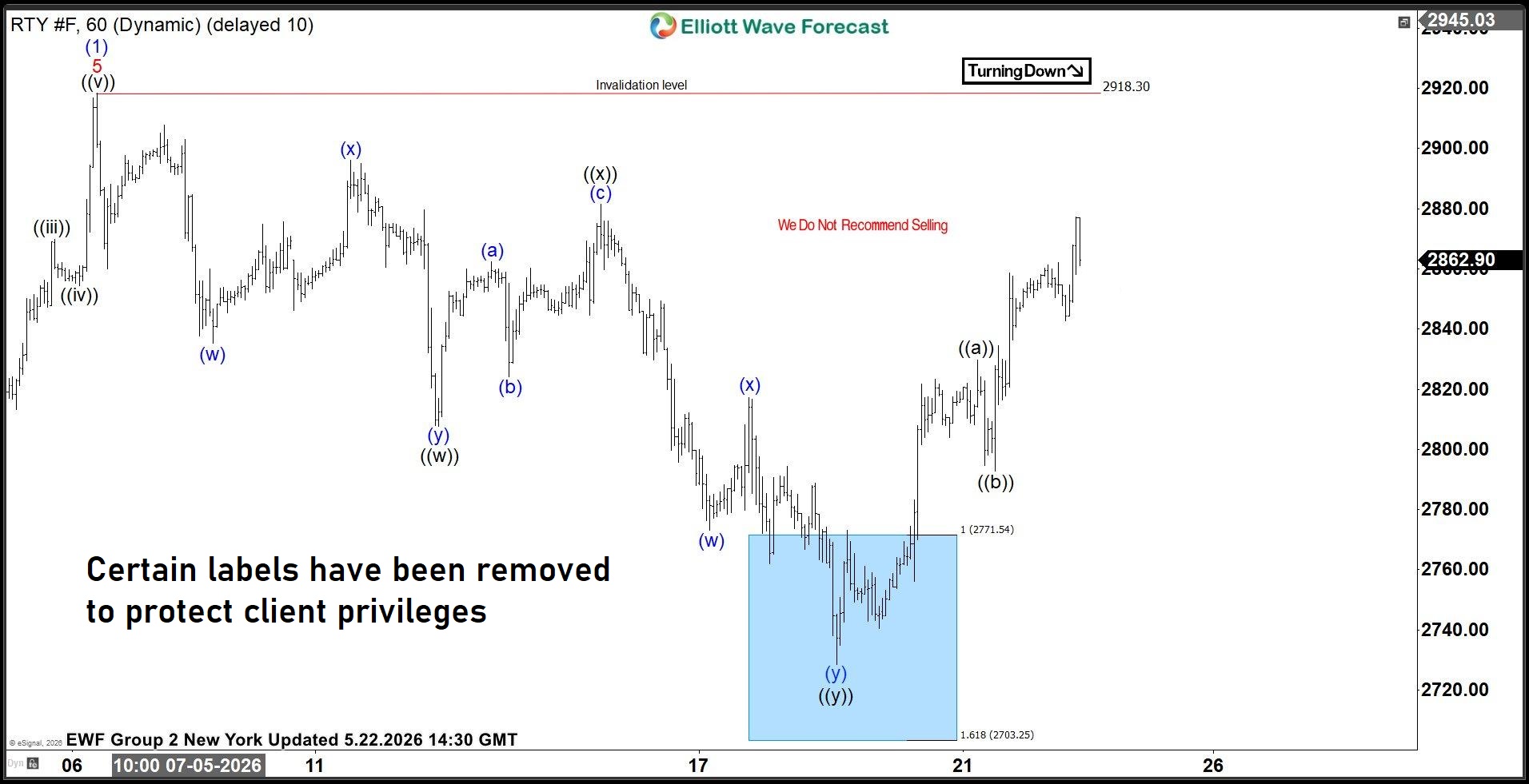
Hello fellow traders. In this technical article we’re going to take a look at the Elliott Wave charts charts of RUSSELL Futures $RTY_F published in members area of the website. As our members know we are favoring the long side in Indices. RUSSELL made clear 3 waves down from the 2918 peak and completed correction right at the Equal Legs zone . In further text we’re going to explain the Elliott Wave pattern and trading setup.

RUSSELL Elliott Wave 1 Hour Chart 05.18.2026​

RUSSELL is showing lower low sequences from the peak, suggesting pull back is still in progress. The price structure is incomplete at the moment, calling for another leg down toward : 27771.54-2703.25 area. Our members know that we constantly emphasize the importance of incomplete sequences, as these determine the market’s path. We don’t recommend selling RTY_F and prefer the long side from the marked Blue Box ( buying zone). Once RUSSELL reaches our buying area, it should ideally make either rally toward new highs or in 3 waves bounce alternatively. Once bounce reaches 50 Fibs against the X red high, we will make long position risk free ( put SL at BE) and take partial profits.

Official trading strategy on How to trade 3, 7, or 11 swing and equal leg is explained in details in Educational Video, available for members viewing inside the membership area.

Russell

RUSSELL Elliott Wave 1 Hour Chart 05.22.2026​

RUSSELL reached our buying zone at : 27771.54-2703.25 area and found buyers as expected. RTY_F is giving us very good reaction from the Blue Box Area. Consequently, any long positions should be risk free by now. 2918.3 is important pivot at this stage.

You can check the latest charts and target levels in the membership area of the site. The best instruments to trade are those with incomplete bullish or bearish swings. These are listed in the Sequence Report, and the best ones are shown in the Live Trading Room.

90% of traders fail because they don’t understand market patterns. Are you in the top 10%? Test yourself with this advanced Elliott Wave Test

Russell

Thank you for exploring our Russell technical article with us. While we analyze 78 instruments, it’s important to remember that not every chart represents a trading recommendation. For official trading signals, we invite you to join our Live Trading Room, where we provide actionable insights in real-time. If you’re not yet a member, take advantage of our 14-day trial to unlock new trading opportunities.

Over the years, we’ve developed a reliable trading strategy that clearly defines entry, stop loss, and take profit levels. By joining us, you’ll gain access to expert guidance and the chance to refine your trading skills.

Source: https://elliottwave-forecast.com/st...s-rty_f-buying-the-dips-at-the-blue-box-area/
 
Reports surrounding the Iran negotiations continue to dominate global headlines as markets wait for clarity regarding a potential agreement. Officials from both sides have recently signalled that discussions remain active despite ongoing disagreements, keeping investors focused on the possibility of a diplomatic breakthrough.

The uncertainty has created sharp swings across commodities, currencies, and equity indices as traders attempt to position themselves ahead of a final outcome. Oil markets remain especially sensitive to every headline, while equities continue trying to price the probability of a broader Risk-On environment if an agreement is reached.

The Market is desperately waiting for news regarding the Iran Deal — either a deal gets finalized, or negotiations fail.

At ElliottWaveForecast.com , we always focus on anticipating the move rather than reacting to the headlines afterwards.

Video: Deal or No Deal


For years, we have maintained one of the more bullish long-term views across the Elliott Wave community because we let price action guide the analysis instead of opinions or news cycles. Elliott Wave Theory continues to demonstrate that markets move in repetitive cycles across every degree of trend.

Our team has expanded the traditional approach further through sequence analysis and the importance of High-Frequency areas (Blue Boxes). The key concept remains the same: trends unfold in repetitive sequences.

Within impulsive structures, markets tend to develop in sequences of: 5-9-13-17-21 swings.

Corrective structures usually unfold in: 3-7-11-15 swings.

The behavior repeats continuously across all timeframes and degrees.

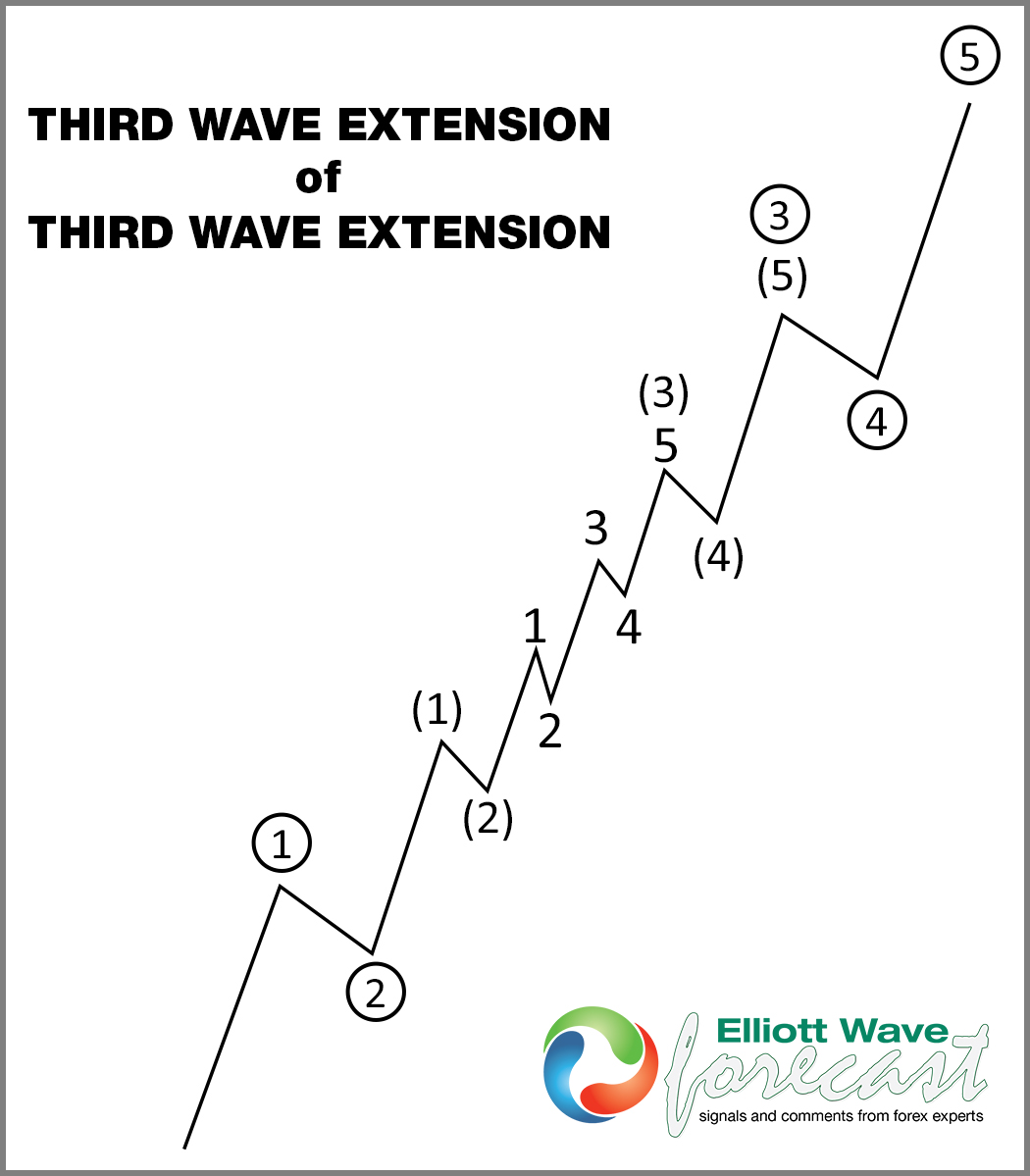
A standard impulsive advance develops in five waves: ((i)), ((ii)), ((iii)), ((iv)), ((v))

Those five waves create wave 1 at the next degree, followed by a corrective structure into wave 2. The correction itself typically unfolds in 3, 7, or 11 swings. A simple correction is generally a 5-3-5 sequence. If the correction extends into 7 or 11 swings, the market continues connecting corrective structures while preserving the same internal rhythm.

The Russell ($RTY) has been showing one of the cleanest bullish structures in the market since the 03.30.2026 low — the same date the broader market reached our Blue Box buying area, as shown in the $SPX Daily chart before breaking into new all-time highs.

SPX Daily Chart March 28 2026

SPX-DAILY20260328125258-1024x508.jpg


The big question now is: What happens next?

Most participants are focused entirely on the geopolitical outcome:

Deal completed = Risk On
No Deal = Risk Off

However, when we step away from the headlines and focus strictly on structure, we find that $RTY continues to display a very clean impulsive advance from the 03.30.2026 low.

The rally completed a textbook five-wave structure, followed by an 11-swing WXY correction that reacted perfectly from our Blue Box (High-Frequency) area presented to members.

RTY_F 1 Hour Chart May 25 2026​

RTY-F-RUSSELL-6020260525093051-1024x487.jpg


More importantly, when relating the 03.30.2026 low with the 05.18.2026 low, the market continues to maintain a bullish sequence. That higher-degree bullish sequence strongly suggests continuation higher remains the preferred path.

RTY_F 4 Hour Chart May 25 2026​

RTY-F-RUSSELL-24020260525161522-1024x508.jpg


The alternative scenario would require the market to be developing a larger FLAT correction from the peak of wave (1), but at this stage that remains the lower probability outcome.

The current $RTY 1H and 4H structures continue to support the same conclusion:

The market price action is behaving as if a deal is eventually expected.

Whether the official confirmation comes tomorrow or later is secondary. The structure itself continues pointing toward higher prices unless the bullish sequence breaks, and at this stage the market continues favoring the scenario that a deal will eventually happen.

Source: https://elliottwave-forecast.com/st...ure-suggests-markets-already-know-the-answer/
 
RVTY appears to still have several months to several years before completing the current bearish phase. This analysis could serve as a warning to new buyers to wait until the correction is over before going long. How much longer could this bearish phase continue? What support zone should traders expect before a fresh bullish cycle begins?

Revvity (RVTY) is a global life sciences and diagnostics company focused on improving human and environmental health. Previously part of PerkinElmer, Revvity provides advanced technologies, testing solutions, and software for applications in genomics, reproductive health, immunodiagnostics, and medical imaging. The company serves pharmaceutical, biotech, clinical, and research markets worldwide, continually expanding its role in precision medicine and laboratory innovation.

What's been happening to RVTY?

RVTY has been in a bullish trend since its lowest price recorded in September 1974. At that low, it traded at just 43.7 cents. However, from that low, the stock rallied to its record peak of nearly $204, representing a gain of over 46,500%. The stock didn't achieve this in one swing; it consistently moved higher, forming a sequence of higher highs and higher lows. With Elliott Wave theory, we can determine where it is in its overall trend. What's perhaps more important is the current bearish correction that began from the all-time peak in December 2021.

Given the massive 46,500% gain, this stock likely appears on many traders' watchlists. However, many might not know how to handle a deep bearish phase within such a significant bullish cycle. This post will use Elliott Wave analysis to determine the market stage of this bearish phase. Additionally, we can gain an understanding of where the pullback could end. Why is this important? It could help traders better position themselves for the next bullish phase.

RVTY Long Term Elliott Wave Analysis

RVTY_2026-05-25_21-10-29_c2c12-1024x558.jpg


As the monthly chart above shows, RVTY rallied from $0.4375 to $61.26, completing the grand supercycle degree wave ((I)) in October 2000. A pullback emerged from what was the record top at the time to correct its 5-wave impulse structure. The pullback ended at $4.28 in August 2002, completing wave ((II)). From the low of August 2002, wave ((III)) started. After a 5-wave cycle from the August 2002 low to the December 2021 record peak, the stock completed wave (I) of ((III)). The current pullback from the record top represents wave (II) of ((III)). However, wave (II) doesn't appear completed. After finishing a 3-swing decline, it went sideways. From an Elliott Wave perspective, the sideways structure appears to be a triangle pattern.

Triangles are corrective structures, consisting of 3 waves. When a 3-wave structure is followed by another 3-wave structure, the broader corrective structure is positioned to be a double correction, also known as a double zigzag structure. In the chart above, the price completed waves w and x of (II) with a zigzag and a triangle structure, respectively. Following the triangle structure should be another 3-wave structure lower for wave y of (II). Afterwards, the long-term bullish trend could resume. Using the Fibonacci forecasting tool, if the price completes the triangle and breaks lower as expected, the stock could plummet further to the $50.84 - $28.58 zone. In that zone, the stock could bottom and begin wave (III) of ((III)) to prices above $500. Thus, if you are considering going long on RVTY, it's probably good to wait, as the low may still be a bit further away.

Source: https://elliottwave-forecast.com/stock-market/rvty-long-term-elliott-wave-analysis/
 
Dell Technologies (NYSE: DELL) continues to validate the bullish Elliott Wave outlook discussed in our previous analysis. In the first chart, we anticipated that the rally into wave ((1)) would be followed by a corrective pullback in wave ((2)). At the same time, we expected buyers to reappear above the invalidation level and push the stock higher again. That scenario unfolded exactly as anticipated. After completing wave ((1)), Dell entered a pullback and found support well above the invalidation level at $66.34.

The stock then resumed higher from the blue box reaction area and produced a strong impulsive rally. Since the wave ((2)) low, Dell has gained nearly 170%, confirming the strength of the bullish sequence.

DELL Elliott Wave Counts from 10.27.2025​

DELL_2025-10-27_14-44-42-scaled.png


Previously, we identified the blue box area as a high-probability support zone during wave IV. The correction unfolded as a clear double three structure labeled ((W))-((X))-((Y)). In addition, the decline respected the red corrective channel throughout the entire move. Once price reached the blue box area, buyers stepped in aggressively. As expected, Dell turned sharply higher and broke out from the corrective channel. This bullish reaction confirmed that wave IV had completed and that the next impulsive sequence had already started.

This now shows how accurately the Elliott Wave structure guided the market direction. The rally developed exactly in line with our forecast after the completion of wave ((2)).

DELL_2026-05-26_05-36-45-scaled.png

Current Elliott Wave Structure​

The latest chart suggests that Dell is now extending higher within larger degree wave V. Inside this sequence, wave ((1)) and wave ((2)) already appear complete. The stock is currently progressing within wave ((3)), which is typically the strongest portion of an impulsive move.

So far, Dell has already achieved the equal legs extension target within this advance. However, we still expect a little more upside before calling wave ((3)) complete. Once this rally finishes, the stock could enter a pullback in wave ((4)).

What Comes Next?​

The expected retracement in wave ((4)) may provide another buying opportunity. We prefer buying the pullback at the extreme areas in 3, 7, or 11 swings. As long as the structure remains above 66.34, the long-term outlook stays bullish. After wave ((4)) completes, we expect another advance in wave ((5)) of V. This final leg could also extend higher before the larger cycle ends. Therefore, we continue to favor the upside and do not recommend selling against the trend at this stage.

Source: https://elliottwave-forecast.com/st...-elliott-wave-blue-box-reaction-wave-v-rally/
 
JPMorgan’s stock (JPM) may face mixed conditions during June as markets digest recent economic data and shifting rate expectations. Investors will likely watch credit trends closely because tighter financial conditions can pressure loan growth. However, JPM’s strong balance sheet often helps it navigate uncertain periods, and its diversified revenue streams can soften short‑term volatility. As June progresses, sentiment may hinge on updated guidance from bank leadership and broader market risk appetite.

During July and August, JPM could experience steadier momentum if economic indicators show resilience. Seasonal trading patterns often support financial stocks when liquidity improves and corporate activity rises. Moreover, JPM’s investment banking pipeline may strengthen if deal flow continues to recover. Even so, markets may react quickly to inflation updates and Federal Reserve signals, which can influence expectations for bank profitability. Therefore, investors may see a blend of stability and tactical swings through late summer.

Elliott Wave Outlook: JPM Weekly Charts January 2026

Elliott Wave Outlook: JPM Weekly Charts January 2026


Last time we updated JPM in January, we noted that bullish momentum had carried into the new year while price action stayed choppy and uncertain. That behavior suggested the stock was entering a consolidation range that could break either through a correction or a strong bullish continuation. We also highlighted how each new high showed weaker follow‑through, which increased the probability of a corrective move and supported the idea of an emerging ending diagonal.

The range persisted because buyers still lack the strength to break it decisively. Only a powerful upside impulse would invalidate this scenario; otherwise, JPM continues to drift sideways while working through its wave (2) correction.

(If you want to learn more about Elliott Wave Principle, please follow these links: Elliott Wave Education and Elliott Wave Theory.)

Elliott Wave Principle Behind the Market Structure​

Impulse

An impulse is a clean 5‑wave pattern that drives the trend forward.

  • Waves 1‑3‑5 are strong and directional.
  • No overlap between waves 1 and 4.
  • Wave 3 is usually the strongest.
  • Structure is clear, with increasing momentum.
Elliott Wave Principle Behind the Market Structure


Elliott Wave Outlook: JPM Weekly Charts May 2026

Elliott Wave Outlook: JPM Weekly Charts May 2026


In this new update, we adjusted the count and now call wave (1) completed in September 2025. From that point, the market started a flat correction as wave (2), which ended at the 279.10 low. As long as price stays above that level, we continue to favor the bullish rally. Even so, the scenario remains unclear because wave (2) may still be incomplete.

If that happens, the market could follow the blue path. That view means wave (1) ended where we marked wave B and the market is still forming wave (2). Only a break below 279.10 would confirm that scenario. Until then, we maintain the most aggressive view, which becomes confirmed once price breaks to new all‑time highs.

Source: https://elliottwave-forecast.com/stock-market/jpm-updated-wave-structure-key-confirmation-levels/
 
Johnson & Johnson (JNJ) engages in research & development, manufacture & sale of range of products in the healthcare sector worldwide. It operates through Innovative Medicine & MedTech. It comes under Healthcare sector & trades as “JNJ” at NYSE.

The JNJ found support in daily blue box area as anticipated in last article. It ended double correction at $220.37 low & favors rally targeting $259.3 or higher. The buyers already able to create a risk-free long as price crosses above $233.45 as 50 of (Y).

JNJ - Elliott Wave Latest Daily View:​

In weekly, it ended (I) impulse at $186.69 high in April-2022 & (II) correction at $140.68 low in January-2025. The pullback in (II) as choppy double three structure. Within (II), it ended w at $150.11 low, x at $175.97 high & y at $140.68 low. Above April-2025 low, it ended ((1)) of I at $169.99 high, ((2)) at $141.50 low, ((3)) at $251.71 high, ((4)) at $220.37 low & favors upside in ((5)). It is showing extended ((3)) sequence. In ((3)), it ended (1) at $159.44 high, (2) at $146.12 low, (3) at $215.19 high, (4) at $200.91 low & (5) at $251.71 high.

JNJ - Elliott Wave View From 4.20.2026:​

Within ((4)), it ended (W) at $232.24 low (3.24.2026), (X) at $247.21 high (4.02.2026) & (Y) at $220.37 low (5.11.2026). Buyers expected to enter from daily blue box area for next rally or at least 3 swing bounce. It favors upside in (1) & expect five swings to finish. It ended 1 of (1) at $232.13 high, 2 at $225.86 low & favors 3 of (1) towards $237.68-$244.99 area. The bullish rally within January-2025 low should extend higher to new high.

Source: https://elliottwave-forecast.com/stock-market/jnj-elliott-wave-signals-rally-toward-259/
 
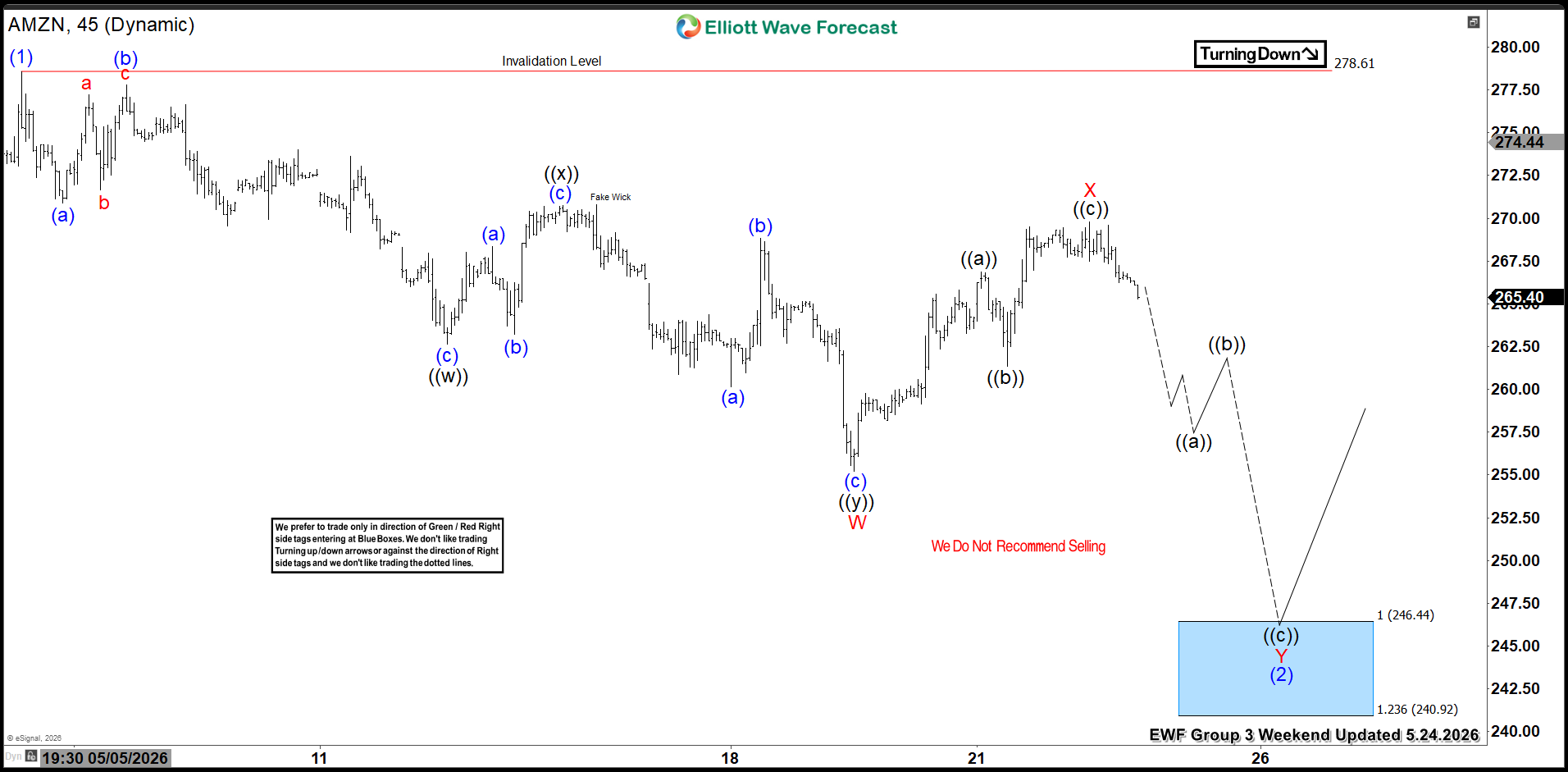
In this Elliott Wave update, we look at the latest structure in Amazon.com Inc. ($AMZN). The stock appears to have ended the bullish cycle from February 2026 and has since turned lower in a larger corrective pullback. However, the decline still looks corrective rather than impulsive. As a result, $AMZN is now pulling back in 7 swings, and the current structure is opening a Blue Box Area buying opportunity.

5 Wave Impulse + 7 Swing WXY correction​

$AMZN Ended the Cycle From February 2026​

$AMZNLooking at the 45-minute chart, $AMZN completed the rally from the February 2026 cycle and then started to correct lower. After reaching a meaningful high, the stock failed to extend further and shifted into a bearish swing sequence.

This change matters because it suggests the prior bullish cycle has ended for now, at least in the short term. Even so, the decline does not yet look like the start of a larger bearish trend. Instead, the structure continues to point to a corrective pullback within the broader sequence.

Pullback Is Unfolding in 7 Swings​

At this stage, $AMZN is not dropping in a straight impulsive move. Instead, the stock is developing a 7-swing correction, which is a common Elliott Wave pattern after a completed cycle.

More specifically, the decline is unfolding as a W-X-Y structure. This tells us the market is still correcting the prior advance rather than building a sustained bearish trend. Therefore, the current weakness should be viewed as part of a corrective sequence that can offer support lower.

Blue Box Area Offers Buying Opportunity​

Most importantly, the Blue Box Area between 246.44 and 240.92 marks the next key support zone. This is the area where the 7-swing pullback can finish and where buyers are expected to appear.

Typically, Blue Box Areas represent high-frequency reaction zones where selling pressure starts to fade and buyers step in for a bounce. In this case, if $AMZN reaches that region, the stock can attract buyers and produce a recovery from support.

For that reason, we do not like selling into the blue box. Instead, the preferred view is to watch that area for a buying opportunity as the correction matures.

Short-Term Outlook for $AMZN​

In the near term, the focus remains on the current decline into 246.44–240.92. As long as the stock continues to pull back in a corrective structure, that area remains the next important support to watch.

Once the blue box is reached, buyers can step in and trigger a rebound. That bounce would confirm the market found support in the expected reaction zone and would fit the idea of the larger correction unfolding in 7 swings.

Meanwhile, the broader structure remains valid as long as $AMZN stays below the 278.61 invalidation level on this short-term view.

Technical Summary​

To summarize, $AMZN appears to have ended the cycle from February 2026 and is now pulling back in a 7-swing correction. Most importantly, the Blue Box Area at 246.44–240.92 stands out as the next buying opportunity, where buyers can appear and trigger a reaction higher.

Accordingly, traders should keep a close eye on that support area as the corrective structure approaches completion.

Source: https://elliottwave-forecast.com/st...ng-buying-opportunity-after-7-swing-pullback/
 
Hello fellow traders. In this technical article, we are going to present Elliott Wave charts trading setup of AMD Stock (Advanced Micro Devices, Inc) . The stock completed its corrective decline precisely at the Equal Legs area, also known as the Blue Box. In the following sections, we’ll break down the Elliott Wave structure in detail and explain the setup and present the target levels.

AMD Elliott Wave 1 Hour Chart 05.15.2026​

The current analysis suggests that AMD stock is forming a wave ((4)) black pull back. Blue Box comes at 418.75-390.32. That is our buying zone. We recommend members avoid selling AMD stock, as the main trend remains bullish. We anticipate at least a 3-wave bounce from this Blue Box area. Once the price touches the 50% fib level against the (X) blue connector, we’ll make positions risk-free, set the stop-loss at breakeven, and book partial profits. Stop Loss is placed a few points below 1.618 fib extension : 390.32

90% of traders fail because they don’t understand market patterns. Are you in the top 10%? Test yourself with this advanced Elliott Wave Test
Official trading strategy on How to trade 3, 7, or 11 swing and equal leg is explained in details in Educational Video, available for members viewing inside the membership area.

Quick reminder on how to trade our charts :

Red bearish stamp+ blue box = Selling Setup
Green bullish stamp+ blue box = Buying Setup
Charts with Black stamps are not tradable.
1f6ab.svg


AMD

AMD Elliott Wave 1 Hour Chart 05.28.2026​

The stock found buyers into the Blue Box area, just as expected. AMD completed wave IV correction at the 392.99 low and made a decent reaction higher from our buying zone. As a result all long positions are risk free + partial profits have been taken. The stock has gained more than 25% from our buying zone. As long as price holds the pivot at 392.99 , further upside remains likely.

Reminder for members: Our chat rooms in the membership area are available 24 hours a day, providing expert insights on market trends and Elliott Wave analysis. Don’t hesitate to reach out with any questions about the market, Elliott Wave patterns, or technical analysis. We’re here to help.

AMD

Source: https://elliottwave-forecast.com/stock-market/amd-delivers-25-rally-off-our-blue-box-entry/
 
In this technical blog, we will look at the past performance of the Daily Elliott Wave Charts of $XME. In which, the rally from July 2022 low ended in an impulse sequence & showed higher high sequence in weekly structure therefore, called for an extension higher to take place. We knew that the structure in XME should remain supported & extend higher. So, we advised members not to sell the ETF & buy the dips in 3, 7, or 11 swings at the blue box areas. We will explain the structure & forecast below:

XME Daily Elliott Wave Chart From 3.22.2026​

Elliott Wave in Action: $XME Secures Another Blue Box Win


Here’s the Daily Elliott wave Chart from the 3.22.2026 Weekend update. In which, the rally to $135.68 high completed the cycle from July 2022 low & made a pullback against that cycle. The internals of that pullback unfolded as Elliott wave double three correction where wave w ended at $117.14 low. A rally to $126.45 high-ended wave x bounce. Then started the next leg lower in wave y towards $101.34- $85.31 blue box area. From there, buyers were expected to appear looking for new highs ideally or for a 3-wave bounce minimum.

XME Latest Daily Elliott Wave Chart From 5.24.2026​

Elliott Wave in Action: $XME Secures Another Blue Box Win


This is the latest Daily Elliott wave Chart from 5.24.2026 Weekend update. In which the XME is showing a very strong reaction higher taking place, right after ending the double correction within the blue box area. Allowed members to create a risk-free position shortly after taking the long position at the blue box area. However, a break above $135.68 high is needed to confirm the next leg higher targeting $146.57- $160.75 area minimum.

Source: https://elliottwave-forecast.com/bl...e-in-action-xme-secures-another-blue-box-win/
 
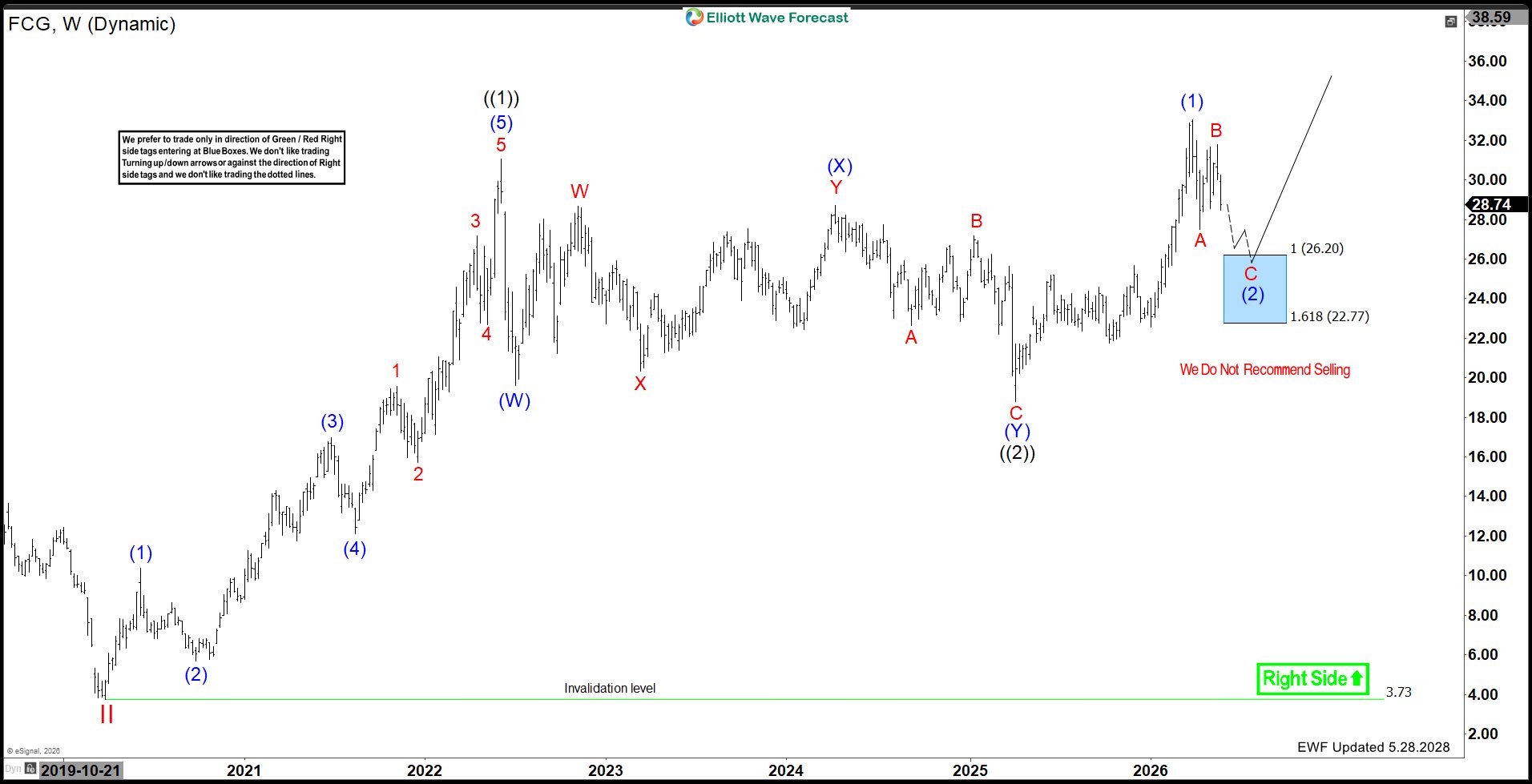
In this Elliott Wave update, we look at the latest structure in the First Trust Natural Gas ETF ($FCG). The ETF has been showing a strong bullish sequence from the 2020 lows, where a double nest appears to have formed and helped launch the larger rally. More recently, FCG seems to have ended the cycle from April 2025 and has started a corrective pullback. However, the decline still looks corrective rather than impulsive. As a result, the ETF is now pulling back in 3 swings, and the Blue Box Area is standing out as the next buying opportunity.

$FCG

FCG Built a Double Nest From the 2020 Lows​

Looking at the weekly chart, $FCG formed an important base at the 2020 lows and then began to rally in a bullish impulsive structure. The price action from that low suggests a double nest, which is a bullish Elliott Wave setup that often leads to a strong extension higher.

That larger bullish structure helped support the rally into the 2022 high and then again into the more recent advance. Therefore, the bigger picture remains constructive, even though the ETF is currently correcting the latest cycle.

Cycle From April 2025 Appears Complete​

From the April 2025 low, $FCG advanced in another bullish leg and eventually reached a meaningful peak in 2026. After that high, the ETF failed to extend immediately and turned lower in a corrective sequence.

This shift suggests the cycle from April 2025 has likely ended for now. Even so, the current move lower does not yet show the characteristics of a larger bearish trend. Instead, it looks like a correction within the broader bullish sequence from the 2020 low.

Pullback Is Unfolding in 3 Swings​

At this stage, $FCG is not declining in a straight five-wave impulsive move. Instead, the structure points to a 3-swing correction, which is a common Elliott Wave pattern after a completed bullish cycle.

More specifically, the current decline is unfolding as a A-B-C structure. This is important because 3-swing pullbacks often end in extreme areas where selling pressure fades and buyers step back in. Therefore, the current weakness should be viewed as a corrective pullback rather than the start of a major bearish reversal.

Blue Box Area Offers Buying Opportunity​

Most importantly, the Blue Box Area between 26.20 and 22.77 marks the next key support zone. This is where the 3-swing pullback can complete and where buyers are expected to appear.

Typically, Blue Box Areas represent high-frequency reaction zones where the market reaches an extreme in a corrective structure. In this case, if $FCG reaches that region, buyers can step in and trigger a reaction higher in line with the larger bullish trend.

For that reason, we do not like selling into the blue box. Instead, the preferred view is to watch that area for a buying opportunity as the correction matures.

Near-Term Outlook for $FCG​

In the near term, the focus remains on the decline into 26.20–22.77. As long as the current move continues to unfold as a corrective structure, that area remains the next important support to watch.

Once the ETF reaches the blue box, a bounce can develop and confirm that buyers are defending the larger bullish sequence. That would fit the view that the pullback is only correcting the cycle from April 2025, while the bigger trend from the 2020 lows remains intact.

Meanwhile, the broader structure remains valid above the 3.73 invalidation level.

Technical Summary​

To summarize, $FCG shows a bullish double nest from the 2020 lows and appears to have ended the cycle from April 2025. The ETF is now pulling back in a 3-swing correction, and the Blue Box Area at 26.20–22.77 stands out as the next buying opportunity.

Video Analysis​

[video width="1920" height="1080" mp4="[URL]https://elliottwave-forecast.com/wp-content/uploads/2026/05/Debut-2026-05-28-11_45_36.mp4[/URL]" poster="[URL]https://elliottwave-forecast.com/wp-content/uploads/2026/05/fcg.png[/URL]"][/video]

Source: https://elliottwave-forecast.com/vi...ng-buying-opportunity-after-7-swing-pullback/
 
Pan American Silver Corp. (PAAS) is one of the world’s largest primary silver producers, with a diversified portfolio of mines and exploration projects across the Americas. Headquartered in Vancouver, the company has built a reputation for operational scale and resource depth, producing not only silver but also significant volumes of gold and base metals. Its long history in the sector, combined with exposure to multiple jurisdictions, makes PAAS a key player in the precious metals market and a closely watched stock among investors seeking leverage to silver prices.

PAAS Monthly Elliott Wave Chart​

PAAS-Monthly20260601120344.jpg


Pan American Silver (PAAS) completed wave ((II)) of the Grand Supercycle at the $5.70 low, marking a significant long‑term pivot. From that base, the stock advanced in wave ((III)), reaching an all‑time high of $69.99. The subsequent pullback in wave (IV) is proposed complete at $45.94, aligning with the 38.2%–50% Fibonacci retracement of wave ((III)). The stock has since turned higher in wave (V), though a decisive break above the wave ((III)) peak at $69.99 remains necessary to fully invalidate the risk of a double correction.

PAAS Daily Elliott Wave Chart​

PAAS-Daily20260601120318-1.jpg


Pan American Silver (PAAS) began its rally from the February 13, 2024 low in an impulsive structure. Wave I peaked at $27.47, followed by a wave II correction to $20.55. The stock then advanced in wave (III) to $42.57, with wave IV pulling back to $33.08. Wave V extended to $69.99, completing wave ((III)) of the higher degree. The subsequent wave (IV) correction bottomed at $45.94, and the stock has since turned higher in wave (V). From wave (IV), wave ((1)) ended at $60.56, with wave ((2)) pulling back to $50.51. The next advance carried wave (1) to $64.94, followed by a wave (2) retracement to $52.22. While price remains above $20.55, the expectation is for the stock to continue extending higher.

Source: https://elliottwave-forecast.com/video-blog/paas-correction-concludes-bullish-continuation-expected/
 
Riot Platforms Inc (NASDAQ: RIOT) stands as a key player in the crypto mining space. The stock has positioned itself for further growth. In this article, we explore the bullish Elliott Wave Structure behind RIOT's upward trajectory. This analysis highlights potential advances and opportunities for investors.

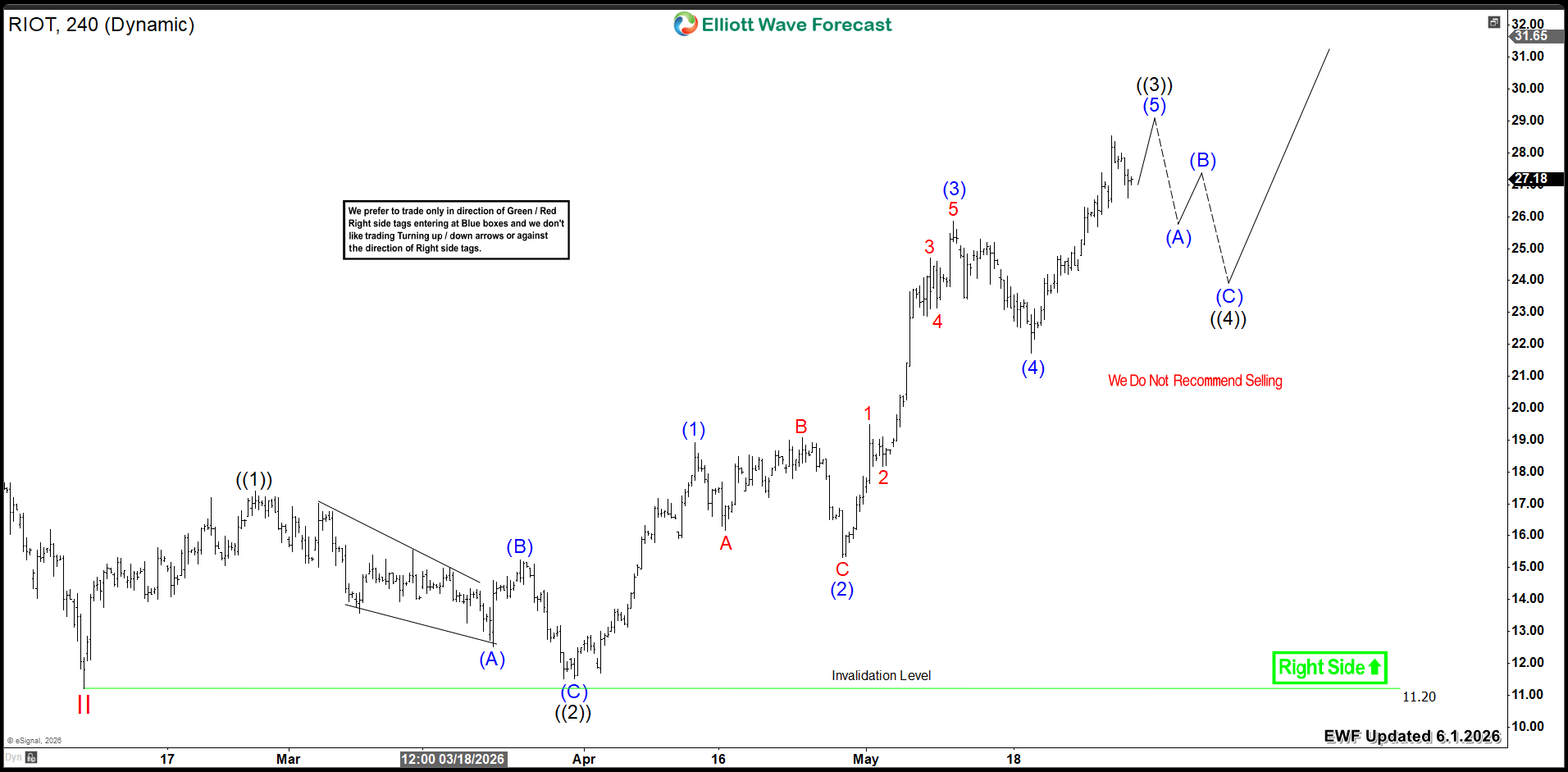
Riot shows an incomplete bullish sequence from its February 2026 low. The stock managed to break above the 2025 peak of $23.90. Currently, it trades within wave (5) of ((3)). This cycle from the March 2026 low is entering its final phase. The target area sits at $28.20 - $30.40.

Therefore, Riot should soon end this regular impulse. Then, a corrective three-wave pullback in wave ((4)) will begin. We still expect bulls to support the following correction. They will look to buy it in 3, 7, or 11 swings. This will set up the next advance above $30, continuing the rally from 2026 lows.

RIOT 4 Hour Chart 6.1.2026​

RIOT 4H 6.1.2026

Conclusion​

Riot Platforms maintains an active bullish trend. The stock appears ready for additional gains. Consequently, traders should focus on entry points during daily dips.

Source: https://elliottwave-forecast.com/stock-market/riot-platforms-breaks-out/
 
XBI shows steady momentum as it continues building its larger bullish cycle. However, the ETF still trades inside wave I, which keeps the door open for a deeper pullback. Because of this, traders should expect volatility to increase as the structure matures. Moreover, the next months may reveal whether buyers can defend key support levels.

Even so, the broader trend remains constructive while the cycle stays incomplete. As wave II develops, price could create a healthier base for the next advance. After that, a confirmed reaction higher would strengthen the bullish outlook. Therefore, traders should monitor the sequence closely and adapt as the structure unfolds.

Elliott Wave Structure: XBI Weekly Chart February 14th 2026

Elliott Wave Structure: XBI Weekly Chart February 14th 2026

Back in February, we believed the impulse from the extreme zone had already reached 132.00 before pulling back toward 122.88. That advance delivered a gain above 62%, so we thought wave I likely ended at that stage. Yes, price could still print a marginal high above 132, but caution made more sense then. Besides, we expected choppy action until the market revealed a clear direction.

When that move appeared, we anticipated the first break to point lower. We projected a double correction as wave II, although any corrective pattern remained possible. Even a sharp drop could unfold before the bullish trend resumed. At that time, we anticipated a correction toward the 107–91 zone. That area looked promising for new buying opportunities and the next rally in wave III.

If you're eager to dive deeper into Elliott Wave Theory and learn how its principles apply to market forecasting, you might find these resources helpful: Elliott Wave Education and Elliott Wave Theory.

Elliott Wave Principle Behind the Market Structure​

Impulse

An impulse is a clean 5‑wave pattern that drives the trend forward.

  • Waves 1‑3‑5 are strong and directional.
  • No overlap between waves 1 and 4.
  • Wave 3 is usually the strongest.
  • Structure is clear, with increasing momentum.
Elliott Wave Principle Behind the Market Structure


Elliott Wave Structure: XBI Weekly Chart June 1st 2026

Elliott Wave Structure: XBI Weekly Chart June 1st 2026

XBI currently shows lagging momentum, which suggests the correction should appear soon. However, only a strong bullish move would invalidate this view. Therefore, we expect wave I to complete a leading diagonal with one more high, possibly near 142.60. If price shows a strong bearish reaction at that level, we will consider wave I completed and the expected correction underway.

If we do not see that bearish reaction and price keeps lagging, we cannot rule out additional upside. Even so, the structure still favors a pending correction before the next bullish phase.

Source: https://elliottwave-forecast.com/stock-market/xbi-momentum-fades-as-wave-i-nears-completion/
 
Hindustan Copper (NSE: HINDCOPPER) continues to show a strong bullish Elliott Wave structure despite the recent pullback from the February 2026 high. The stock completed wave (2) near 234.52 in September 2025 and then began a powerful rally in wave (3). From that low, price developed a clear five-wave advance and surged into the January-February 2026 peak. Wave (3) extended strongly and topped near the 758 region. Strong buying pressure and bullish momentum supported the advance throughout the rally. The move also formed clean impulsive subdivisions, reinforcing the view that the larger trend remains bullish.

After wave (3) ended, Hindustan Copper entered a corrective phase in wave (4). The decline unfolded as an A-B-C structure and reached a low near the 445 region. Importantly, the correction held within the key Fibonacci support area between 479.35 and 394.70. Buyers quickly stepped in from this zone and triggered a strong rebound. This reaction suggests that wave (4) has likely ended and that the next bullish phase is already underway.

HINDCOPPER_2026-05-29_06-31-42-scaled.png


Following the wave (4) low, Hindustan Copper started a new bullish sequence. The rally from the low appears to have completed wave 1, while wave 2 remains in progress. Once wave 2 ends, the stock should resume higher in wave 3 of (5). This setup is important because it points to more than a short-term bounce. Instead, it suggests the beginning of the final leg higher within the larger bullish cycle that started in June 2022.

Elliott Wave Forecast and Price Targets​

From an Elliott Wave perspective, we expect the current wave 2 pullback to finish soon while price remains above 445.70. Once the correction ends, the stock should resume its bullish trend.The minimum target for wave (5) is a break above the previous wave (3) high at 758.85. Such a move would confirm continuation of the larger uptrend.

However, the broader structure suggests significantly more upside. Based on Fibonacci projections and the current wave count, Hindustan Copper could rally toward the 859–1052 area before completing the five-wave cycle from the June 2022 low.

Conclusion​

Hindustan Copper remains bullish as wave (4) appears complete at a key Fibonacci support zone. As long as price stays above 445.70, we expect further upside. A break above 758.85 should confirm the next rally, with potential targets in the 859–1052 region.

Source: https://elliottwave-forecast.com/st...dcopper-elliott-wave-wave-5-targets-859-1052/
 
AST SpaceMobile, Inc., (ASTS) together with its subsidiaries designs & develops the constellation of BlueBird Satellites in the United States. The company provides a cellular broadband network in space to be accessible directly by smartphones for commercial use & other applications for government use. It comes under Technology sector & trades as “ASTS” at Nasdaq.

ASTS favors bullish sequence in weekly started from 4.02.2024 low. It ended (I) at $129.89 high (1.30.2026) & (II) at $63.13 low (5.05.2026). The buyers are looking for pullback into Blue box area for another long set up against May-2026 low.

It made all time low of $1.97 in April-2024 low. Above there, it ended I of (I) at $39.08 high, II at $17.50 low, III at $102.79 high, IV at $49.31 low & V at $129.89 high. Within III, it ended ((1)) at $33.55 high, ((2)) as flat at $18.22 low, ((3)) at $60.95 high, ((4)) at $36.08 low & ((5)) at $102.79 high. Within V, it ended ((1)) at $85.45 high, ((2)) at $61.40 low, ((3)) at $120.80 high, ((4)) at $96.93 low & ((5)) at $129.89 high. Below (I) high, it ended w at $77.17 low, x at $104.15 high as flat & y at $63.13 low in (II) double correction.

ASTS - Elliott Wave Latest Daily View:​

Above (II) low, it ended ((1)) of I of (III) at $133.80 high & favors ((2)) correction against 5.05.2026 low. It ended (1) of ((1)) at $75 high, (2) at $64.91 low, (3) at $131.20 high, (4) at $121.05 low & (5) at $133.80 high. Below ((1)) peak, it proposed ended (A) at $105.37 low & (B) at $115.50 high. As long as the bounce fail below $115.50 high, it expects (C) to extend toward $87.04 - $69.44 area to end ((2)) correction. Buyers can enter that area for next leg higher.

ASTS - Elliott Wave Latest 2-hour View:​

There are few possible alternates in ((2)) correction. (1) If it makes a minor low and bounce later to break above $108.75 high. Then it can be (B) bounce, while low will be (A). In that case, it can see another push lower later in (C) to end ((2)). (2) If it breaks above $115.50 high without further extension lower, then it can be truncated in (C) & continue higher in ((3)), which confirms above $133.80 high to rule out double correction.

Source: https://elliottwave-forecast.com/st...-buyers-look-to-buy-between-87-04-69-44-area/
 
Micron Technology Inc (NASDAQ: MU) stands as one of the largest semiconductor producers in the USA. It trails only giants like NVIDIA and Intel. In recent months, the stock price doubled to a milestone above $1000. This article explores the bullish Elliott Wave structure behind MU's upward trajectory. Our analysis highlights potential advances and key targets for investors.

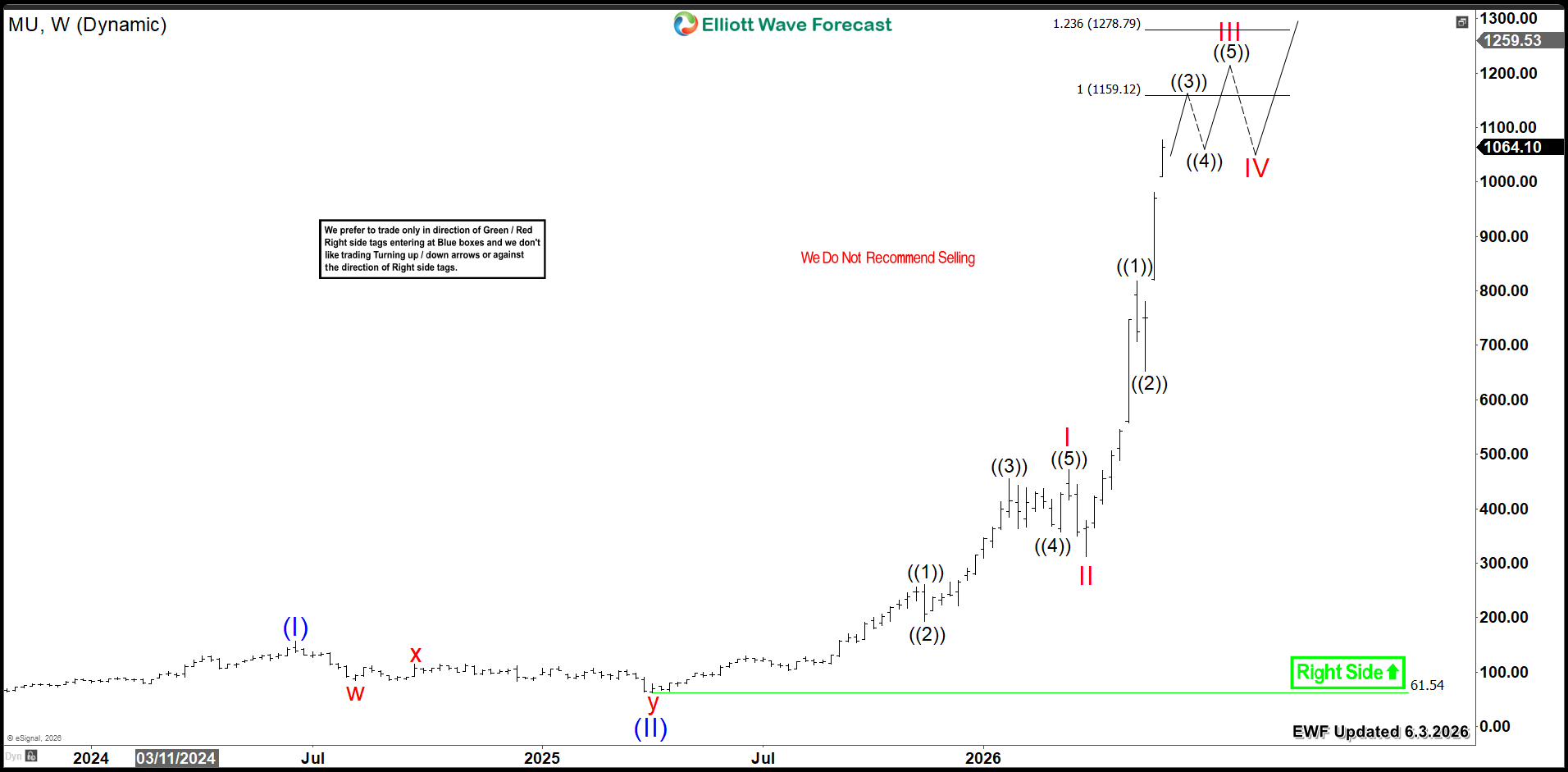
Since its April 2025 low, MU started a new impulsive advance within wave (III). This created a bullish nesting structure. The current rally shows an incomplete sequence within wave ((3)) of III. Therefore, this represents the strongest wave of the entire cycle.

The stock's initial target sits at the $1159 - $1278 equal legs area. However, this zone will not stop the rally. The full extension comes at the $1472 Fibonacci 1.618 level. MU could face some profit-taking there as the third wave extension ends.

Investors will continue seeking buying opportunities during fourth wave pullbacks. These corrections will appear within daily timeframes.

MU Weekly Chart 6.3.2026​

MU Weekly Chart 6.3.2026

The following video offers a technical outlook for Micron Technology:​

[video width="1280" height="626" mp4="[URL]https://elliottwave-forecast.com/wp-content/uploads/2026/06/MU-Video-6.3.2026.mp4[/URL]"][/video]

Conclusion​

Micron Technology maintains a strong bullish trend. The stock appears ready for additional gains. Consequently, traders should focus on entry points during daily dips.

Source: https://elliottwave-forecast.com/video-blog/micron-technology-mu-bullish-path/
 
Introduction Financial markets often appear chaotic, with price swings that seem unpredictable. Many traders rely on indicators, news headlines, or gut instinct to make decisions. Yet beneath the surface, Elliott Wave Theory reveals that markets move in recognizable patterns driven by collective psychology. This structured approach offers clarity where randomness seems to dominate.

The Problem with Randomness

  • Indicator overload: Traders often stack multiple tools—RSI, MACD, moving averages—without a unifying framework.
  • Reactive trading: Decisions are made after moves happen, chasing momentum instead of anticipating it.
  • Noise vs. signal: Random price action can mislead traders into overtrading or misjudging risk.
Without structure, trading becomes guesswork—akin to navigating a storm without a compass. Example look at the below chart with a lot of indicators

Trading-Screen.png


This makes reading the market as a whole challenging, and even more difficult when deciding the right moment for execution. Chart above is carrying excessive noise, leading to mixed signals that can cause traders to execute either too early or too late.

The Power of Structure in Elliott Wave

  • Defined patterns: Impulse waves (trend) and corrective waves (retracement) provide a roadmap.
  • Risk management: Invalidation levels act as guardrails, reducing emotional decision-making.
  • Forecasting ability: By identifying where a market is within its wave cycle, traders can anticipate likely scenarios instead of reacting blindly.
  • Psychological discipline: Structure enforces patience—waiting for setups to complete rather than forcing trades.
Structure transforms uncertainty into probability, giving traders a strategic edge. Take for example the chart below of IWM.
IWM-1-hr-29-april-before.png


The chart presents a clean, well‑defined structure with clear expectations and an invalidation level that establishes risk. The pattern is precise, and rather than chasing price, we simply wait for it to reach a predetermined Blue box area—where execution becomes clear and decisive.

Fast‑forward the outcome of a planned trade by focusing on structure and clear levels at the Blue box area, without the distraction of multiple indicators cluttering the chart.

IWM-1-hr-2-june-after.png


Comparing Methods

Each trading approach carries distinct advantages and limitations. Indicators such as RSI and MACD provide quick, easy‑to‑use signals, but they often lag price action and can generate false entries. News and events offer valuable contextual awareness, yet markets frequently price in information ahead of time, making outcomes unpredictable. Decisions based on randomness or instinct allow for speed, but they lack consistency and carry high risk. In contrast, Elliott Wave analysis stands out for its structured, anticipatory framework that defines risk and helps traders prepare for future moves. However, it demands practice, discipline, and patience to apply effectively, making it less straightforward than other methods but potentially more rewarding for those who master it.

Why Structure Wins

Markets are not random—they reflect human behavior, which follows cycles of optimism and pessimism. Elliott Wave Theory captures this rhythm, turning chaos into a structured narrative. While no method is perfect, structure consistently outperforms randomness because it provides:

  • A framework for analysis
  • A discipline for execution
  • A strategy for risk control
Conclusion Trading without structure is gambling. Elliott Wave Theory offers a disciplined, pattern-based approach that helps traders anticipate moves, manage risk, and stay patient. In the long run, structure beats randomness—because markets may be noisy, but they are never truly chaotic.

Source: https://elliottwave-forecast.com/el...other-methods-why-structure-beats-randomness/
 
Warner Bros. Discovery (NASDAQ: WBD) appears to have completed a significant long-term corrective cycle and is now showing signs of a new bullish trend. The monthly Elliott Wave chart suggests the stock finished a large 3 wave flat correction at the 2024 low near 6.64 in wave II, which now serves as the key invalidation level for the bullish outlook. Following that low, buyers stepped in aggressively and triggered a strong recovery. The reaction from this area supports the view that a major bottom is already in place and that a new impulsive cycle has begun.

From the 2024 low, WBD has started to build a five-wave advance. The initial rally appears to have completed wave (1), followed by a corrective wave (2). The stock is now expected to continue higher in wave (3), which is typically the strongest and most dynamic phase of an Elliott Wave sequence. The projected path on the chart shows a continued advance in wave (3), followed by a pullback in wave (4), and then another rally in wave (5). Together, these waves should complete a larger degree wave ((1)) and confirm that a long-term bullish cycle is underway.

WBD_2026-06-04_06-13-57-scaled.png


WBD Elliott Wave Forecast​

The current structure suggests that the recent recovery is more than a temporary bounce. Instead, it appears to be the beginning of a larger bullish cycle from the wave II low completed in 2024. As long as price remains above 6.64, the bullish count remains valid. The stock should continue forming higher highs and higher lows as wave (3) develops. Any corrective pullbacks in 3, 7, or 11 swings could provide opportunities to join the trend while the larger structure remains intact.

Most importantly, we expect this new bullish cycle from the wave II low to eventually break above the previous all-time high and establish new highs over the coming years. The current advance is viewed as the early stages of that larger recovery, with wave ((1)) expected to lead the stock significantly higher before the next larger correction unfolds.

Conclusion​

Warner Bros. Discovery appears to have completed a major correction and started a new bullish Elliott Wave cycle from the wave II low. While price remains above 6.64, we expect further upside within wave (3), followed by wave (4) and wave (5) to complete the larger wave ((1)) structure. Ultimately, this new cycle should lead to a break above the previous all-time high and the creation of new highs in the years ahead.

Source: https://elliottwave-forecast.com/st...covery-stock-forecast-elliott-wave-new-highs/
 
Hello fellow traders. In this technical article, we are going to present Elliott Wave charts trading setup of Apple Stock (AAPL ). The stock completed its corrective decline precisely at the Equal Legs area, also known as the Blue Box. In the following sections, we’ll break down the Elliott Wave structure in detail and explain the setup and present the target levels.

AAPL Elliott Wave 1 Hour Chart 06.01.2026​

The current analysis suggests that Apple stock is forming a wave ((ii)) black pull back. Blue Box, buying zone comes at 307.73-304.33. We recommend members avoid selling Apple stock, as the main trend remains bullish. We anticipate at least a 3-wave bounce from this Blue Box area. Once the price touches the 50% fib level against the (x) blue connector, we’ll make positions risk-free, set the stop-loss at breakeven, and book partial profits. Stop Loss is placed a few points below 1.618 fib extension : 304.33

90% of traders fail because they don’t understand market patterns. Are you in the top 10%? Test yourself with this advanced Elliott Wave Test

Official trading strategy on How to trade 3, 7, or 11 swing and equal leg is explained in details in Educational Video, available for members viewing inside the membership area.

Quick reminder on how to trade our charts :

Red bearish stamp+ blue box = Selling Setup
Green bullish stamp+ blue box = Buying Setup
Charts with Black stamps are not tradable.
1f6ab.svg


AAPL

AAPL Elliott Wave 1 Hour Chart 06.01.2026​

The stock found buyers into the Blue Box area, just as expected. AAPL completed correction above the invalidation level and made a decent reaction higher from our buying zone. As a result all long positions are risk free + partial profits have been taken. As long as price holds the pivot at 294.87 , further upside remains likely.

Reminder for members: Our chat rooms in the membership area are available 24 hours a day, providing expert insights on market trends and Elliott Wave analysis. Don’t hesitate to reach out with any questions about the market, Elliott Wave patterns, or technical analysis. We’re here to help.

AAPL

Source: https://elliottwave-forecast.com/bl...iott-wave-perfect-reaction-from-the-blue-box/
 
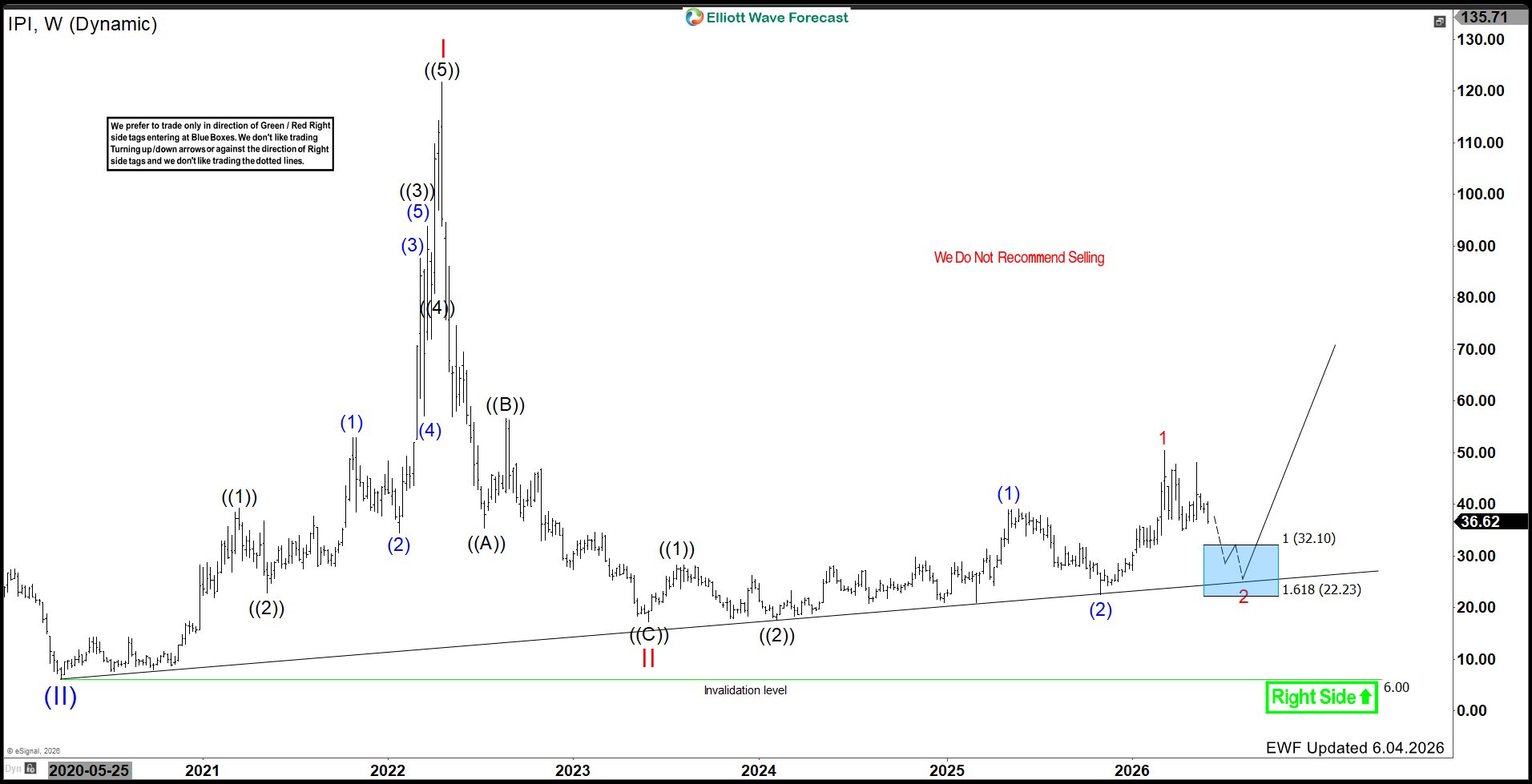
In this Elliott Wave update, we take a look at the long-term structure in Intrepid Potash, Inc. ($IPI). The stock appears to be starting a new bullish cycle, and the price action since June 2023 suggests a nesting structure is developing. As a result, the current pullback is approaching a key blue box area, where buyers can return and where the next leg higher may begin. If that setup holds, $IPI could see a strong acceleration phase over the next 3 years.

$IPI

$IPI

$IPI Has Been Nesting Since June 2023​

Looking at the weekly chart, $IPI appears to have built an important base following the larger correction into the 2023 low. From there, the stock started to turn higher and began to form a bullish structure with overlapping but constructive price action.

More importantly, the move from June 2023 suggests that the market has been nesting, which in Elliott Wave terms means the stock may be building the foundation for a much larger upside move. Nesting structures often appear in the early stages of a new bullish cycle, especially when wave (1) and wave (2) of a higher degree start taking shape.

Therefore, the current setup points to the possibility that $IPI is not just bouncing, but rather preparing for a broader bullish expansion.

New Bullish Cycle May Be Starting​

The larger picture suggests that $IPI may have already completed a major corrective phase and is now transitioning into a new cycle to the upside. The rally into the 2026 high supports that view, while the current pullback appears corrective rather than impulsive.

This is important because a corrective pullback inside a developing bullish structure often creates the next opportunity for buyers to enter before the trend extends higher again. In other words, the current dip may be part of a larger setup rather than a sign of renewed long-term weakness.

Blue Box Area Is the Key Support Zone​

Most importantly, $IPI is approaching the blue box area between 32.10 and 22.23. This zone marks the next high-frequency support region, where wave 2 can complete and where buyers may step in again.

Typically, blue box areas represent extreme zones in corrective pullbacks. In this case, if price reaches that support region, the stock can attract fresh buying interest and begin the next advancing leg in the new bullish cycle.

For that reason, we do not like selling into the blue box. Instead, the preferred view is to watch that area closely for signs that the correction has ended and the next bullish phase has started.

Why the Next 3 Years Could Be Important​

If $IPI completes the current pullback in the blue box and resumes higher, the stock could enter a much stronger upside phase over the coming years. That is because a completed nesting structure often leads to acceleration once the market breaks out of the corrective base.

Accordingly, the next 3 years could become a very important period for $IPI if the bullish count continues to develop as expected. A sustained move higher from the blue box would strengthen the case that a larger degree advance is unfolding.

Near-Term Outlook for $IPI​

In the near term, the focus remains on the pullback into 32.10–22.23. As long as the decline stays corrective, that region remains the key area to watch for a bullish reaction.

Meanwhile, the larger bullish structure remains valid above the long-term 6.00 invalidation level. Therefore, the broader outlook continues to favor higher prices over time as long as the stock stays above that support.

Technical Summary​

To summarize, $IPI appears to be starting a new bullish cycle and has been nesting since June 2023. The stock is now approaching the blue box area at 32.10–22.23, where buyers may appear and set the stage for the next advance.

If the stock reacts higher from that zone, it could begin a stronger acceleration phase, and the next 3 years may become very important in the development of the new bullish cycle.

Source: https://elliottwave-forecast.com/st...-bullish-cycle-builds-from-june-2023-nesting/