Elliott Wave Analysis by EWF

Sprott Physical Silver Trust (PSLV) is a closed-end fund managed by Sprott Asset Management. It provides investors with direct exposure to physical silver bullion. Unlike synthetic products, PSLV is fully backed by allocated silver bars. Below we will look at the long term Elliott Wave technical outlook of the instrument:

PSLV Weekly Elliott Wave Chart​

PSLV Elliott Wave Chart

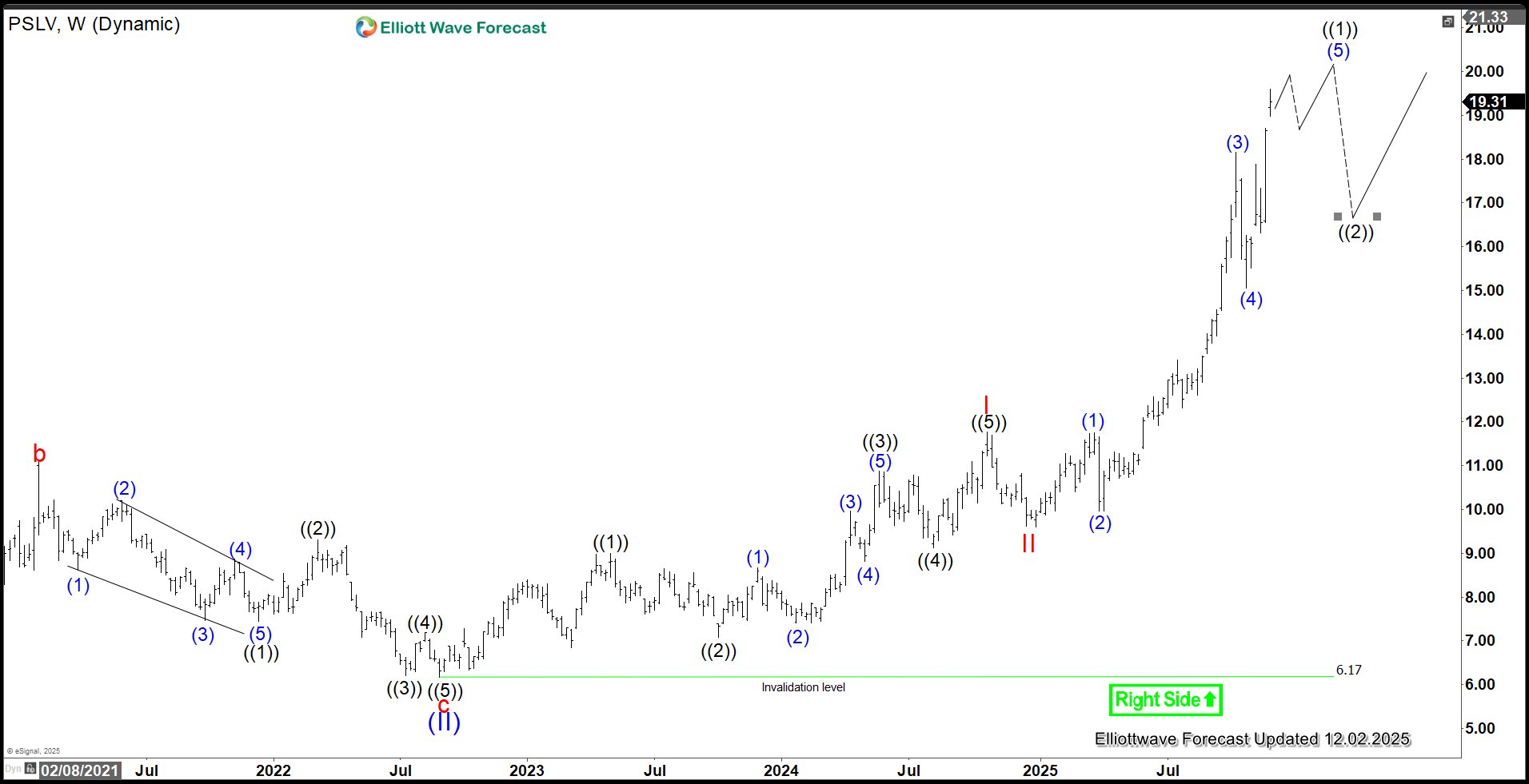
The weekly chart indicates that PSLV established a major wave (II) low at 6.17 on August 29, 2022, which marked the beginning of a sustained impulsive rally. From that base, wave I advanced to 11.77, followed by a corrective wave II that bottomed at 9.61. The current wave III is unfolding as an impulse. Wave (1) peaked at 11.75 and pullback in wave (2) retraced to 9.97. The instrument then extended sharply in wave (3) to 18.15. Afterwards, wave (4) corrected to 15.06. A final push higher in wave (5) should happen, which should complete wave ((1)) of III at the larger degree.

Once this initial sequence concludes, a corrective wave ((2)) is expected to retrace the cycle from the December 16, 2024 low, before the broader uptrend resumes. As long as the 6.17 pivot remains intact, the bias stays firmly bullish. Any pullback should provide a buying opportunity within the familiar 3, 7, or 11 swing sequences.

Source: https://elliottwave-forecast.com/vi...ver-trust-pslv-surges-to-a-new-all‑time-high/
 
Hello everyone! In today’s article, we’ll examine the recent performance of Apple Inc. ($AAPL) through the lens of Elliott Wave Theory. We’ll review how the powerful rally from the August 2025 low unfolded as a textbook 5-wave impulse and discuss our evolving forecast for the next move. Let’s dive into the structure and expectations for this tech giant.

5 Wave Impulse Structure + ABC correction​

$GOOGL

$AAPL 1H Elliott Wave Chart 8.21.2025:​

$AAPL

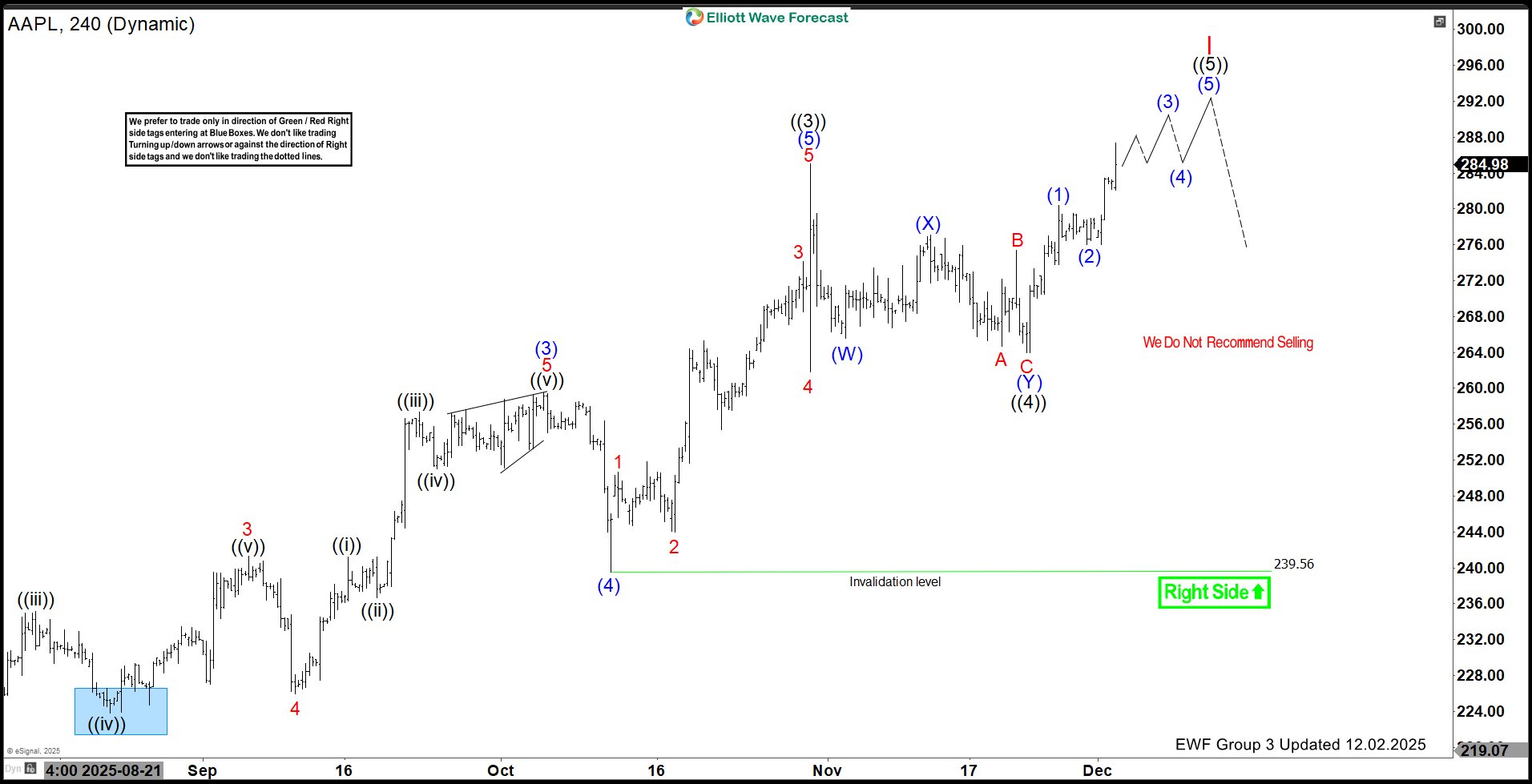
$AAPL 4H Elliott Wave Chart 12.02.2025:​

$AAPL

Fast forward three months to our latest update, and the charts tell a compelling story. $AAPL bounced right from that “blue box.” The stock was able to hold the low and dips kept finding buyers. The stock hit new all-time highs and is up about 30% from the blue box area.

Right now, the stock is still climbing. It is in what we call wave (3) of wave ((5)). This means more gains are likely. We think $AAPL could reach $290 –$298 next. After that, we might see another pullback.

Conclusion

In conclusion, our Elliott Wave analysis of $AAPL continues to prove accurate, suggesting that the stock remains well-supported against its April 2025 lows. For traders who capitalized on the entry opportunities presented in the “blue box” area, the $290–$298 zone should be closely monitored as the next significant objective. In the interim, keeping a vigilant eye out for any healthy corrective pullbacks could present fresh entry opportunities for those looking to join the trend.

By applying the principles of Elliott Wave Theory, traders can gain a deeper understanding of market cycles, better anticipate the structure of upcoming moves, and ultimately enhance their risk management strategies in dynamic markets like the current one for $AAPL.

Source: https://elliottwave-forecast.com/video-blog/apple-aapl-soars-blue-box-area-290-target-ahead/
 
Bitcoin’s recent surge toward $91K has traders buzzing with excitment and some are already anticipating the start of next bullish leg, but the charts tell a different story. ProShares Bitcoin ETF (BITO) is flashing signs of weakness, with a potential retracement toward the $10.10 zone. In Elliott Wave terms, this suggests BTCUSD may still be consolidating in a corrective phase rather than gearing up for the next impulsive leg higher. Understanding these signals is critical for traders who want to avoid chasing momentum at the wrong time.

BITO Bearish Sequence Points Toward $10.10​

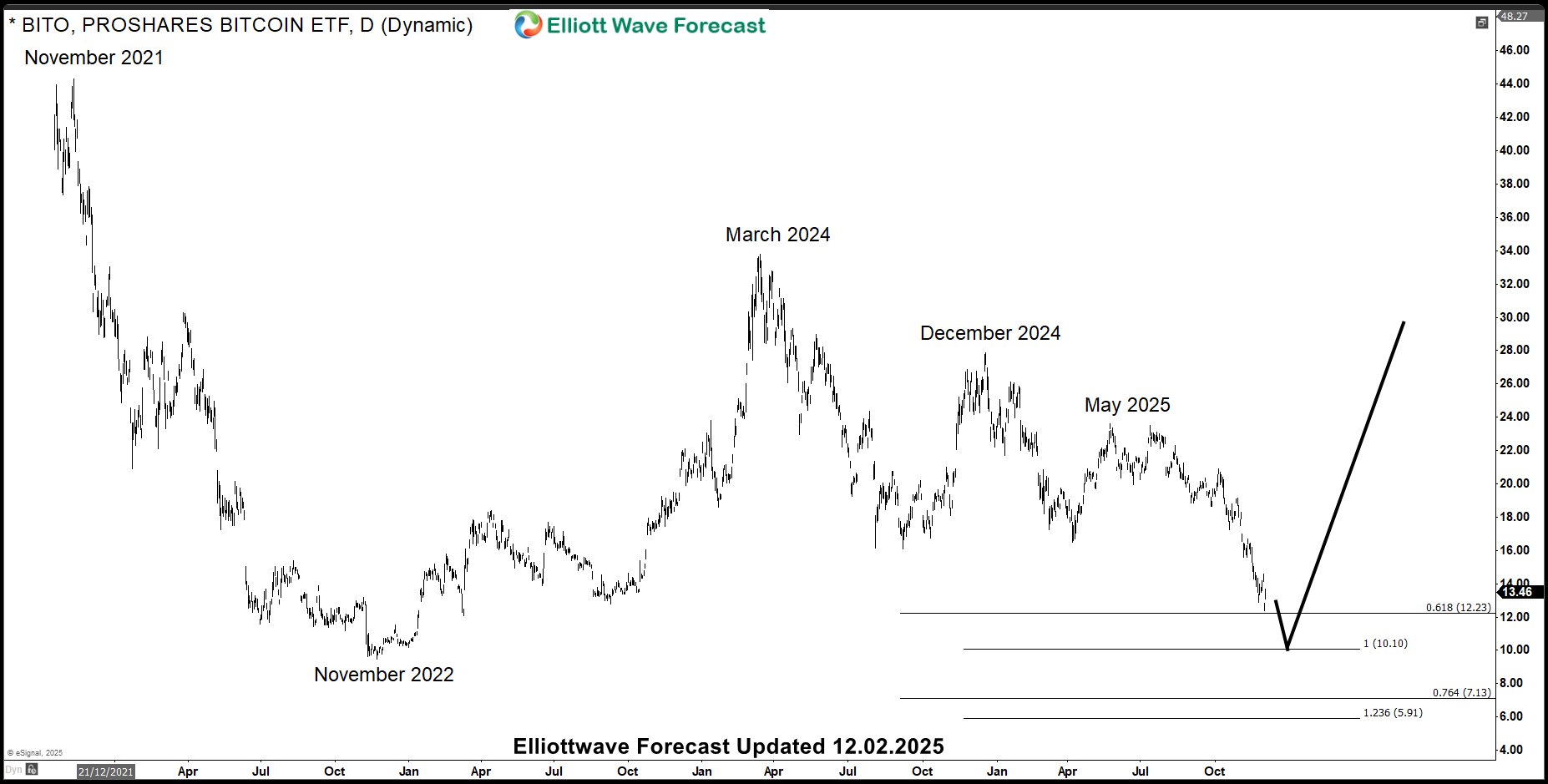
The ProShares Bitcoin ETF (BITO) completed its cycle from the November 2022 low back in March 2024. Since peaking in March 2024, the ETF has been trending lower, carving out what appears to be an incomplete bearish sequence against the December 2024 and May 2025 highs. This structure suggests that short-term bounces are likely to fail, reinforcing the case for further downside. The key level to watch is $10.10, which represents the 100% Fibonacci extension of the first leg down from the March 2024 peak, projected lower from the December 2024 peak. In Elliott Wave terms, this aligns with a corrective sequence that has yet to fully play out. Traders should be cautious about chasing rallies here, as the broader cycle bias favors continuation lower before any sustainable reversal can take shape.

BITO (Bitcoin ETF) Weekly Elliott Wave Analysis

BITO’s Chart Suggests Bitcoin Correction Not Over Yet​

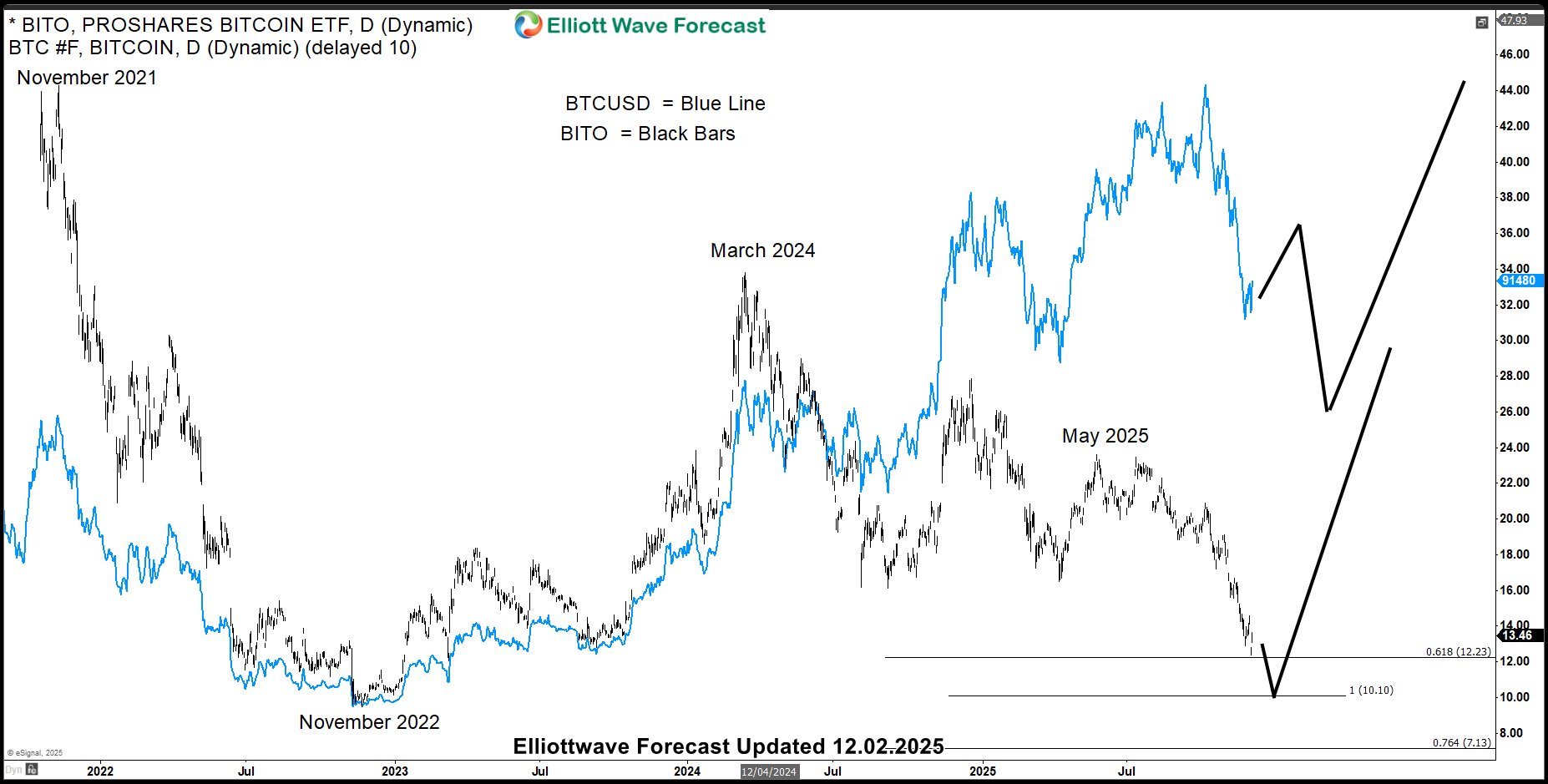
This chart highlights how closely Bitcoin ($BTCUSD) tracked BITO (ProShares Bitcoin ETF) from the November 2022 low to the March 2024 high. While the two assets appear to diverge after March 2024, a closer inspection reveals that Bitcoin continued to follow BITO’s directional path, albeit with a different magnitude of swings. This divergence in amplitude allowed Bitcoin to extend its rally all the way to the October 2025 high, even as BITO began its corrective phase. The recent decline in Bitcoin suggests that it has now completed its cycle from the November 2022 low, and is entering a broader corrective phase. Importantly, this correction is expected to persist until BITO reaches its extreme area near $10.10—a level derived from the 100% Fibonacci extension of the first leg down from the March 2024 peak, projected from the December 2024 peak.

Bitcoin Bulls, Hold Your Horses—BITO’s Chart Has Other Plans

BITO and BTCUSD overlay

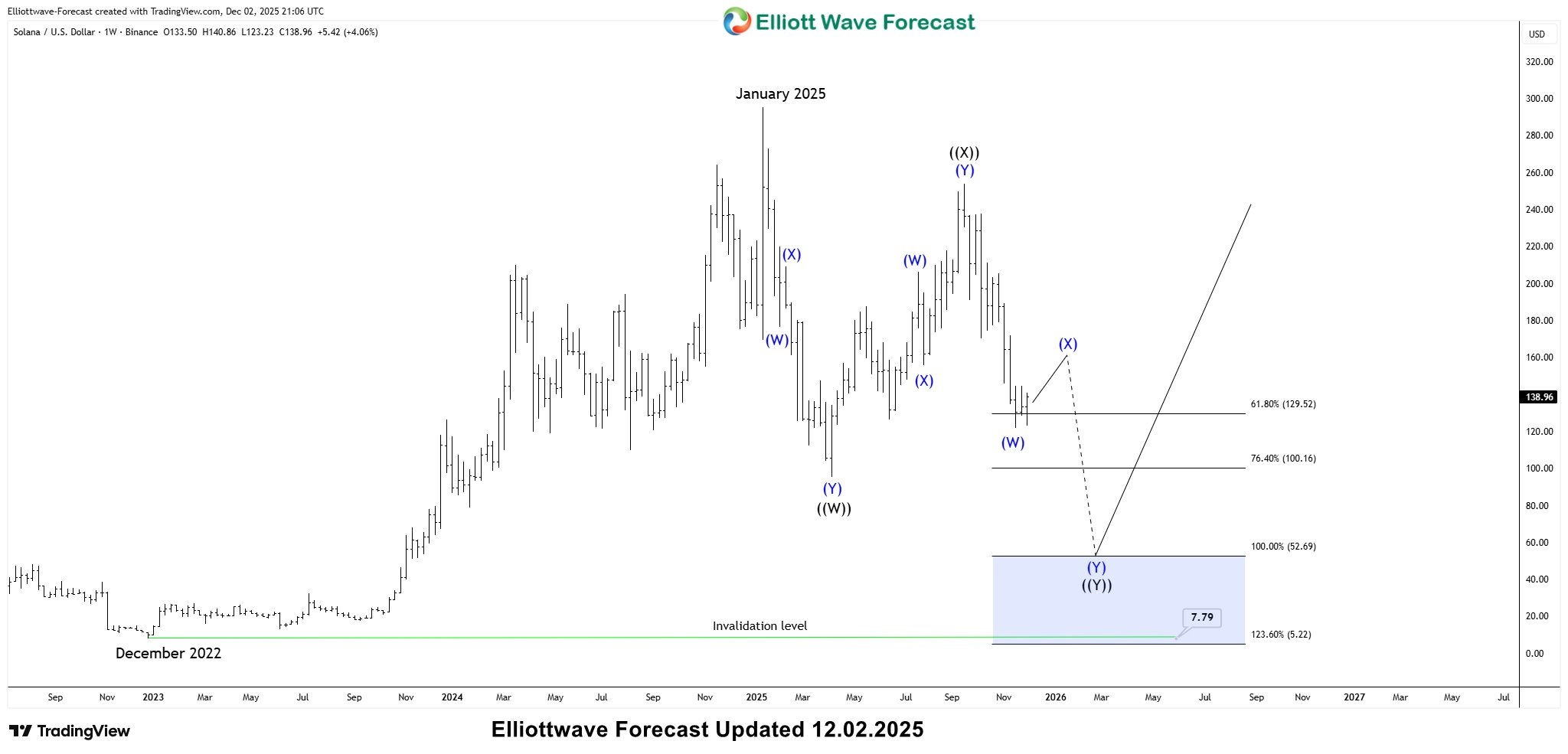
Solana’s Correction in Focus​

SOLANA's weekly chart shows the cryptocurrency is still unwinding the cycle that began in December 2022. As far as price stays below September 2025 peak, all signs are pointing toward further weakness with rallies likely to remain short-lived. The next extreme area lies beween $52.69–$7.79 , where buyers are expected to step back in. This downside target should align with BITO reaching its $10.10 extreme area, suggesting that major crypto instruments could bottom together before starting a new bullish phase.

Solana Weekly Cycle


The charts and path is clear: BITO, Bitcoin, and Solana are all signaling that the crypto market is still in a corrective phase, with extreme areas yet to be tested. For traders, this is not the time to chase rallies but to prepare for the opportunities that will emerge once these levels are reached. Staying patient now can make all the difference when the next impulsive cycle begins.

Source: https://elliottwave-forecast.com/cryptos/bito-etf-warning-about-bitcoin-rally/
 
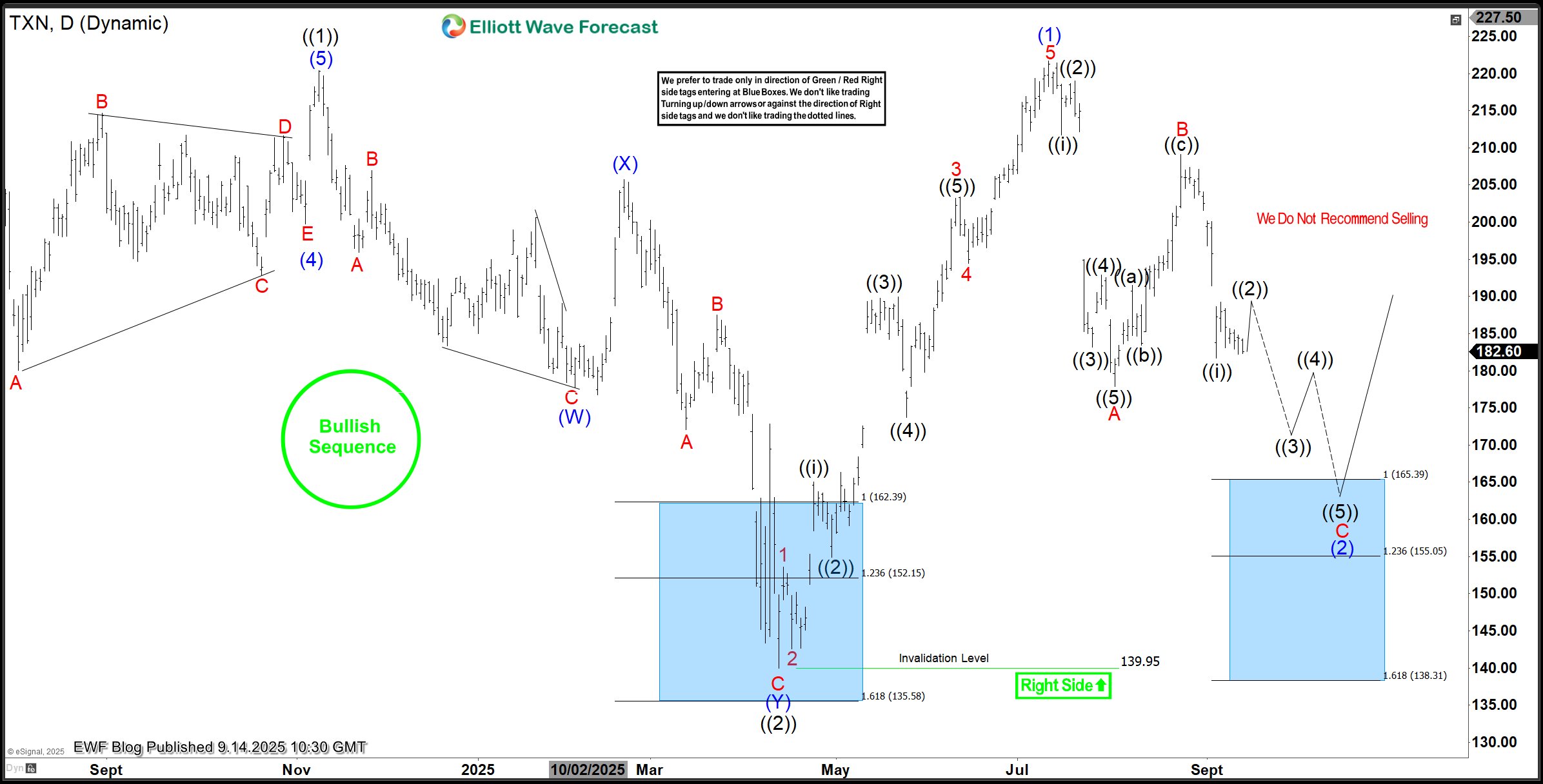
TXN completed a zigzag correction from the July 2025 high, finishing right inside the blue-box support area where new buying interest emerged. The stock has since launched into a strong rally from that zone, putting buyers solidly in profit.

Texas Instruments (TXN) is a global semiconductor company known for designing and manufacturing analog and embedded processing chips. With products used in everything from industrial equipment to personal electronics, TXN plays a critical role in powering modern technology. Its consistent innovation and strong market presence make it a closely watched stock in the tech sector.

TXN completed its long-term grand supercycle wave ((II)) in October 2002, bottoming near $13. From there, the stock launched into a powerful two-decade advance as grand supercycle wave ((III)) unfolded. Wave (I) of ((III)) peaked in August 2007 at $39.6, followed by a deep wave (II) correction that pulled prices back to around $13.4 in December 2008.

The next major advance—wave (III)—began in December 2008. TXN turned decisively bullish once it broke above its March 2000 all-time high at $99.8, eventually reaching a new peak at $202.2 in October 2021. This high completed wave III of (III) of ((III)). A corrective wave IV followed, lasting until October 2023, after which the stock resumed its climb and posted a fresh high of $220.38 in November 2024.

From the November 2024 peak, TXN pulled back in a 7-swing sequence to complete wave ((2)). That correction ended in the blue-box support area, where buyers stepped back in as anticipated. The stock then rallied sharply in a clean 5-wave advance, completing wave (1) of ((3)) on July 11, 2025.

A wave (2) pullback followed: wave A bottomed on August 1, 2025, wave B peaked on August 22, 2025, and in the September 1, 2025 update, the chart highlighted expectations for wave C to continue lower.

TXN

TXN Elliott Wave Analysis – 9/14/2025

On 14th September, I shared another updated blog showing how wave C of (2) was evolving. Thus, I marked the 165.39-138.31 as the blue box buying zone. At this zone, buyers should revive their interests.

TXN

For those who read the last blog, the plan was to buy at 165.39 and set stop at 138.3 while anticipating profits above $220.

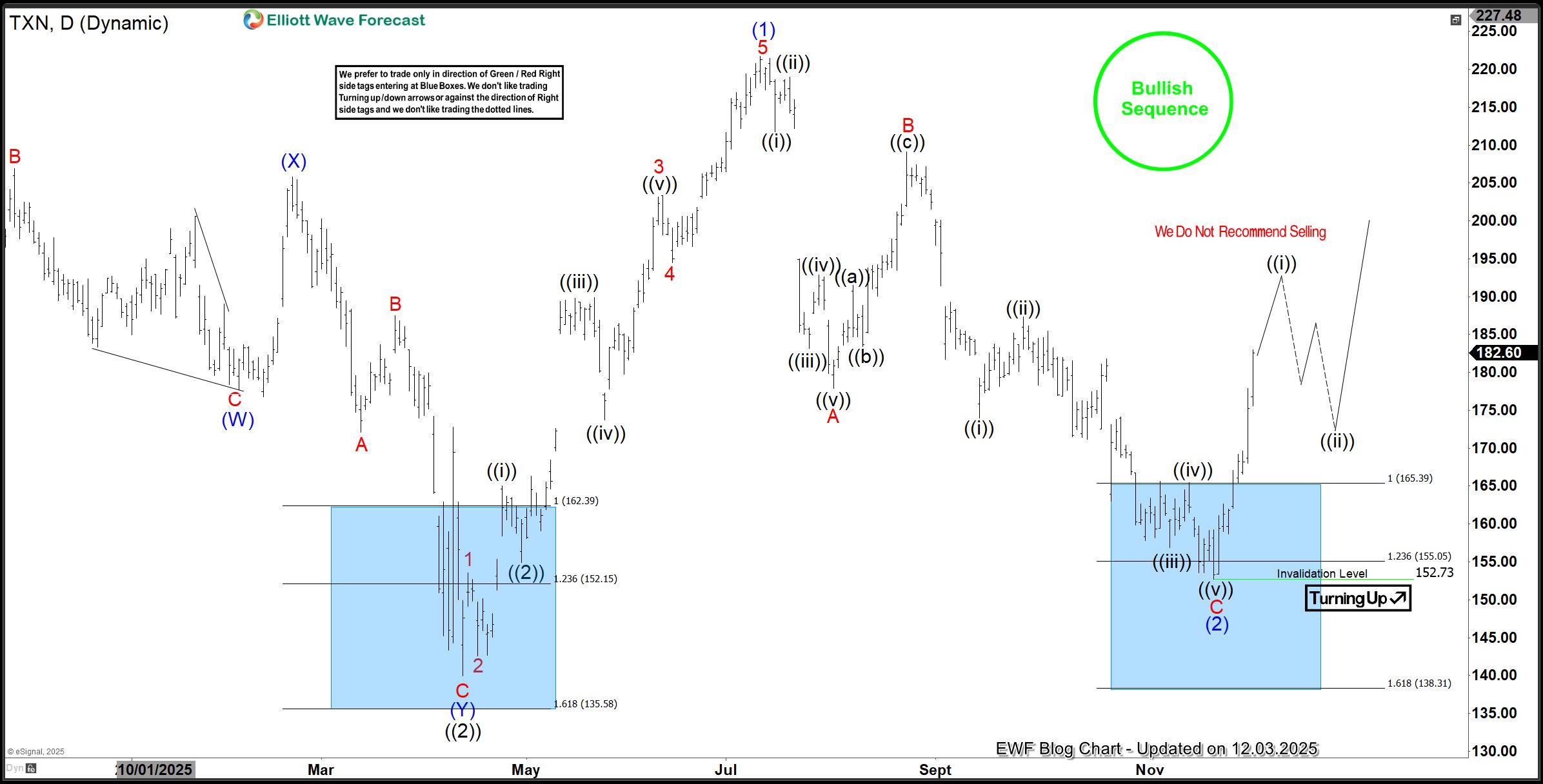
TXN Elliott Wave Analysis - 12.03.2025 Update

TXN

As the chart above shows, wave C of (2) dropped directly into the blue-box support area and completed a full 5-wave decline. This confirmed the end of wave (2), which then produced the expected rebound. With price already reaching the initial target at 180.8, buyers should take partial profits and move the stop for the remaining position to 152.73. This locks in gains and converts the trade into a risk-free setup. Looking ahead, projections suggest wave (3) could extend toward the 253–284 area, with potential for even higher levels.

Source: https://elliottwave-forecast.com/stock-market/txn-rebounds-strongly-off-blue-box/
 
Hello traders. As our members know we have had many profitable trading setups recently. In this technical article, we are going to talk about another Elliott Wave trading setup we got in Invesco NASDAQ ETF. Recently the ETF made a clear three-wave correction. The pull back completed as Elliott Wave Double Three pattern and made a decent rally. In this discussion, we’ll break down the Elliott Wave pattern and present targets. Let’s start by explaining the pattern.

Elliott Wave Double Three Pattern

Double three is the common pattern in the market. It’s a reliable pattern which is giving us good trading entries with clearly defined invalidation levels.
The picture below presents what Elliott Wave Double Three pattern looks like. It has (W),(X),(Y) labeling and 3,3,3 inner structure, which means all of these 3 legs are corrective sequences. Each (W) and (Y) are made of 3 swings , they’re having A,B,C structure in lower degree, or alternatively they can have W,X,Y labeling.

AUDJPYNow, let’s look at how this pattern appears in a real market example.

QQQ Elliott Wave 4 Hour Chart 11.18.2025​

The ETF is forming a 3-wave pullback, unfolding as a Double Three pattern. At the moment, we can see incomplete sequences in both cycles: from the main peak on October 29th, labeled as wave (3) blue, and from the smaller cycle starting on November 12th, labeled as X red. Our members know that we constantly emphasize the importance of incomplete sequences, as these determine the market’s path.
The structure suggests more weakness toward the Equal Legs area at 586.28–561.62, where we are looking to re-enter as buyers. We expect at least a three-wave bounce from the Blue Box area. Once the price reaches the 50% Fibonacci retracement against the red X connector, we will make the position risk-free by moving the stop loss to breakeven and booking partial profits.

Did you know ? 90% of traders fail because they don’t understand market patterns. Are you in the top 10%? Test yourself with this advanced Elliott Wave Test

Official trading strategy on How to trade 3, 7, or 11 swing and equal leg is explained in details in Educational Video, available for members viewing inside the membership area.

QQQ

QQQ Elliott Wave 4 Hour Chart 11.26.2025​

QQQ found buyers as expected at the Blue Box area, making decent bounce. While above the last low 580.31 low we count (4) blue correction completed. Wave (5 ) can be in progress toward new highs, targeting 652.32 area.

Reminder for members: Our chat rooms in the membership area are available 24 hours a day, providing expert insights on market trends and Elliott Wave analysis. Don’t hesitate to reach out with any questions about the market, Elliott Wave patterns, or technical analysis. We’re here to help.


Source: https://elliottwave-forecast.com/stock-market/qqq-trading-setup-explained/
 
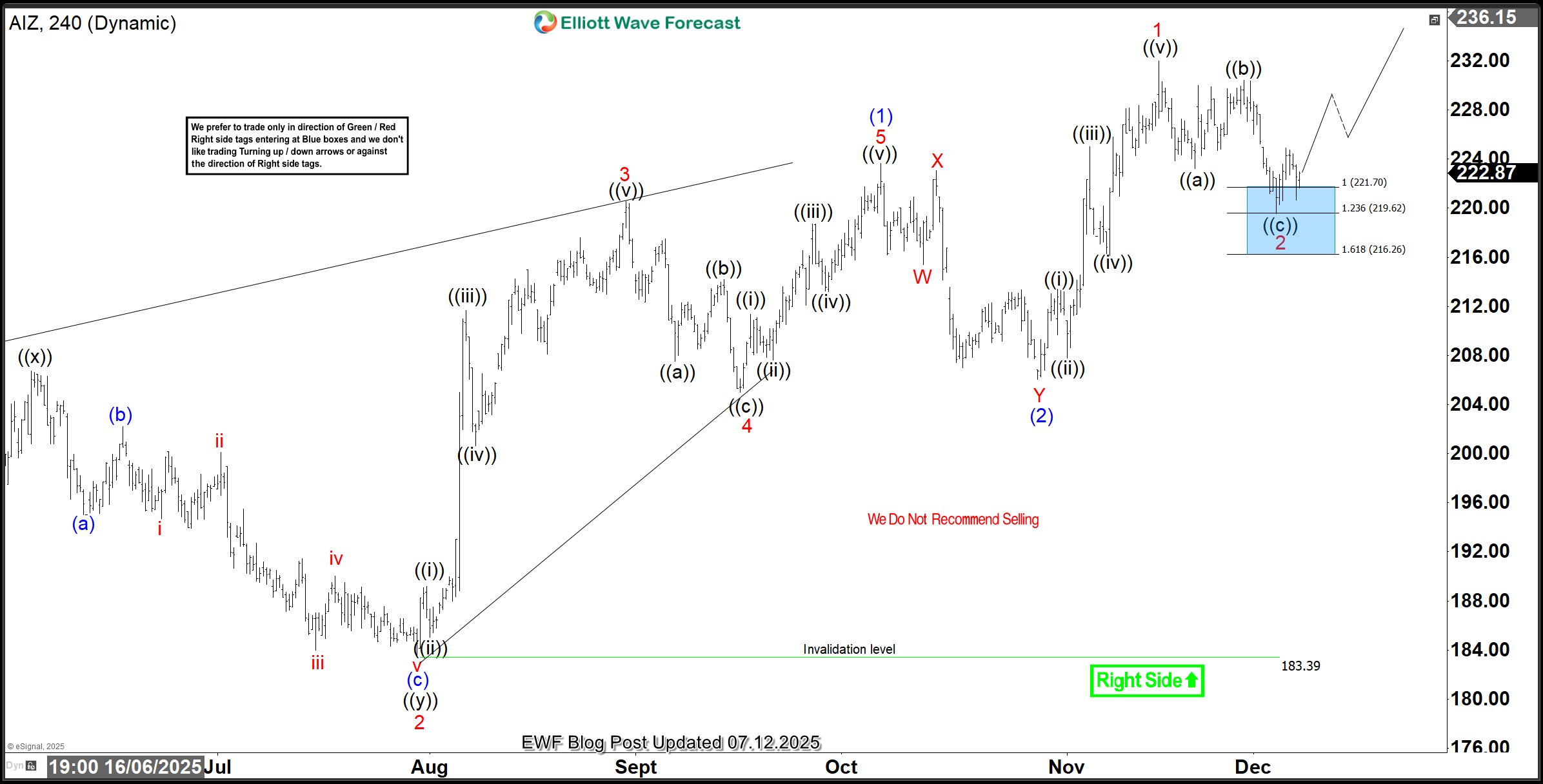
AIZ maintains the bullish sequence from the March 2020 low. In November, the stock broke a key resistance level and set up new opportunities for buyers from the dip targeting $250 next. This blog post explains the overall view and where buyers could find new entries.

Assurant Inc. (NYSE: AIZ) is a leading global provider of risk management and insurance solutions, serving the housing and lifestyle markets. Headquartered in Atlanta, it operates across Global Housing and Global Lifestyle segments, offering products such as mobile device protection, vehicle service contracts, and renters insurance. With operations in over 20 countries, Assurant partners with major financial institutions and retailers, leveraging data-driven innovation to deliver consistent growth and strong shareholder value.

The all-time bullish cycle for AIZ began in November 2008 at $12.52. From that low, wave (I) ended with an impulse in February 2020 at $146.21. Then, wave (II) pulled back sharply to $76.26 in March 2020. After that, wave (III) is expected to extend toward $287–$417.

Between March 2020 and April 2022, another impulse completed as wave I of (III). Next, wave II pulled back and finished in March 2023. Since the March 2023 low, a clean impulse has developed and pushed price into a new cycle high. The weekly chart from the 28 October update also highlights these sub-waves from the end of wave (II).

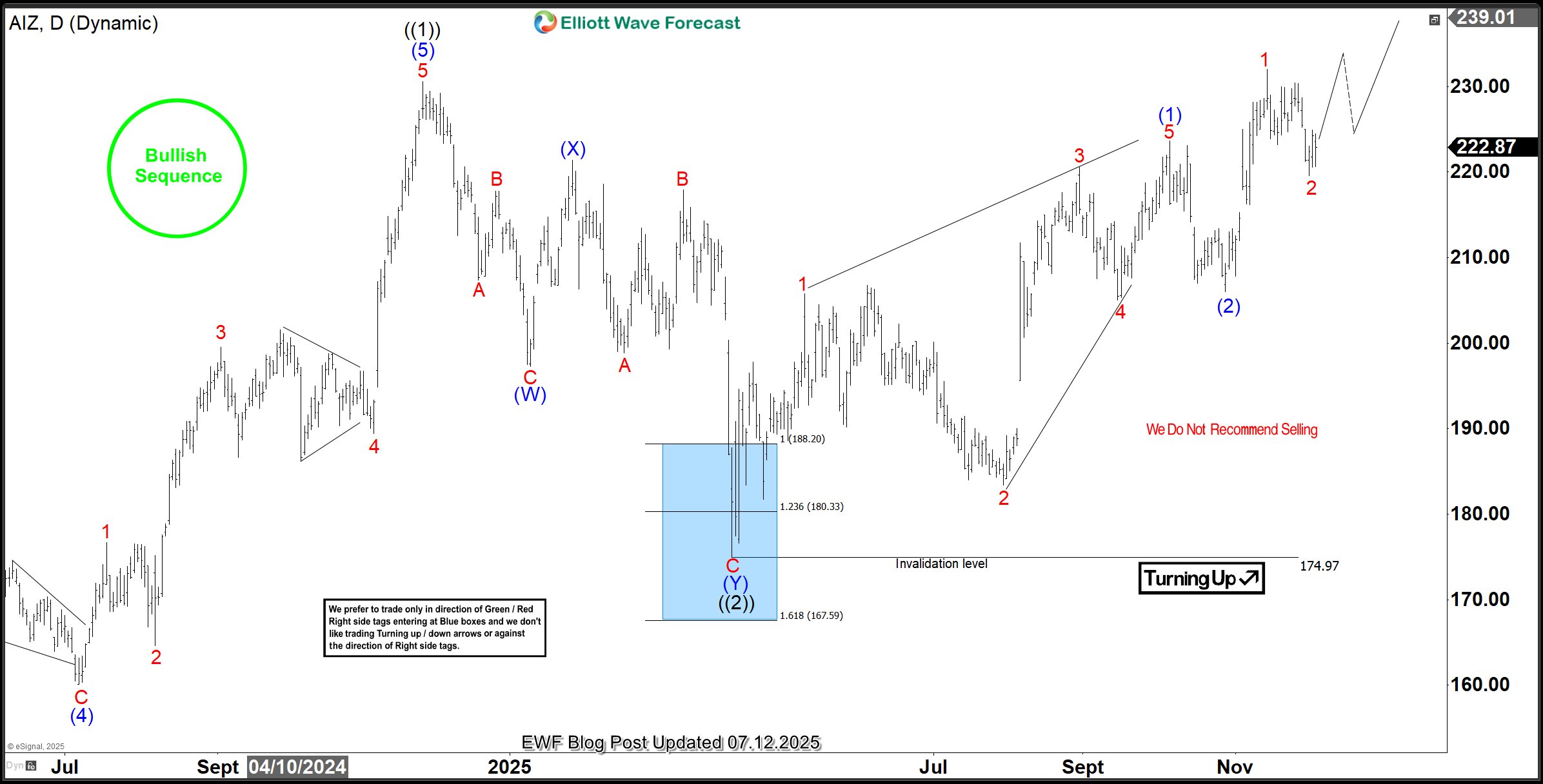
In that update, the weekly chart showed a completed impulse for wave ((1)) of III. Afterward, a 7-swing pullback formed wave ((2)) and found buyers in the blue box on the daily chart. With wave ((2)) complete, price extended again and broke above wave ((1)) high. As a result, wave ((3)) is now in progress and can target $330–$380 in the coming weeks or months.

AIZ Elliott Wave Analysis - Daily Chart

AIZ

The latest daily chart shows a nest of (1)-(2)-1-2. Price must stay above the 29 October 2025 low to extend higher. The top of wave 1 not only broke the 1) high, but also cleared the ((1)) top. Therefore, traders should buy dips from a 3-, 7-, or 11-swing extreme, as the H4 chart indicates.

AIZ Elliott Wave Analysis - H4 Chart


On the H4 chart, price corrected wave 1 in wave 2 with a 3-swing pullback. At the blue box zone of 221.7–216.26, the stock attracted fresh buyers. Price should reach at least 225, allowing traders to take partial profits and move stops to breakeven.

Looking ahead, price may complete a 5-wave advance to form wave 3. Alternatively, it may form a 3-swing bounce below the 13 November high and then drop into a 7-swing pullback for a deeper wave 2. In both scenarios, traders must stay ready. We always prepare members for such paths. As long as the stock holds its bullish sequence, it will keep attracting buyers from the blue box area.

Source: https://elliottwave-forecast.com/stock-market/aiz-short-term-trade-idea-targets-250/
 
McDonald’s (MCD) stock has faced short-term pressure, dropping about 2% recently, yet its fundamentals remain strong. The company continues to benefit from its global franchising model, which delivers high margins and stable cash flow. Moreover, analysts highlight that despite inflationary challenges, McDonald’s has maintained revenue growth and resilient consumer demand. Transitioning into the next quarter, investors should expect moderate volatility, as forecasts show the price fluctuating between $279 and $336 before stabilizing near $303. This range reflects both inflationary risks and the company’s ability to sustain profitability through menu innovation and operational efficiency.

Looking further ahead, Wall Street maintains a consensus “Hold” rating, with 11 analysts recommending “Buy” and 15 suggesting “Hold”. Importantly, the average price target of $324 implies a 4% upside from current levels, while long-term projections anticipate gradual growth into 2026 and beyond. Therefore, while short-term headwinds may limit sharp gains, McDonald’s remains positioned as a defensive stock in the consumer sector. Investors should watch for upcoming earnings reports and consumer spending trends, as these will likely determine whether MCD consolidates near $300 or begins a gradual climb toward its forecasted targets.

Elliott Wave Outlook: McDonald's MCD Weekly Chart July 2025

McDonald's MCD Weekly Chart July 2025

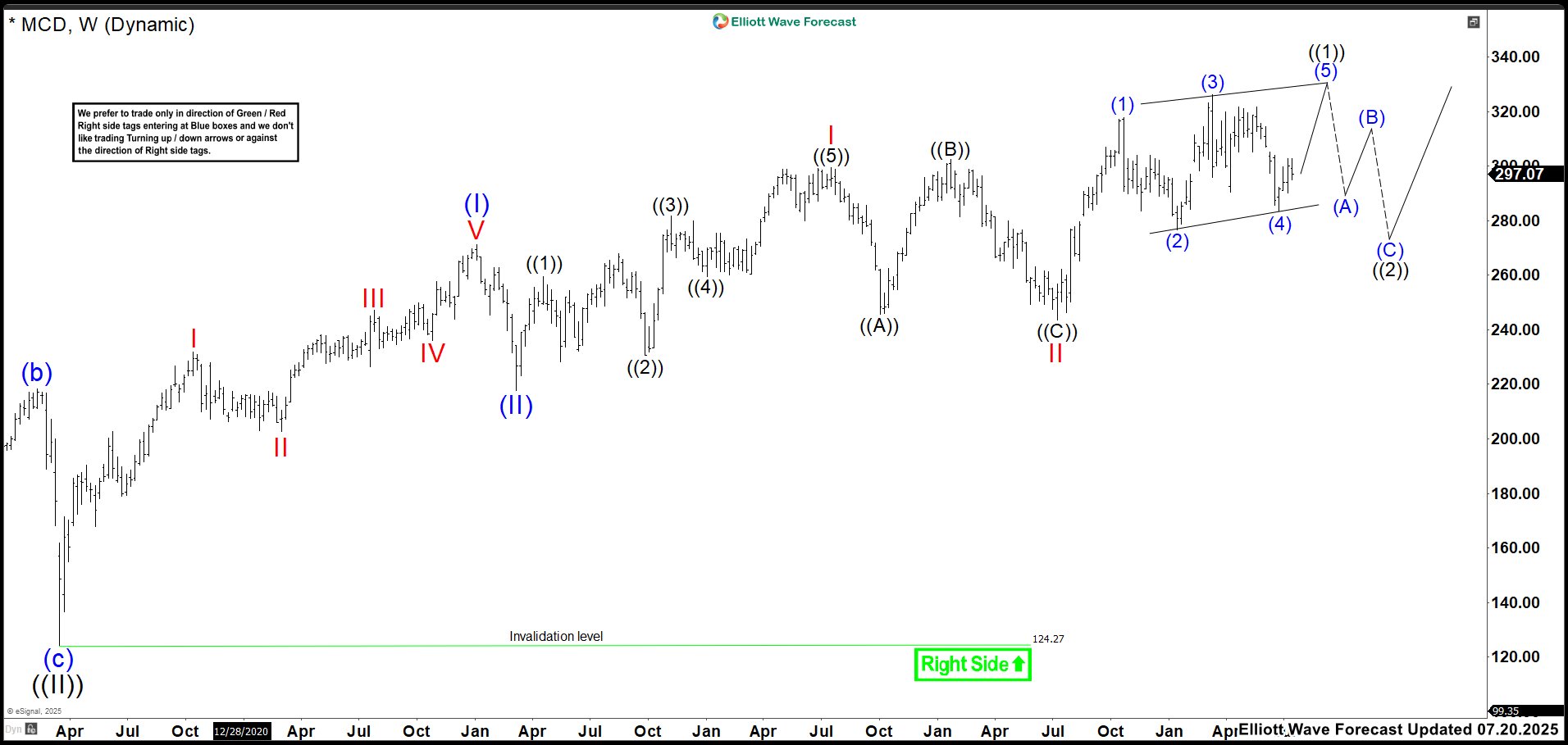
Last time, we noticed that wave (2) unfolded with far more duration than we had expected. At first, we leaned toward a strong bullish continuation, but as the structure matured, we chose to relabel it as a leading diagonal. That adjustment came after we recognized the Dow Jones was likely approaching the end of an impulsive move that had started back in April. With that in mind, we expected McDonald’s (MCD) to rally before giving way to a pullback.

As we mapped the diagonal, we marked wave (1) at the 317.84 high, correction wave (2) at the 276.63 low, the next leg at the 326.27 high, and wave (4) at the 283.47 low. To complete the pattern, we projected wave (5) to rise above wave (3) but remain capped beneath 333.27

If you’d like to deepen your understanding of Elliott Wave Theory, explore these resources: Elliott Wave Education and Elliott Wave Theory

Elliott Wave Outlook: McDonald's MCD Weekly Chart December 2025


After several months, price action has remained stable without any variation. Consequently, this stability may suggest that the market is forming either a triangle or a bullish nest. We will adopt the triangle scenario, since we still believe the markets are close to completing the April cycle. If this is the case, MCD would bring a correction represented on the chart as wave ((2)).

Meanwhile, because we are still looking one further high to complete wave ((1)), we expect the market to stay above 283.63 low. This level supports our primary idea of aiming for another high around 336.36. Finally, we look for a bearish reaction from the market, which would signal that wave ((1)) may have already ended and announce the beginning of a possible correction.

Source: https://elliottwave-forecast.com/stock-market/mcdonalds-mcd-lagging-burn-bounce-back/
 
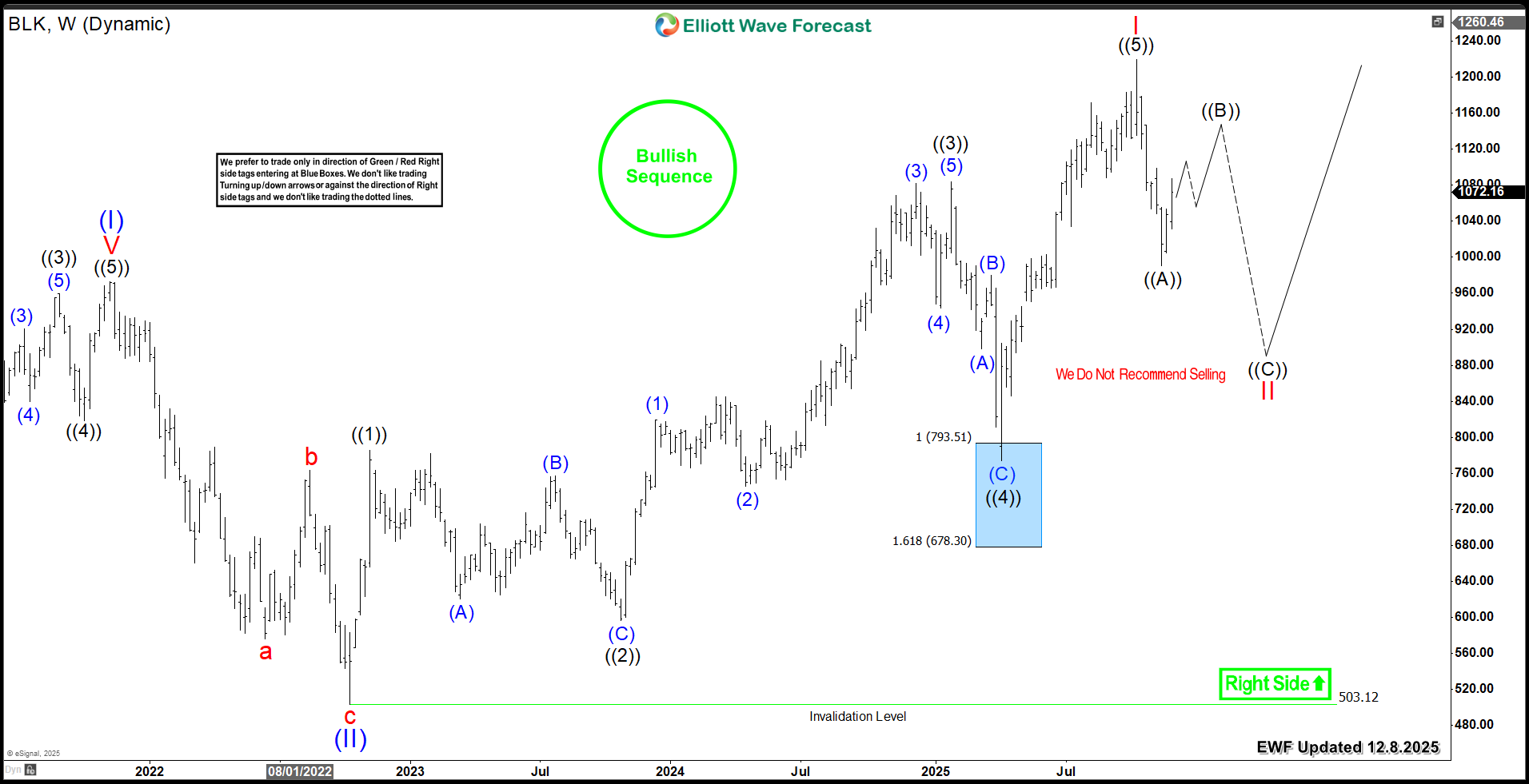
We previously mapped BlackRock's (NYSE: BLK) bullish weekly path earlier this year. Today, our analysis continues with the Elliott Wave structure behind its rally from the 2022 low. This update highlights the next high-probability buying opportunity emerging for the stock.

Elliott Wave Analysis

BlackRock
's April 2025 correction marked wave ((4)), finding support in the Blue Box area $793-$678 . The subsequent rally to new highs then completed wave ((5)). This suggests the cycle from the 2022 low is mature and likely finished.

Currently, BLK holds above the April low of $773. This does not rule out a nesting pattern, but a larger wave II correction may have already begun. Consequently, as long as price stays below the October high of $1219, the path favors another leg down next year.

This larger correction could push BLK below $1,000. The 38.2% - 50% Fibonacci retracement zone sits at $946 - $861. This area will provide a strategic, diamond-level opportunity to position for the next uptrend, with a longer-term target toward $1500.

BlackRock (BLK) Weekly Chart 12.8.2025


Conclusion​

BlackRock's larger-degree bullish cycle remains firmly intact. Therefore, investors should continue targeting buying opportunities within weekly and daily pullbacks. Utilize our Elliott Wave strategy for precise entry timing. Specifically, establish positions after a 3, 7, or 11-swing correction completes. Additionally, our proprietary Blue Box system highlights high-probability zones with pinpoint accuracy. As a result, this disciplined method gives traders the clarity and confidence to catch the next bullish leg.

Source: https://elliottwave-forecast.com/stock-market/blackrock-blk-buying-opportunity/
 
Vertiv Holdings Co., (VRT) is an American multinational provider of critical infrastructure & services for data centers, communication networks & commercial & industrial environments. It comes under Industrials sector & trades as “VRT” ticket for NYSE.

VRT favors bullish sequence in weekly & expects push higher against 11.21.2025 low. It favors rally between $215.3 – $232.75 area within April-2025 sequence.

VRT - Elliott Wave Latest Daily View:​

In weekly, it ended (I) impulse sequence at $155.84 high in January-2025 & (II) at $53.60 low in April-2025. Above there, it favors rally in I of (III) & expect another push higher against 11.21.2025 low. Within I, it placed ((1)) at $153.50 high, ((2)) at $118.70 low, ((3)) at $202.45 high, ((4)) at $149.11 low & favors upside in ((5)). The structure is overlapping & expect final push higher to end the structure in diagonal as I, if the high comes with momentum divergence. But if it erase the divergence, it can be nesting as alternate view. Within ((1)), it placed (1) at $70.35 high, (2) at $60.67 low, (3) at $133.52 high, (4) at $119.10 low & (5) at $153.50 high.

VRT - Elliott Wave Daily View From 8.11.2025:​

The ((2)) was corrected in 3 swings at 0.382 Fibonacci retracement of ((1)). Within ((3)), it ended (1) at $152.45 high, (2) at $133.85 low, (3) at $184.44 high, (4) at $162.68 low & (5) at $202.45 high as ((3)). It ended ((4)) as 3 swings pullback as 0.618 Fibonacci retracement, overlapped with ((1)). Above there, it appears ended (1) at 189.66 high & expect pullback in (2), which should hold above 11.21.2025 low to continue rally in (3). It favors rally into $215.3 – $232.75 area, which confirm above 10.30.2025 high. We like to buy the pullback in (2) in 3, 7 or 11 swings at extreme area. Better opportunity will be II correction to buy at extreme area against April-2025 low.

Source: https://elliottwave-forecast.com/stock-market/vertiv-holdings-vrt-eyes-new-high-215-3-232-75/
 

A detailed weekly Elliott Wave analysis of IndiGo highlighting the Wave IV blue-box zone, right-side bullish outlook, and long-term upside potential.​

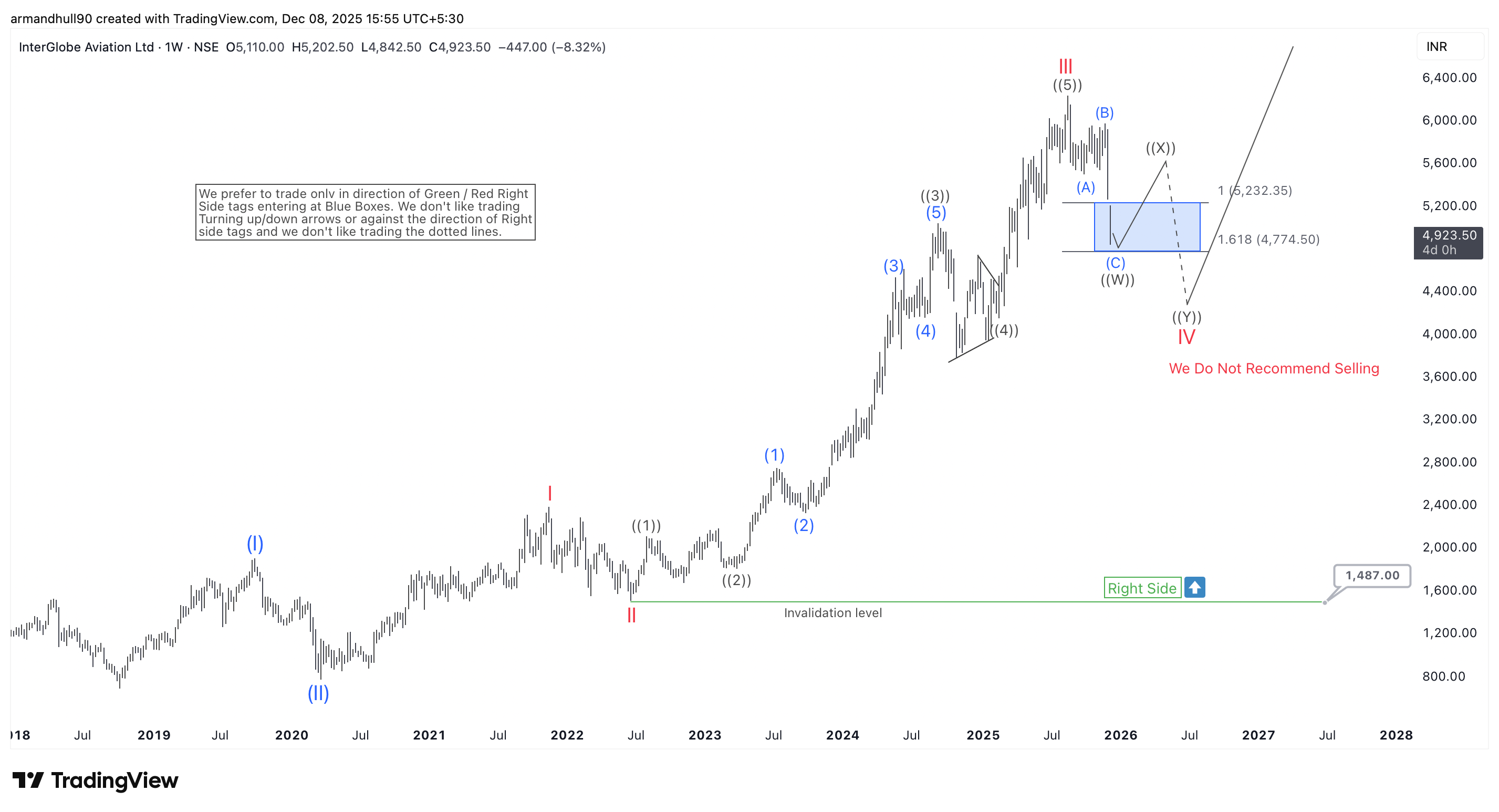
InterGlobe Aviation Ltd (NSE: INDIGO) remains in a strong long-term uptrend. The weekly chart shows a clean Elliott Wave structure that supports this view. The stock recently completed a higher-degree Wave III near the ₹6,000 area. After this peak, the price started a Wave IV correction. This pullback is normal within a larger bullish cycle.

The long-term rally began after Wave II finished in 2020. Since then, IndiGo moved higher in a strong impulsive structure. This move created a clear five-wave advance into Wave III. The current decline is part of Wave IV and is likely forming a double correction.


Wave IV Blue Box and Trading Strategy

The chart highlights a blue box support zone between ₹4,774 and ₹5,232. This area comes from the 1.0 and 1.618 Fibonacci extensions of the internal (A)-(B)-(C) pattern. The market often reacts from such zones. Buyers may step in here to continue the main trend. At the very least, a three-swing bounce is expected. The stock may then continue lower again to complete a full ((W))-((X))-((Y)) structure inside Wave IV.

We do not recommend selling here. The Right Side Tag favors buying, not selling. It signals that the dominant direction is still up. The invalidation level sits near ₹1,487. As long as prices stay above this level, the bullish outlook remains intact.

Wave IV should end once the market completes its swings. After that, Wave V can begin. Wave V may push the stock to new all-time highs. The projected path shows a strong advance that continues the long-term growth trend of IndiGo.

Conclusion:

InterGlobe Aviation still holds a bullish structure despite the current correction. The decline into the blue box is a normal part of the Elliott Wave cycle. It also creates a long-term buying opportunity for investors who follow the dominant trend. With Wave IV close to completion, the next major rally in Wave V may offer strong upside potential.

Source: https://elliottwave-forecast.com/stock-market/indigo-finished-pullback-wave-v-rally-next/
 
Platinum (PL) has developed a strong five‑wave nesting impulse from the March 2020 low, reinforcing the view that the right side of the market remains higher. In this article, we present the latest long‑term Elliott Wave outlook.

Platinum (PL) Monthly Elliott Wave Chart​


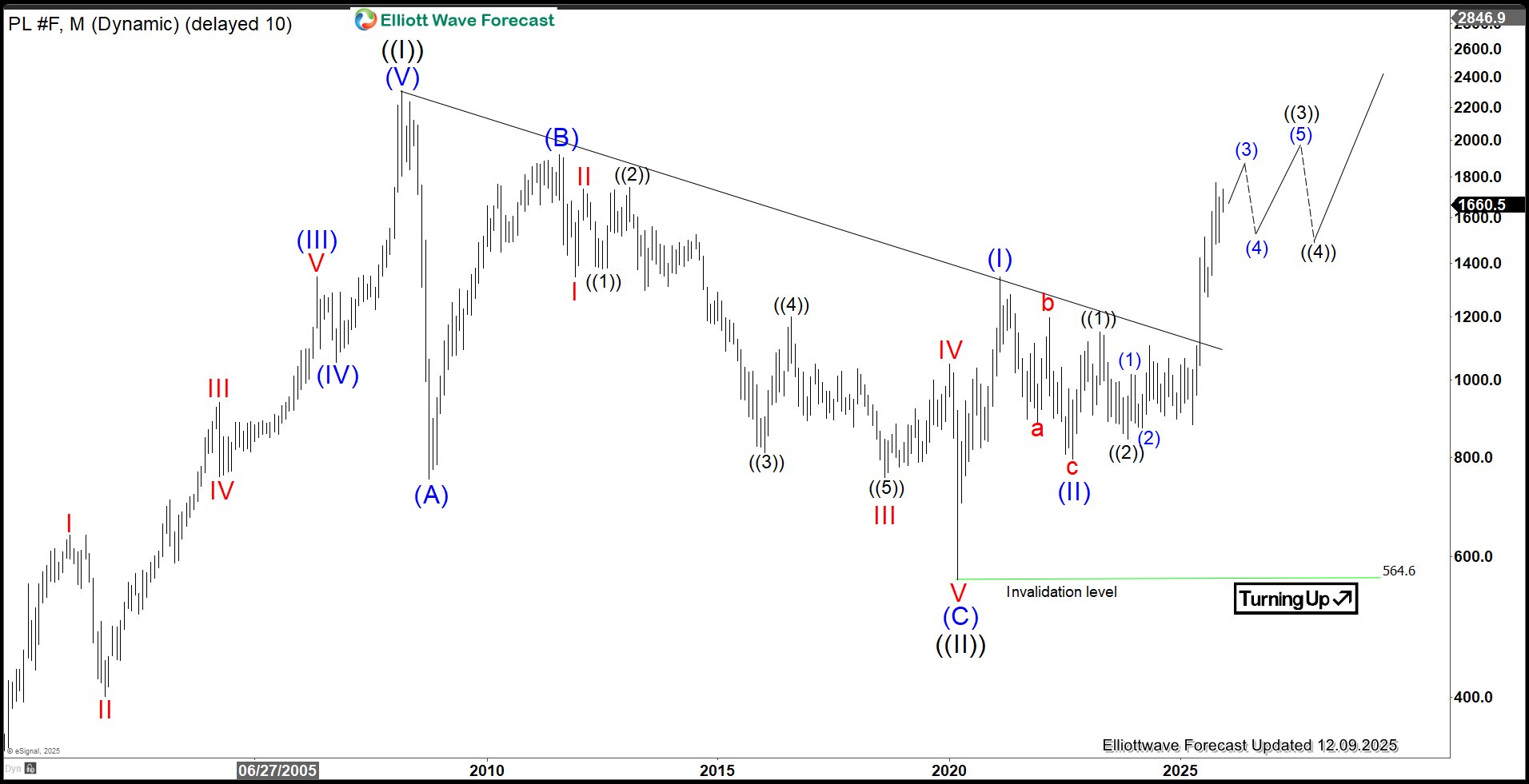
The monthly Platinum chart highlights a strong nesting impulse that began after the March 2020 low at 564.6. We have identified this low as wave ((II)) of the Grand Super Cycle. From that point, the metal resumed its advance in wave ((III)). Within this structure, wave (I) of ((III)) completed at 1348.2, followed by a corrective pullback in wave (II) that ended at 796.8. Platinum then began nesting higher within wave (III), which is expected to unfold through a sequence of fourth and fifth waves before completion. As long as price remains above 564.6, the broader outlook continues to favor further upside.

Platinum (PL) Daily Elliott Wave Chart​


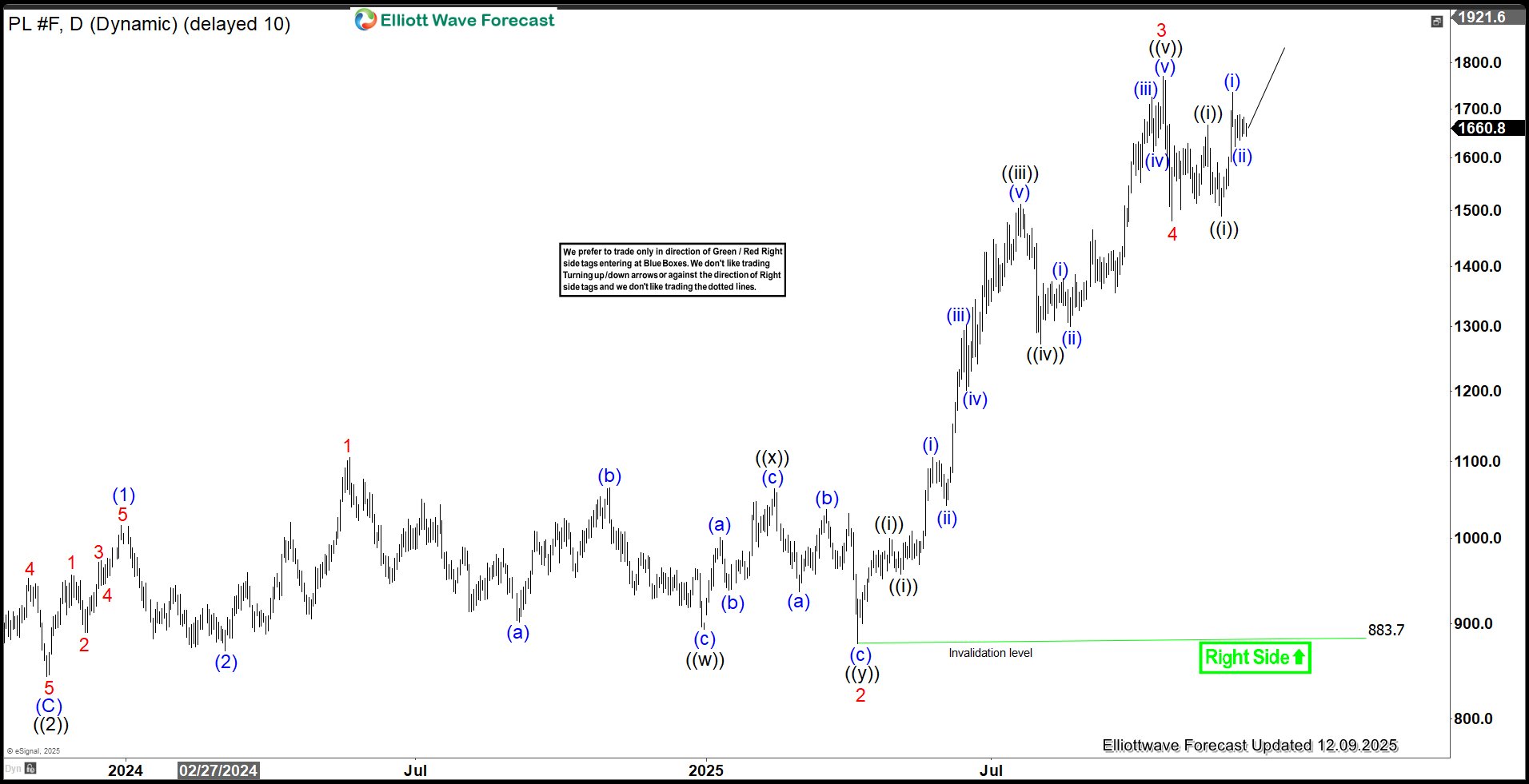
The daily Platinum chart indicates that the wave ((2)) pullback concluded at 843.1. From this low, the metal began nesting higher. Wave (1) completed at 1105 and the subsequent wave (2) pullback ended at 883.7. The advance continued with wave (3) reaching 1770. A corrective wave (4) followed which settled at 1481.2. In the near term, as long as price action holds above 883.7, any pullback should find support within a 3, 7, or 11-swing sequence, setting the stage for further upside.

Source: https://elliottwave-forecast.com/commodities/strong-nesting-impulse-drives-platinum-pl-higher/
 
Hello everyone! In today’s article, we’ll examine the recent performance of Russell 2000 ETF ($IWM) through the lens of Elliott Wave Theory. We’ll review how the powerful rally from the November 2025 low unfolded as a textbook 5-wave impulse and discuss our evolving forecast for the next move. Let’s dive into the structure and expectations for this tech giant.

5 Wave Impulse + 7 Swing WXY correction​

$IWM 4H Elliott Wave Chart 11.18.2025:​

$IWM

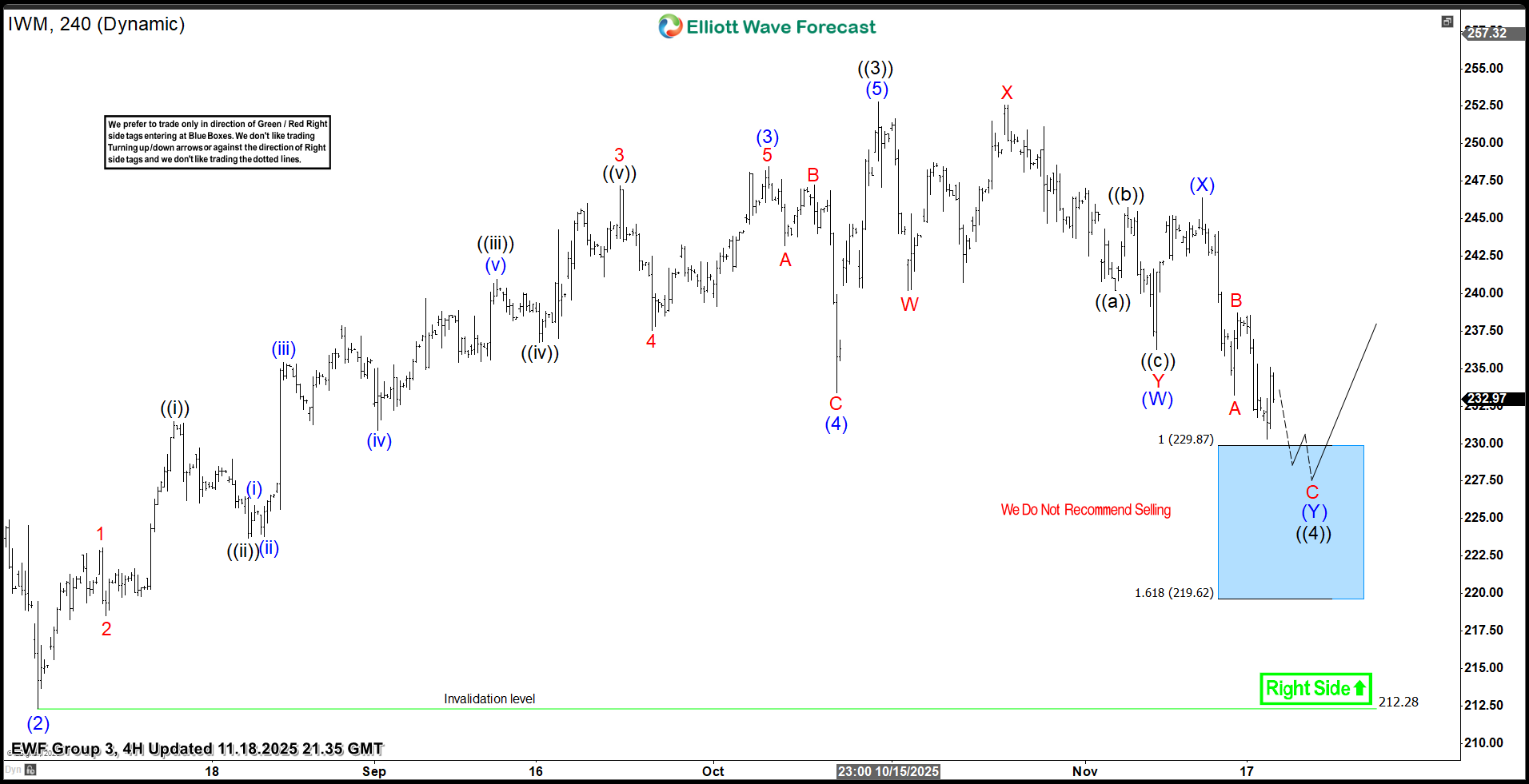
In the 4-hour Elliott Wave count from Nov 18, 2025, we saw that $IWM completed a 5-wave impulsive cycle at black ((3)). As expected, this initial wave prompted a pullback. We anticipated this pullback to unfold in 7 swings, likely finding buyers in the blue box equal legs area between $229.87 and $219.62.

$IWM 4H Elliott Wave Chart 12.08.2025:​

$IWM

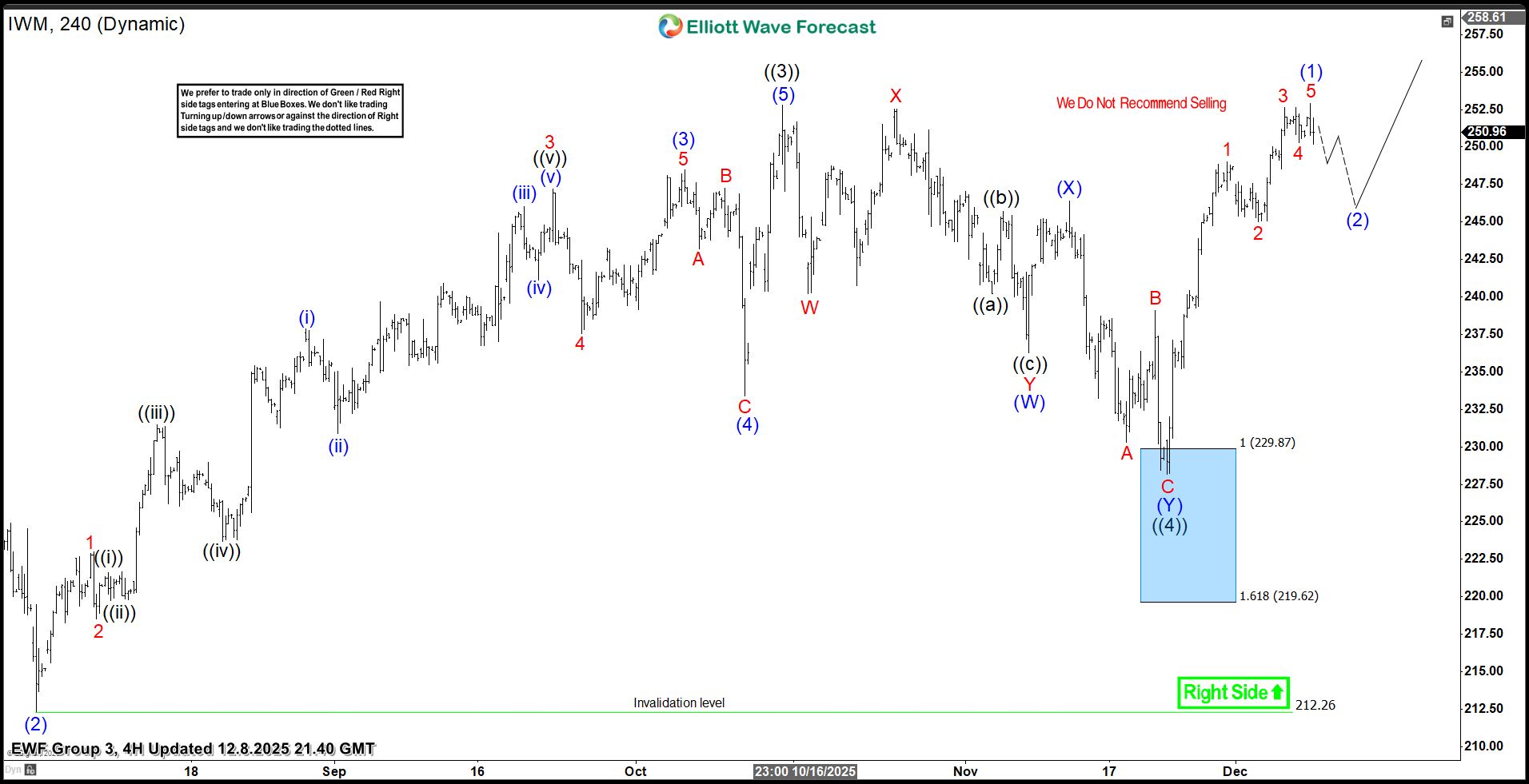
The latest update shows the strong reaction from the blue box area. The ETF was able to rally 11% and hit new all-time highs. Right now, the ETF is looking for a pullback to digest the recent gains and continue climbing. We think $IWM could reach $258–$268 next.

Conclusion

In conclusion, our Elliott Wave analysis of $IWM continues to prove accurate, suggesting that the ETF remains well-supported against its November 2025 lows. Therefore, for traders who capitalized on the entry opportunities presented in the “blue box” area, the $258–$268 zone should be closely monitored as the next significant objective. In the interim, keeping a vigilant eye out for any healthy corrective pullbacks could present fresh entry opportunities for those looking to join the trend.

Ultimately, by applying the principles of Elliott Wave Theory, traders can gain a deeper understanding of market cycles, better anticipate the structure of upcoming moves, and ultimately enhance their risk management strategies in dynamic markets like the current one for $IWM.

Source: https://elliottwave-forecast.com/st...oars-11-blue-box-area-258-target-still-ahead/