Elliott Wave Analysis by EWF

Introduction​

Hecla Mining Company (NYSE: HL) occupies a unique position within the global precious metals sector as the largest primary silver producer in the United States and Canada and a leading domestic producer of critical minerals. With more than 130 years of operating history, Hecla is the oldest precious metals mining company listed on the New York Stock Exchange in North America. Given its concentrated exposure to silver prices, Hecla functions as a leveraged equity proxy for movements in XAG/USD. Recent corrections in silver have weighed on the company’s valuation; however, when viewed through a long-term structural and Elliott Wave framework, these adjustments appear consistent with cyclical price behavior rather than indicative of deteriorating fundamentals. This analysis argues that Hecla is positioned within a powerful secular advance, supported by a developing Elliott Wave nesting structure that aligns with a broader bullish cycle in silver.

Silver Price Corrections and Equity Leverage​

As a primary silver producer, Hecla exhibits pronounced operating and earnings leverage to movements in silver prices. A significant portion of the company’s revenue and margin profile is directly linked to XAG/USD. This means that even modest declines in silver prices can disproportionately compress cash flow expectations and equity valuation multiples. Consequently, corrections in silver prices exert an outsized influence on Hecla’s share price, often amplifying downside moves during corrective phases.

Importantly, this dynamic also works in reverse. During sustained silver advances, primary producers such as Hecla historically outperform the underlying commodity. This is due to expanding margins, improving free cash flow, and re-rating of valuation multiples. Recent weakness in HL shares therefore appears to reflect a cyclical adjustment tied to silver’s consolidation rather than a structural impairment of the business. This sets the stage for asymmetric upside should silver resume its long-term advance.

Elliott Wave Framework and the Significance of the 2000 Low​

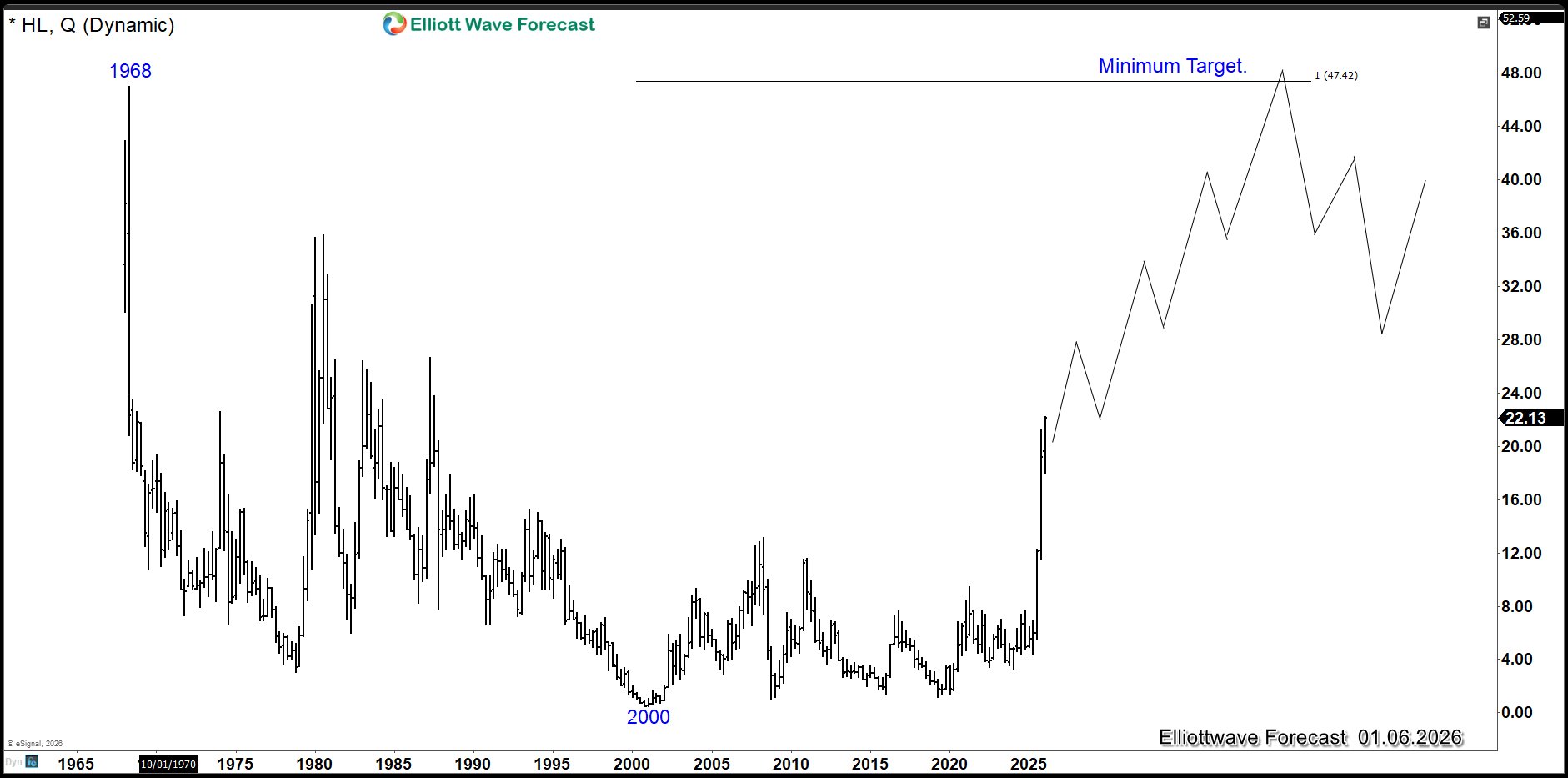
From an Elliott Wave perspective, the year 2000 represents a critical inflection point for Hecla. The lows established during this period marked the end of a prolonged secular bear market and the beginning of a new Grand Super Cycle advance. Despite intermittent volatility and deep corrections since that time, price action has continued to respect higher-degree structural lows, reinforcing the interpretation of a long-term bullish trend.

Hecla remains well below its historical peaks from 1968, underscoring the significance of the 2000 low as a foundational base rather than a terminal high. This long-term underperformance relative to silver further suggests that HL is still in the earlier stages of its secular advance, with substantial upside potential remaining as the cycle matures.

Nesting Structure and Wave (III) Implications​

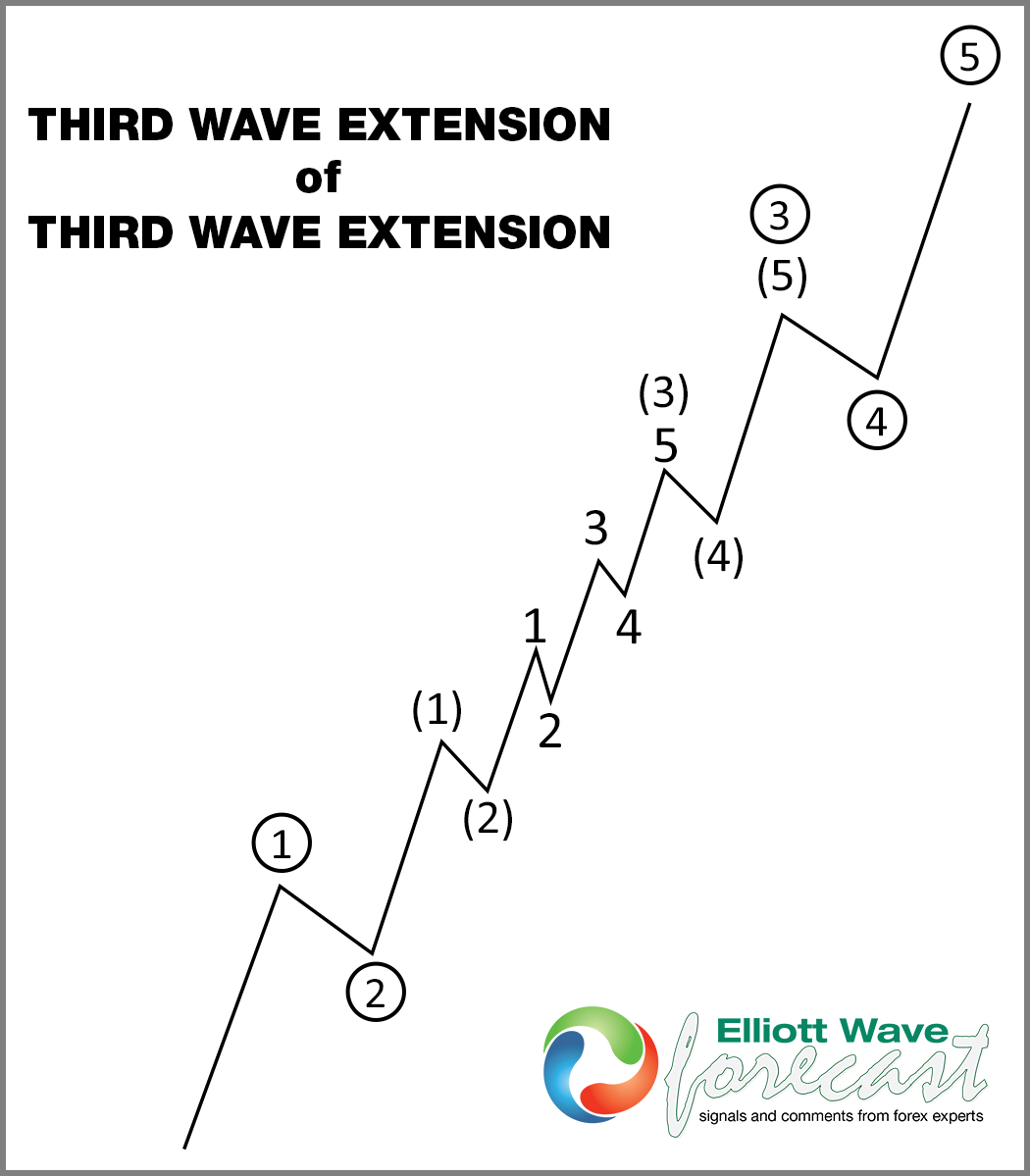
A defining feature of the current Elliott Wave structure in Hecla is the presence of a developing nest. In Elliott Wave Theory, a nest consists of a series of overlapping five-wave advances that form prior to a powerful acceleration into wave (III). These structures reflect persistent accumulation, shallow corrective pullbacks, and increasing momentum. This signals that the market is building energy rather than exhausting a trend.

Here is how a nest looks like in the Elliott Wave Theory:
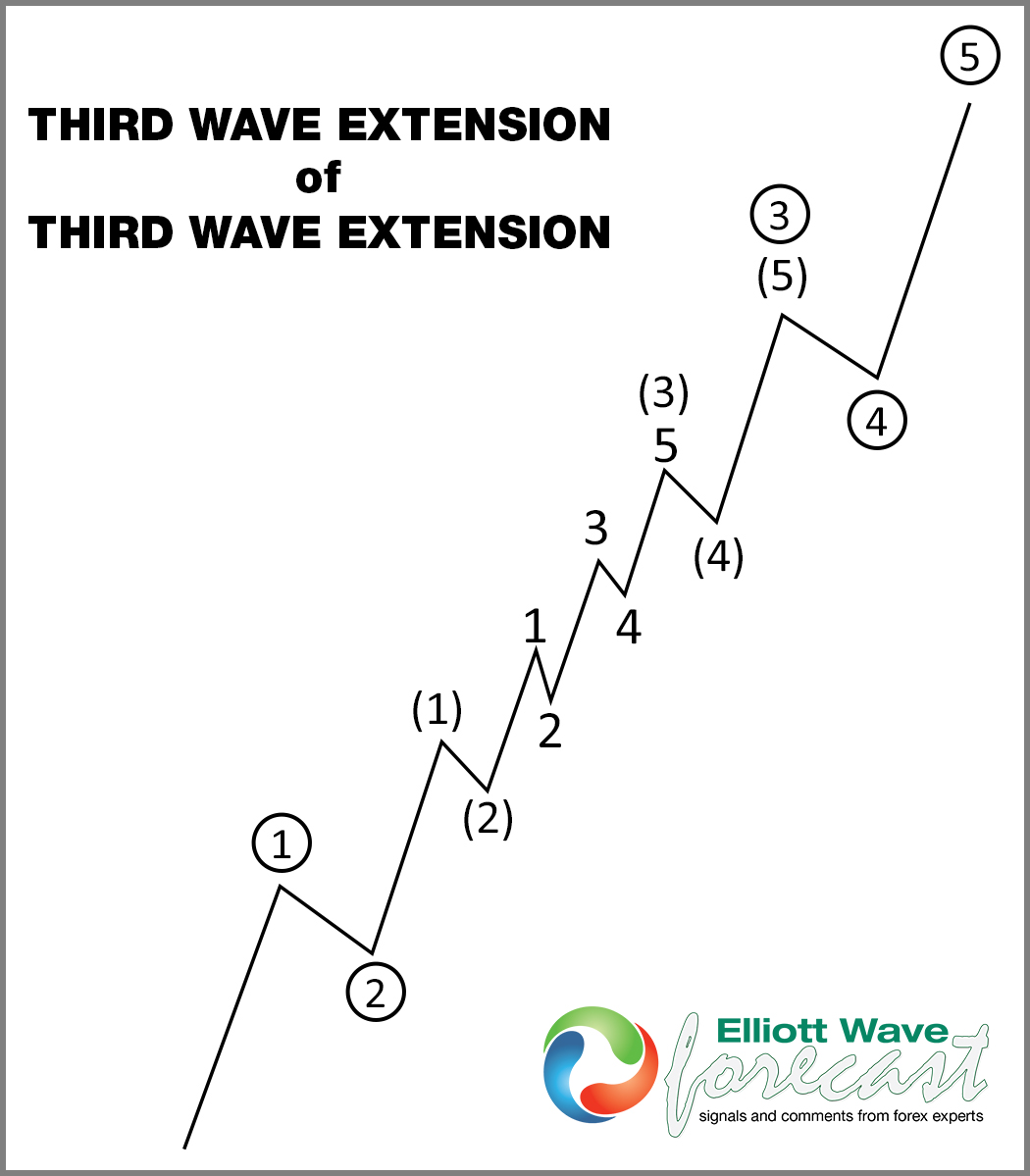


Price action in HL since October 2000 closely mirrors the characteristics of a textbook nesting pattern. Multiple impulsive advances have unfolded without violating key structural support levels. Each correction has served to reset momentum rather than reverse the trend. This configuration strongly supports the interpretation that Hecla is preparing for a major wave (III) advance within the larger Grand Super Cycle. Here is HL nest with labels pointing higher in wave ((3)).
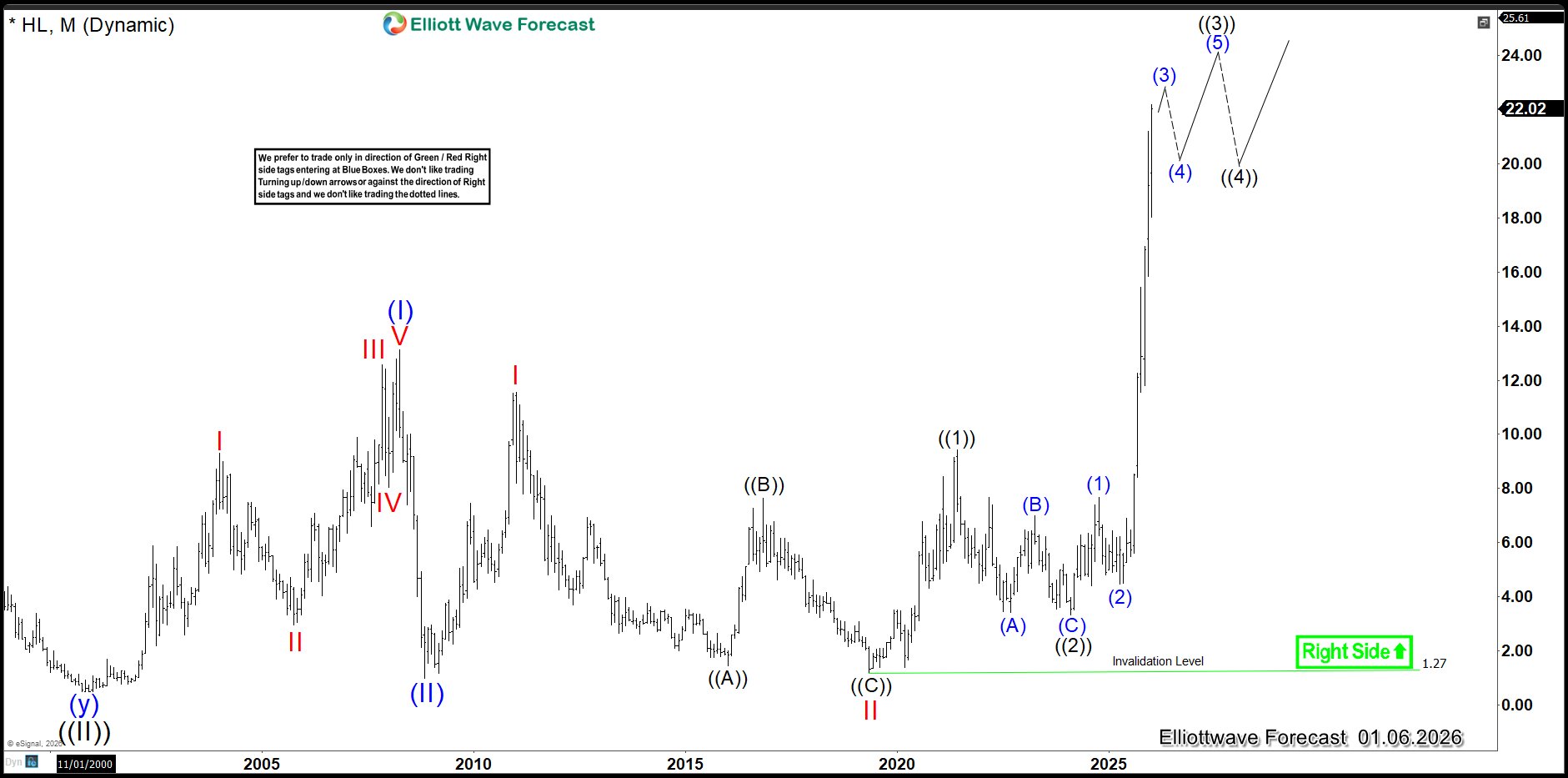


Under this framework, the $47.36 level represents a minimum technical target associated with the completion of three major waves from the secular low. Reaching this level would still not constitute a completed cycle, but rather confirm the strength of the underlying impulsive phase.

Correlation Between HL and Silver​

While the Elliott Wave structures of Hecla and silver differ in form due to the inherent distinctions between equity and commodity markets, their directional alignment remains clear. Long-term charts demonstrate a strong correlation between HL and XAG/USD, particularly during impulsive phases of the silver cycle. Historically, silver tends to lead, with primary producers lagging initially before delivering leveraged performance as the trend strengthens.

Here is HL and Silver in the same chart:
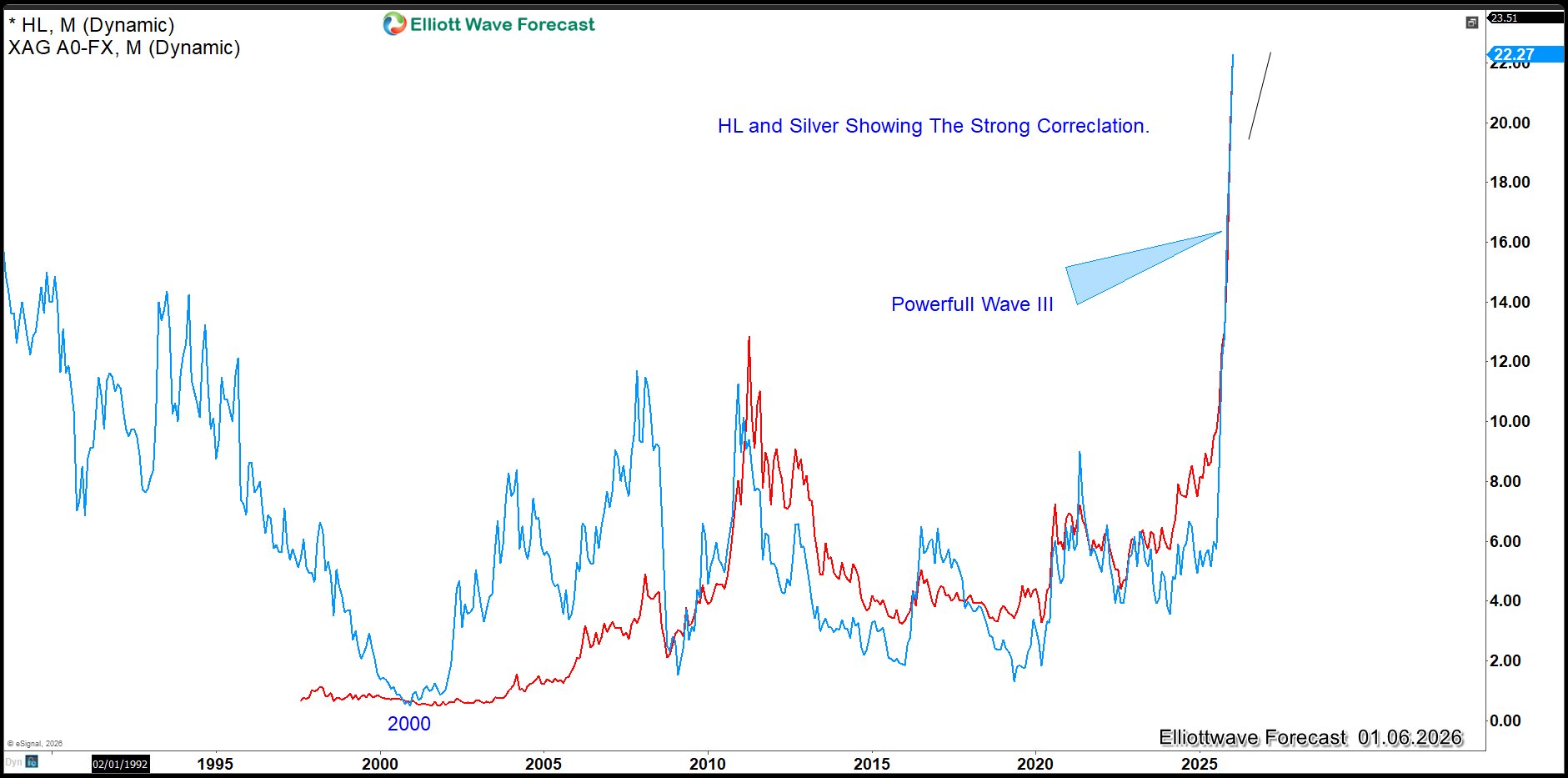


This relationship is evident in the current cycle. Silver has advanced more decisively, while HL remains in a catch-up phase. This reinforces the view that Hecla is positioned for an accelerated move as wave (III) unfolds. At the point HL reaches the $47.36 target, silver is projected to trade within the $91.40–$100.00 range. At this time, both instruments would have completed three waves from their respective all-time lows.

Longer-Term Outlook: Waves ((4)) and ((5))​

Within Elliott Wave methodology, the completion of three waves does not mark the end of a trend. Instead, it implies that a corrective wave ((4)) and a final impulsive wave ((5)) remain ahead within the same Grand Super Cycle. Following the anticipated wave (III) advance, a sizable corrective phase is expected to unfold. Afterwards, the final wave ((5)) could drive Hecla into the $60.00–$65.00 range. Under the same framework, silver could ultimately advance toward the $150.00 level.

These projections highlight the multi-decade nature of the cycle. It reinforces the importance of distinguishing between corrective volatility and structural trend reversals.

Conclusion​

Hecla Mining Company represents a leveraged equity exposure to silver within a clearly defined long-term bullish framework. Recent valuation compression reflects cyclical silver price corrections rather than a breakdown in fundamentals. From an Elliott Wave perspective, both HL and XAG/USD appear to be aligned within a powerful Grand Super Cycle advance. Hecla is developing a nesting structure that often precedes explosive wave (III) behavior.

While trading and timing remain inherently challenging, the integration of Elliott Wave analysis, corrective structures, and intermarket correlation provides a disciplined framework for navigating volatility. With time still mid-cycle, the broader path and long-term targets for both Hecla and silver remain clearly defined. It positions HL as a compelling vehicle for participation in a potentially historic silver advance.

Source: https://elliottwave-forecast.com/stock-market/hecla-mining-hl-and-the-150-silver-thesis/
 
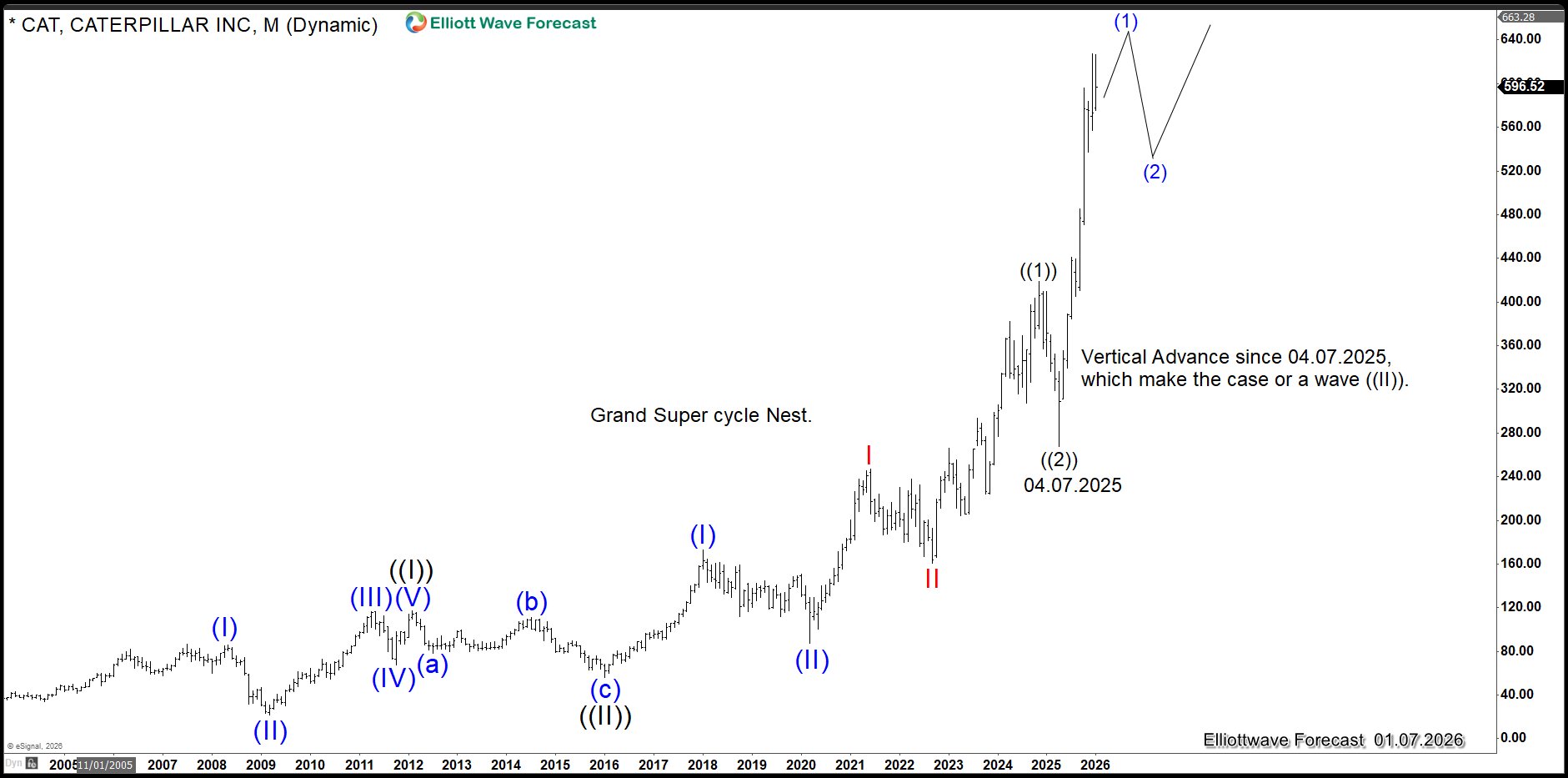
As a bellwether industrial stock, Caterpillar often reflects the underlying strength of the economy and signals long-term market positioning. Its price behavior tends to lead broader market trends, offering insight into structural phases rather than short-term fluctuations. Viewed through this lens, $CAT’s current action suggests stability and leadership, supporting the idea that the $SPX is not topping but instead forming a durable base for a higher long-term move.

Within our Elliott Wave Theory framework, Caterpillar ($CAT) is entering, or may already be within wave ((II)). Wave ((III)) is historically recognized for its strength and vertical price action, occurring when market participants broadly align on one side of the market. Pullbacks in this phase are often regarded as profit-taking rather than genuine reversals. In our system, the most powerful wave ((III)) advances frequently begin after a sequence of smaller-degree 1–2 formations, a structure we call a nest.

Here is a nest in the Elliott Wave Theory:


A nest is a complex arrangement that often confuses traders. It can appear to complete a five-wave move, leading many to expect a correction, when in fact it represents higher-degree setups preparing the market for extension. Caterpillar is currently nesting within the Grand Super Cycle and continues to show strong upside momentum. Since 04.07.2025, the stock has moved vertically, suggesting either that wave ((3)) is already underway or that another nest in wave (1) is forming ahead of wave ((3)). In either case, the message is clear: Caterpillar remains very bullish, with upside targets in the $800–$900 region.

Monthly Elliott Wave Chart of Caterpillar (CAT)​


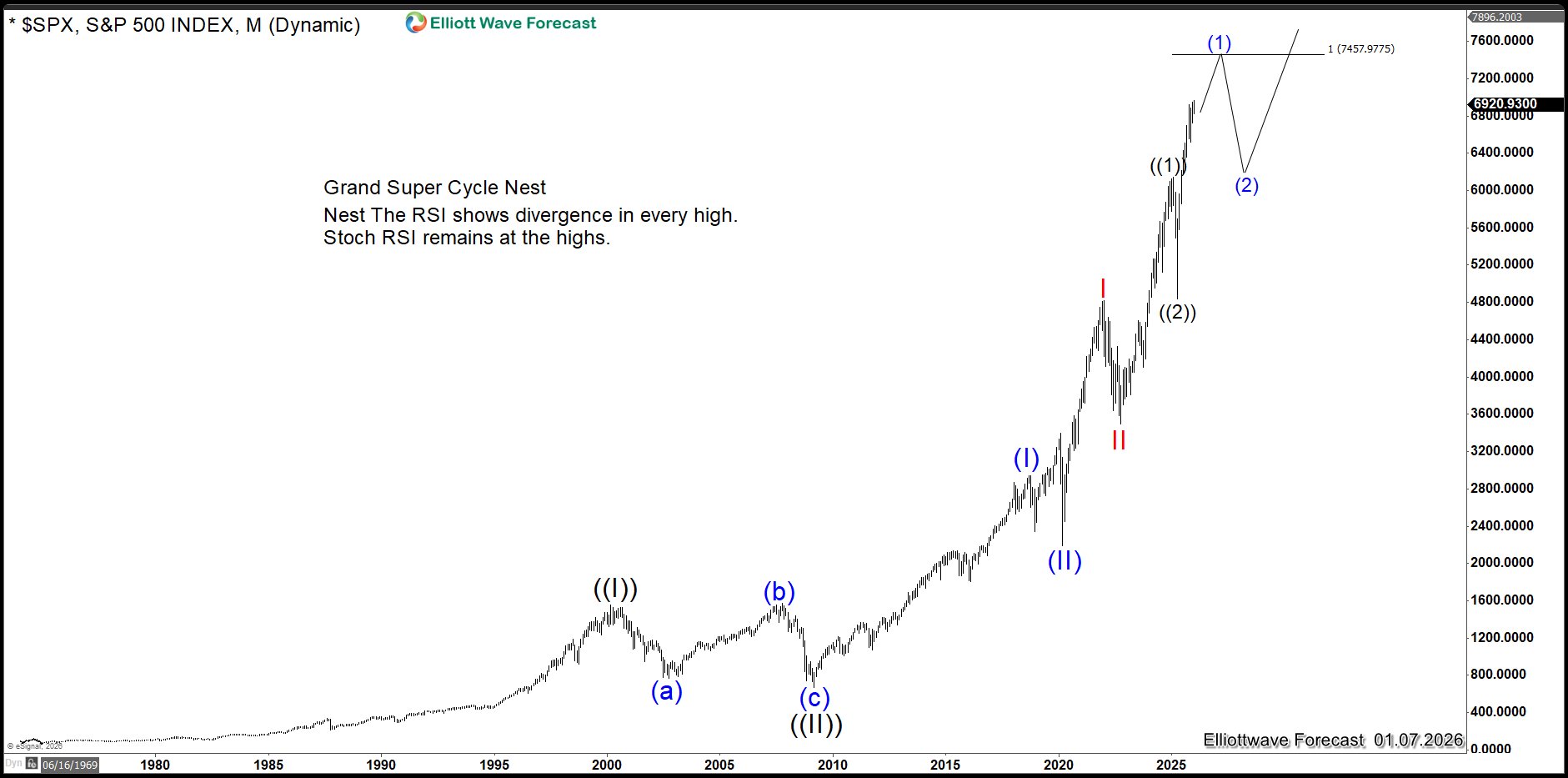
The $SPX chart below shows a similar nest structure, which appears to be ending wave (1) since 04.07.2026. This alignment with $CAT supports the view that both are operating within a powerful wave ((3)). The $10,000 level is the minimum target, but projections extend toward $12,000. Many traders remain skeptical of such levels, yet we have consistently emphasized the validity of the nest and its implications.

Monthly Elliott Wave Chart of S&P 500 (SPX)​


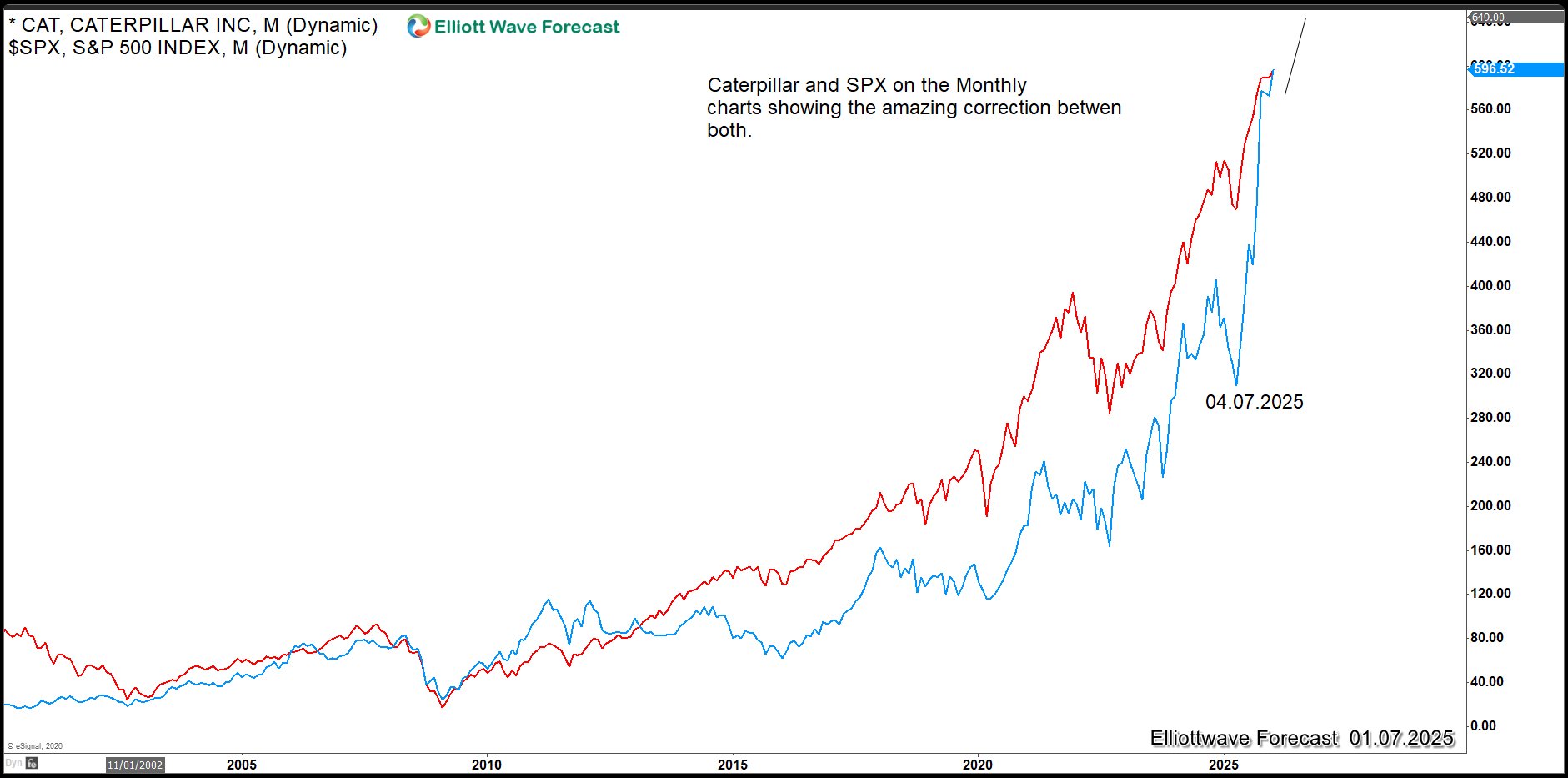
Another chart compares $SPX and $CAT directly, highlighting the strong correlation between the two symbols.


At EWF, we have repeatedly stated that indices remain well supported and that a nest into wave ((3)) is a real possibility despite widespread doubt. In a recent seminar, available here, we explain this quadruple nest structure in detail. We follow our system with discipline, deliberately avoiding market noise, and trust our methodology. While only time will confirm the outcome, Caterpillar’s price action continues to reinforce our view. It strengthens he case that a move in the $SPX toward 10,000 could occur much sooner than many expect.


Source: https://elliottwave-forecast.com/st...-the-structural-spx-nest-thesis-toward-10000/
 
  • 👍
Reactions: mas3

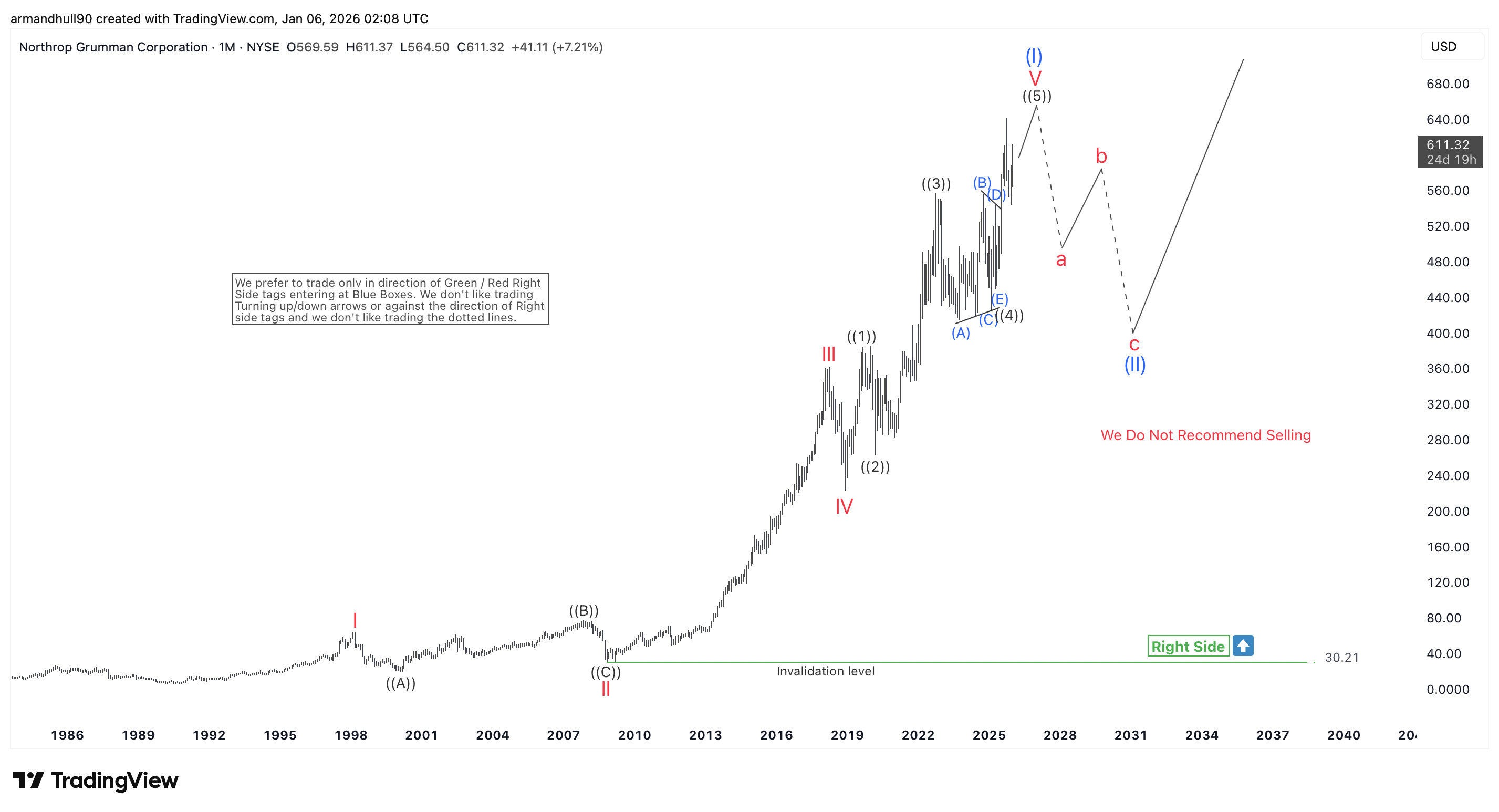
NOC remains in a strong long-term bullish structure, but the Elliott Wave cycle looks mature and may retest recent highs before a deeper corrective phase begins.​

Northrop Grumman Corporation (NYSE: NOC) remains in a strong long-term bullish trend on the monthly chart. The stock has shown years of steady growth supported by a clear Elliott Wave structure. However, the current cycle now looks mature and may be close to completing. Before this cycle ends, price may retest or slightly break recent highs.

The Elliott Wave counts show that Northrop Grumman completed a major long-term Wave II correction in the past. This correction helped reset the market and prepared it for a powerful new bullish phase. After Wave II ended, the stock started a strong impulsive advance. It developed into a multi-year Wave III rally. After that, the market pulled back in Wave IV but stayed above key support. This confirmed that the main bullish trend was still intact.


From Wave IV, the stock entered an even stronger phase. It developed a clear five-wave structure into V. Inside this move, we can see waves ((1)), ((2)), ((3)), ((4)), and ((5)). Wave ((3)) showed strong momentum, which is normal in Elliott Wave theory. Wave ((4)) formed a sideways corrective structure and held well. The final push higher completed Wave V of Wave (I), showing that the bullish cycle is now advanced.

Even though the cycle is near completion, the chart still suggests some upside. The price can retest or slightly break the recent highs before a bigger correction starts. After that, the stock is expected to enter Wave (II), which may unfold as an a-b-c decline. This correction should be seen as healthy and part of a larger bullish outlook, not a bearish reversal.

The long-term Right Side tag remains bullish. The invalidation level is far lower, which keeps the main trend positive for now.

Conclusion​

Northrop Grumman remains bullish, but the current Elliott Wave cycle is getting close to completion. A retest of highs may still happen before a larger corrective Wave (II) develops.

Source: https://elliottwave-forecast.com/stock-market/noc-pullback-completed-bullish-breakout/
 

COP Keeps Its Long-Term Bullish Elliott Wave Structure Intact, with Strong Upside Potential Toward Key Fibonacci Targets.​

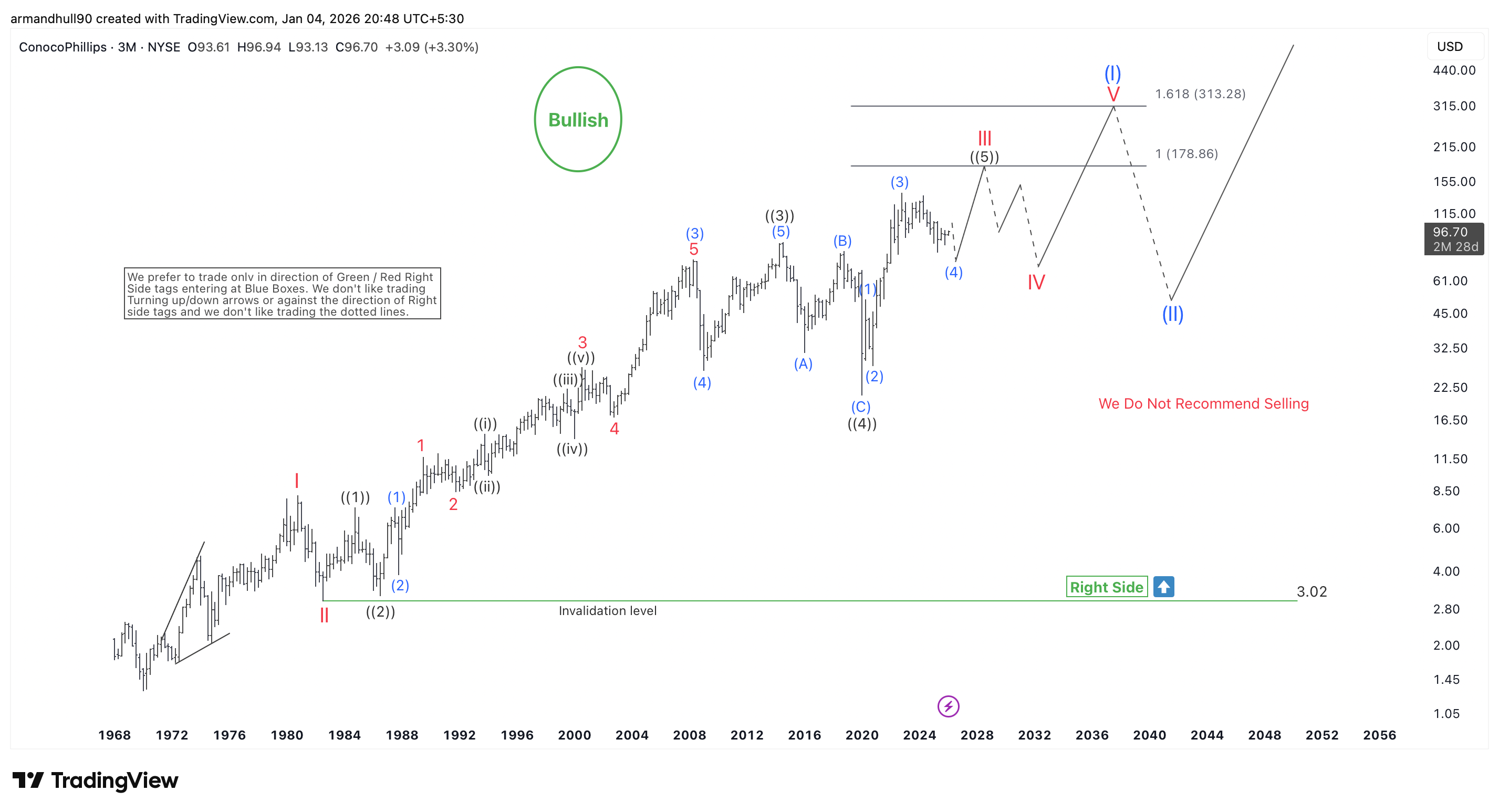
ConocoPhillips continues to show a strong long-term bullish trend using Elliott Wave analysis. The quarterly chart shows a clear impulsive rally from historic lows. The Right Side tag stays bullish as long as price remains above the invalidation level near 3.02. This level is far away from current prices. So, the broader trend remains upward. Pullbacks should act as corrections, not the start of a bearish cycle.

From the earlier historical lows, COP has developed a multi-decade impulsive advance. A clear Wave I, II, and III structure has unfolded over the years, and Wave III is now progressing in its final swings. Each corrective phase has resolved in favor of the larger bullish trend. The most recent strong rally unfolded as Wave (3), followed by a corrective decline that completed Wave (4). After that, price turned higher again and continued to maintain the integrity of the bullish Elliott Wave sequence.


The expectation now is that the stock remains in a broader bullish cycle. The chart suggests a continuation higher toward the 100%–161.8% Fibonacci extension areas around the $178 and $313 levels. Before achieving those higher targets, the structure also allows for an additional corrective leg lower at some stage, labeled as wave IV and then larger wave (II) ahead of another major bullish cycle. However, those declines, if they occur, are expected to remain corrective and should still favor the upside once completed.

The “We Do Not Recommend Selling” note on the chart reinforces the directional bias. With the Right Side tag firmly pointing higher, trading in the direction of the bullish trend remains the preferred approach. Historically, COP has rewarded investors who stayed aligned with the impulsive structure rather than reacting to temporary corrections.

Summary​

In summary, ConocoPhillips continues to present a constructive long-term Elliott Wave outlook. The larger bullish cycle remains dominant, invalidation is extremely distant, and the broader structure favors continuation higher toward significant upside targets in the coming years. Pullbacks remain corrective opportunities within a much larger bullish trend, and the long-term outlook stays positive as long as the Right Side remains intact.

Source: https://elliottwave-forecast.com/st...ips-cop-bullish-elliott-wave-targets-178-313/
 
Hello fellow traders. In this article we’re going to take a quick look at the Elliott Wave charts of DAX index , published in the members area of the website.

As our members know, DAX is showing impulsive bullish sequences in the cycle from the November's 2025 low. Recently it pulled back and found buyers at the equal legs area. Here’s our Elliott Wave Forecast.

DAX Elliott Wave 1 Hour Chart 12.18.2025

DAX is forming a five-wave upward cycle from the 22,941 low. The current view suggests that DAX is undergoing a pullback, wave ((iv)). The extreme zone has already been reached. We expect buyers to appear in the equal-legs zone at 24,032.6–23,843.5 (buyers’ area) to complete wave ((iv)) (black) before the bullish trend resumes.

Did you know? 90% of traders fail because they don’t understand market patterns. Are you in the top 10%? Test yourself with this advanced Elliott Wave Test

DAX

DAX Elliott Wave 1 Hour Chart 12.18.2025

DAX found buyers right at the marked extreme zone and turned higher as expected. We also got a break above the previous peak: December 12th, confirming that the next leg up is in progress. We expect the index to ideally remain supported in the coming days.

Reminder for members: Our chat rooms in the membership area are available 24 hours a day, providing expert insights on market trends and Elliott Wave analysis. Don’t hesitate to reach out with any questions about the market, Elliott Wave patterns, or technical analysis. We’re here to help.

DAX

Thank you for exploring our DAX Forecast with us. While we analyze 78 instruments, it’s important to remember that not every chart represents a trading recommendation. For official trading signals, we invite you to join our Live Trading Room, where we provide actionable insights in real-time. If you’re not yet a member, take advantage of our 14-day trial to unlock new trading opportunities.

Source: https://elliottwave-forecast.com/stock-market/dax-found-buyers-equal-legs/
 
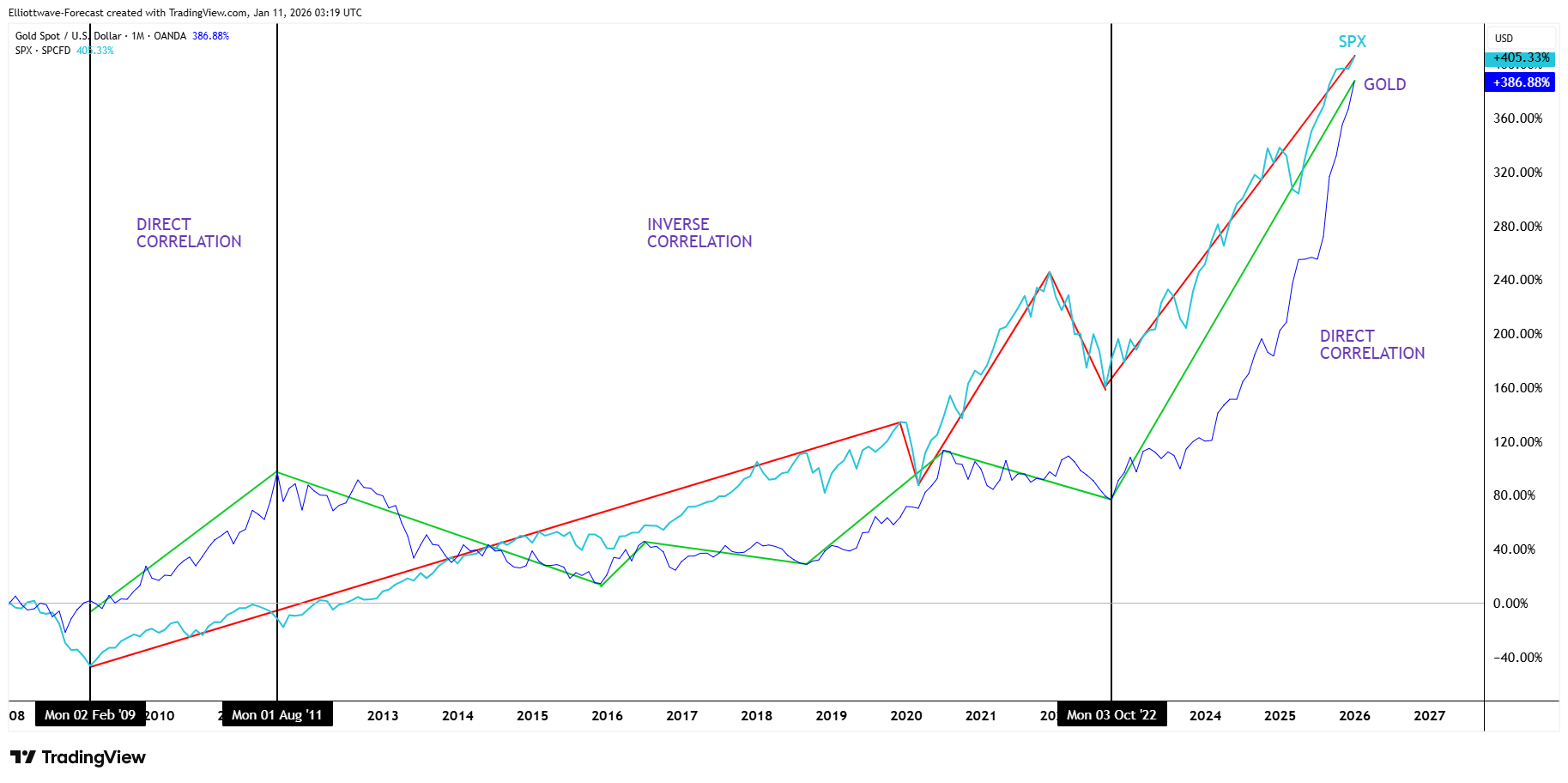
For decades, investors viewed Gold and Silver as the ultimate insurance policy. Traditionally, precious metals and equities moved in opposite directions, providing a natural hedge for portfolios. However, the market dynamics of 2024 and 2025 completely rewrote the rulebook. As we navigate the first quarter of 2026, understanding this new "direct correlation" is vital for protecting your wealth.

The Foundation: Why Metals Traditionally Oppose Stocks​

Historically, Gold (1$XAU$) and the S&P 500 (2$SPX$) maintained a strong inverse correlation.3 When the stock market thrived, gold prices usually stalled or fell. This "tug-of-war" occurred for three main reasons:

  • Risk Sentiment: Investors aggressively pursue growth (stocks) during "risk-on" periods and flee to gold (safety) during "risk-off" cycles.
  • Opportunity Cost: Because gold pays no dividends, high stock returns make holding the metal "costly" in terms of missed gains.
  • Monetary Stability: Gold acts as a hedge against a weak dollar. Consequently, a currency crisis typically hurts stocks while simultaneously boosting gold.

The Great Breakdown of Gold in 2024 and 2025​

The investment playbook broke recently. This was not a sudden shift, but rather an acceleration that consolidated a new, aggressive trend:

  • The 2024 Anomaly: For the first time in the modern era, Gold and the S&P 500 both gained over 25% in the same year. In August 2024, their correlation hit a record 0.91, as they moved in almost total synchrony.
  • The 2025 Consolidation: Last year, the market witnessed simultaneous all-time highs. Stocks rose on the AI boom, while Gold climbed due to mounting fears regarding the massive US fiscal deficit.

GOLD vs SPX

In a startling turn for early 2026, the traditional rulebook has been discarded. We are currently seeing a positive correlation, where both Gold and the S&P 500 reach all-time highs simultaneously (with gold hovering around $4,500 - $5,000 per ounce). This breakdown is driven by three modern forces:

  1. Global Debt & Dollar Debasement: National debt has reached levels that trigger fears of permanent inflation. As a result, institutions buy the S&P 500 for earnings growth and Gold to protect against a devaluing currency. They no longer choose one or the other; they buy both.
  2. Central Bank Dominance: Central banks worldwide are diversifying their reserves away from Treasuries at a record pace. This "non-cyclical" buying pressure keeps gold prices high, regardless of how well Wall Street performs.
  3. Interest Rate Expectations: Anticipation of Fed rate cuts in Q1 2026 has reduced real yields. This makes stocks more valuable (cheaper debt) and gold more attractive (lower opportunity cost) at the same time.

Q1 2026 Outlook: What Should We Expect?​

As we advance through the first quarter of 2026, the market sits at a critical junction. The primary question is: will this direct correlation persist, or will we return to the old dynamics?

The Case for Continued Direct Movement​

Analysts expect this direct correlation to hold through most of Q1. Specifically, as long as the AI-driven earnings boom continues and central banks keep accumulating gold, both assets will benefit from the massive global liquidity in the system.

The Return to Decoupling​

Conversely, we will likely see a "Grand Decoupling" toward the end of the year. Historically, periods where "everything rallies" mark the final stage of a market cycle. If a sudden economic shock occurs, investors will liquidate winning stock positions to cover losses, while Gold will separate to become the only remaining safety net.

Strategic Summary for Investors​

The current movement "in unison" is an anomaly fueled by debt and liquidity. While it is profitable now, astute investors must prepare for an eventual return to the mean. Once the market realizes that corporate growth cannot outrun structural currency debasement forever, the traditional inverse correlation will reclaim its throne.

Source: https://elliottwave-forecast.com/commodities/gold-silver-sp500-new-correlation/
 
SanDisk (NASDAQ: SNDK) surged over 1000% since its IPO last year and it shows no signs of slowing. Today, we decode the Elliott Wave structure behind its powerful breakout. Consequently, our analysis charts a precise path to higher targets. This technical blueprint reveals a compelling setup fueled by pure momentum.

Elliott Wave Analysis

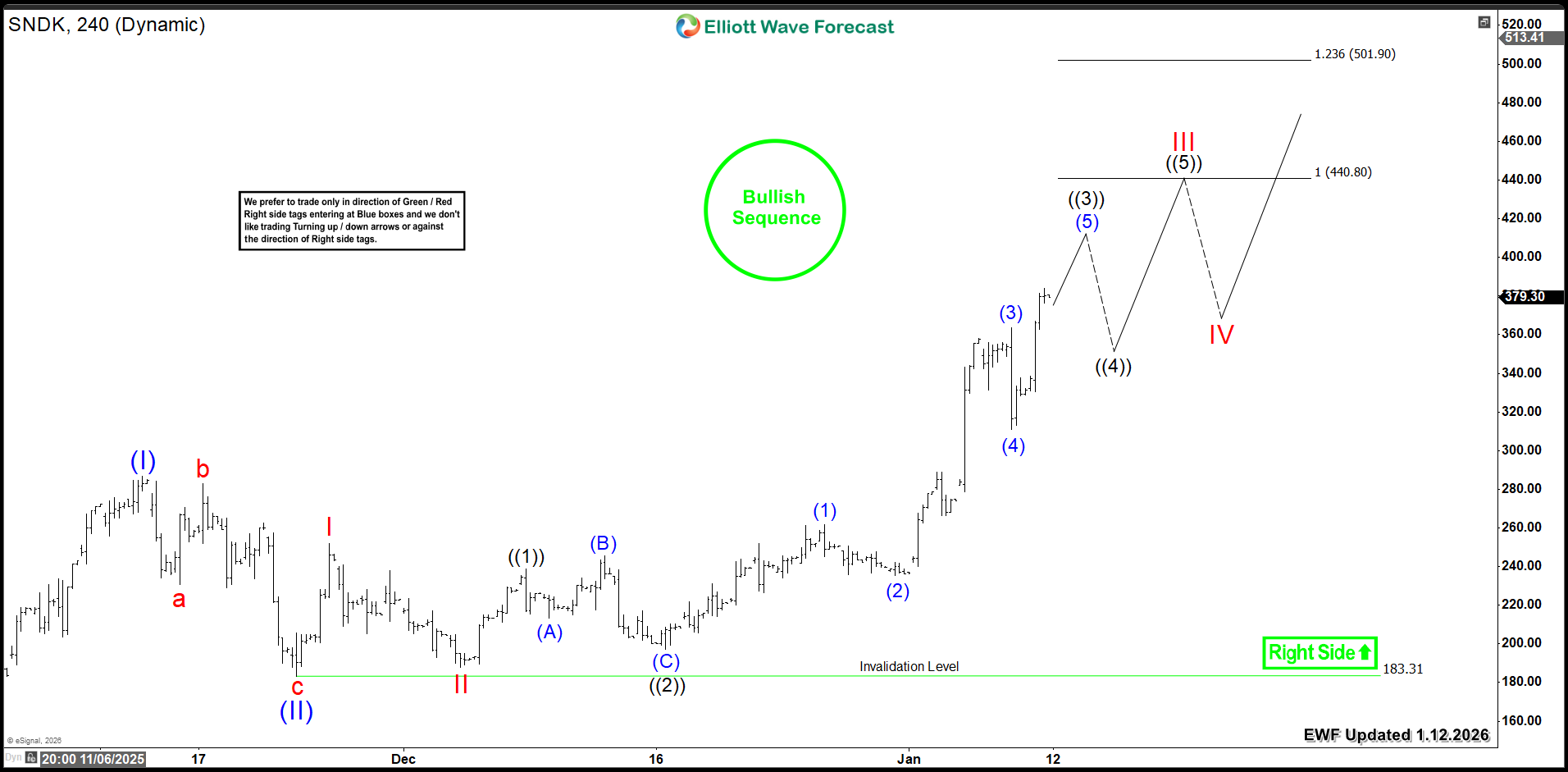
SNDK rallied from its April 2025 low in a strong impulse. This move marked Wave I at $286 in November 2025. Subsequently, a three-wave pullback formed Wave II at $183. Then, the stock turned higher again in a powerful Wave III. This wave broke into new all-time highs within a nesting structure.

Currently, the bullish sequence remains incomplete. Therefore, the stock should continue rallying toward the $440 - $501 target zone. This advance will unfold through a series of third and fourth waves.

Consequently, we expect all short-term SNDK pullbacks to find buyers. These corrections will form as 3, 7, or 11 swings. The primary daily cycle remains active. Ultimately, this should propel prices beyond the $500 level.

SNDK 4 Hour Chart 1.12.2026

SanDisk SNDK 4H

Conclusion​

SNDK's bullish cycle maintains its strength. Consequently, traders should focus on strategic entries during daily pullbacks. Apply our Elliott Wave methodology for exact timing. More precisely, enter the market after a 3, 7, or 11-swing correction finishes. Additionally, our proprietary Blue Box system pinpoints high-probability entry zones. Consequently, this disciplined method provides clarity and confidence. Ultimately, it positions traders to capture the next major bullish leg.

Source: https://elliottwave-forecast.com/stock-market/sandisk-sndk-bullish-path/
 

Wave (II) Looks Complete, Right-Side Remains Bullish, and Wave (III) Targets Higher Prices Ahead​

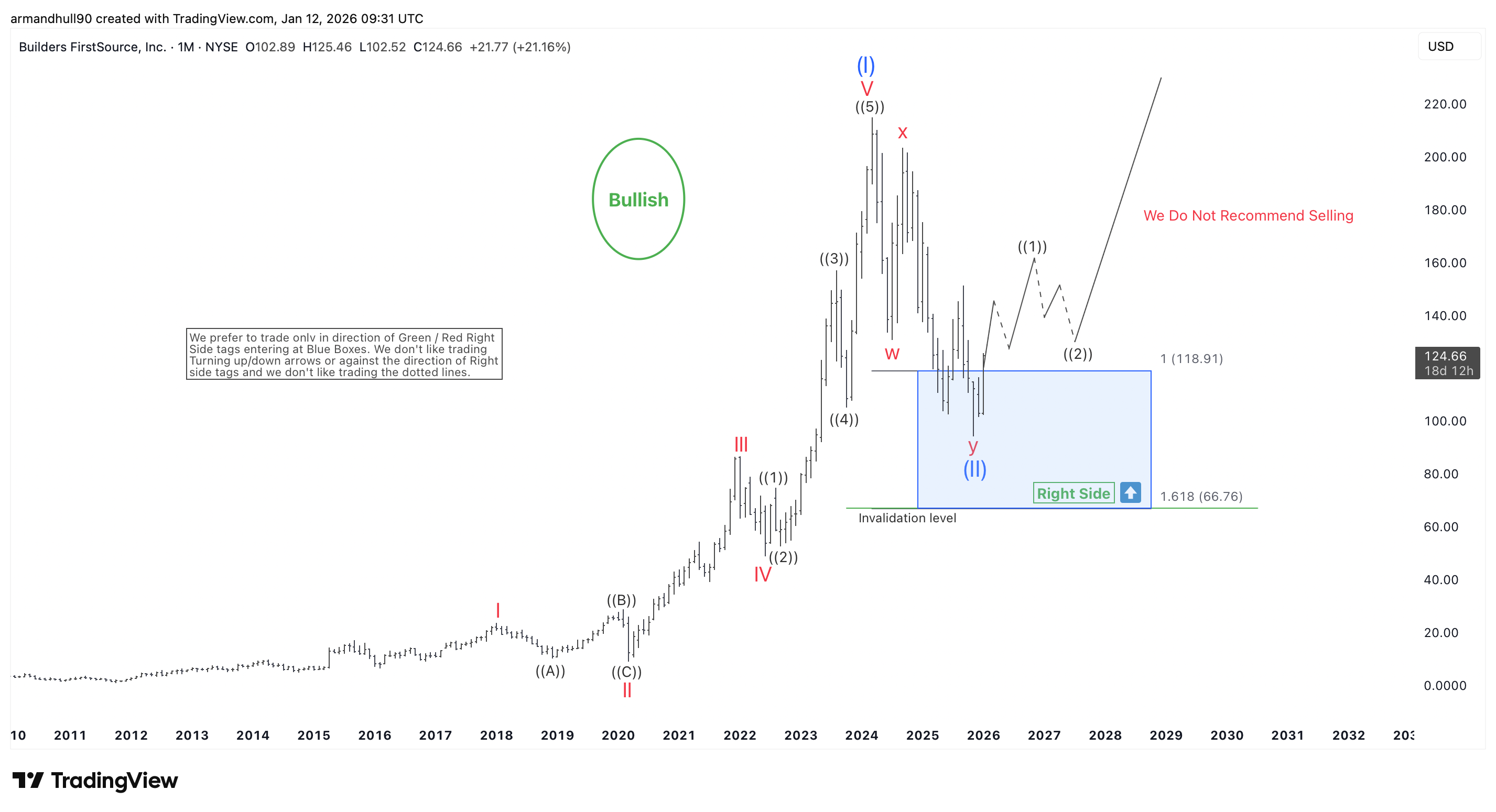
Builders FirstSource (NYSE: BLDR) continues to show a strong bullish outlook based on Elliott Wave Theory. The monthly chart highlights an impressive impulsive advance into the peak of wave (I). After that strong rally, the stock entered a larger corrective phase. This correction formed a W-X-Y structure and likely completed wave (II) inside the blue box support area.

Wave (II) Correction Likely Completed – Bullish Right Side Remains Intact

During the correction, price tested key Fibonacci areas near 118.91 and the deeper 66.76 level. This zone created a major support region and helped the market stabilize. The Right Side tag still favors the bullish direction. The invalidation level remains far below, so the bullish structure stays valid as long as price holds above support.

After stabilizing inside the blue box, BLDR started to turn higher. This move suggests that wave ((1)) of a new bullish cycle may have already begun. A small pullback in wave ((2)) can still happen, but as long as it remains corrective, the stock should continue higher again.

Upside Targets and Long-Term Bullish Expectation

With wave (II) potentially completed, BLDR is positioned to begin a powerful impulsive advance in wave (III). Historically, third waves tend to be the strongest and longest within Elliott Wave structures, often breaking previous highs and establishing new records. Therefore, the next bullish phase is expected to challenge recent highs and then push toward new all-time highs, supported by strong momentum and positive cycle alignment.

We do not recommend selling the stock as the long-term trend remains bullish. As long as the structure holds above the invalidation level and price continues respecting the bullish sequence, buyers are expected to remain in control.

Summary​

In summary, Builders FirstSource maintains a strong bullish Elliott Wave structure, showing that wave (II) is likely in place and the market is preparing for a powerful advance in wave (III). Investors and traders who follow long-term structural trends may continue to favor the upside, anticipating new all-time highs in the coming cycles.

Source: https://elliottwave-forecast.com/st...liott-wave-forecast-wave-iii-bullish-outlook/
 
Hello traders and welcome to a new blog post discussing about our blue box trading strategy. In this post, the spotlight will be on CHFJPY currency pair.

The Yen pairs continue to rise as expected, with bullish cycles from last year appearing incomplete despite being in advanced stages. This presents more opportunities for buyers to enter the market from dips. Specifically, CHFJPY has been in the 3rd wave of a bullish cycle since September 2024. This bullish run is developing as an impulse wave structure within an extended 3rd wave, following the conclusion of the 2nd wave in February 2025. Since then, the 3rd wave has been extending.

In December, wave 3 reached 2.618% of wave 1 from wave 2. However, the divergence from July 2025 has been erased, suggesting further upside potential. Furthermore, the Indices seem to have not completed the bullish cycle from April 2025. Consequently, we maintain a bullish outlook on the Yen pairs. In a bullish sequence, we favor buying at the extremes of 3, 7, and 11 swing pullbacks.

CHFJPY Shorter Cycle Bullish Opportunity - 7th January 2026

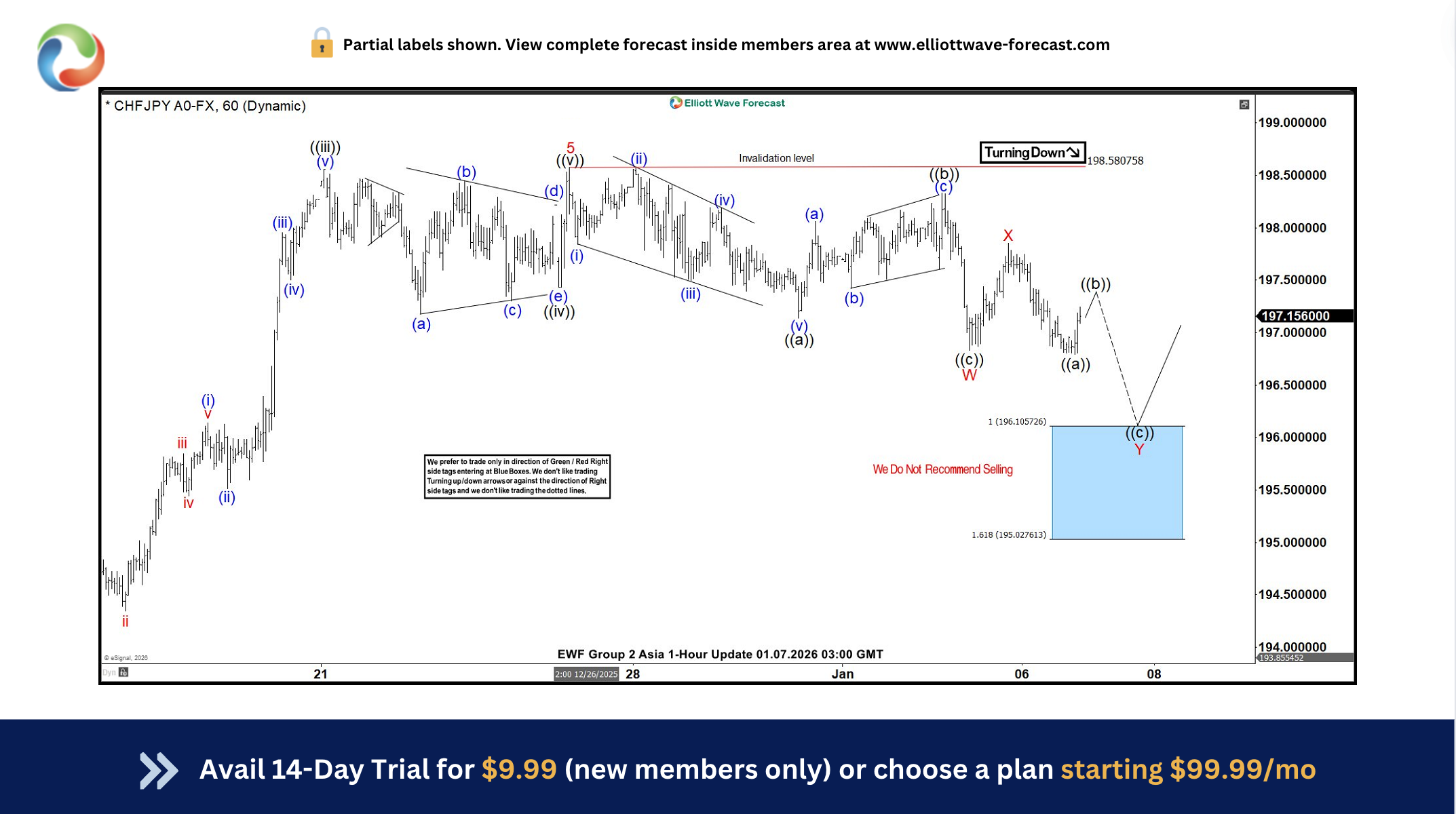
In late December, the pair began to pull back. While some may have considered it time to sell against the trend, we remained focused on buying the pullback. It continued through the last week of December and into the first week of January. On January 7, 2026, we identified the pullback structure as a double three corrective setup. Therefore, we shared the chart below, displaying the blue box, with Elliottwave_Forecast members.


The blue box on the chart indicates the buying zone of 196.105-195.027. Traders entered long positions at 196.10, setting their stop-loss at 195.02, anticipating either a recovery or at least a 3-swing bounce. We documented this trade in the trading journal and discussed it with members in the live trading room. In the live trading room, we cover all aspects of trading, from initial setup and entry points to thorough trade management until closure. We also maintain a watchlist and share trade outcomes there to keep members informed.

CHFJPY Setup: 12th January, 2026

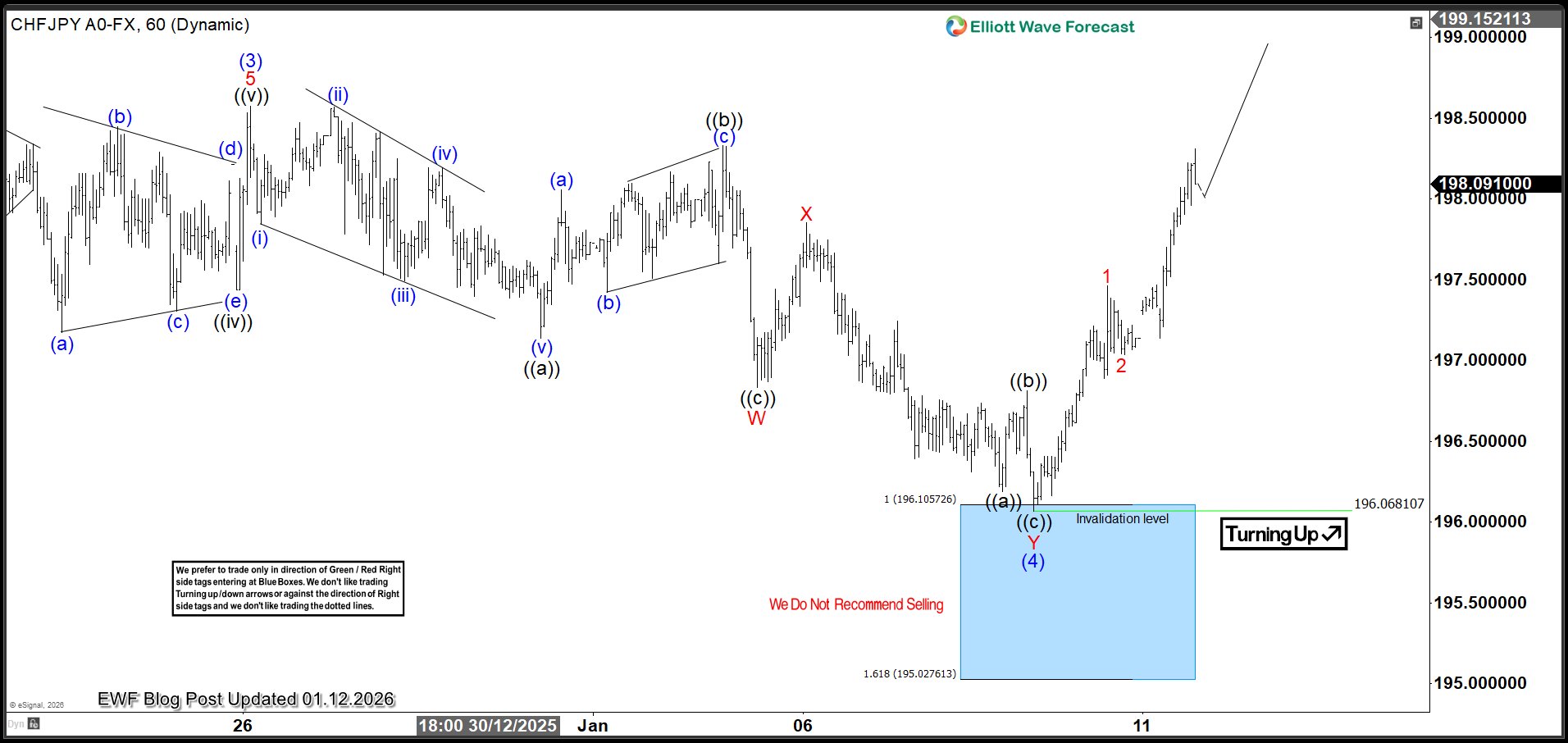
chfjpy

The pair reached the blue box, triggering buying interest, and subsequently bounced sharply as anticipated. Consequently, our members are realizing significant profits, even after taking partial profits at the initial target. We anticipate continued upside support as the pair moves towards $200 and beyond. This has been a successful trade for all our participating members.

Source: https://elliottwave-forecast.com/forex/chfjpy-aims-200-from-blue-box/
 
Newmont Mining (NEM) is the world’s largest gold producer, with a diversified portfolio of mines and projects spanning North America, South America, Australia, and Africa. Founded in 1921 and headquartered in Denver, Colorado, the company plays a central role in the global precious metals market, offering investors exposure to gold and other resources through its scale, operational expertise, and long-standing industry presence. This article looks at the Elliott Wave Outlook for the stock.

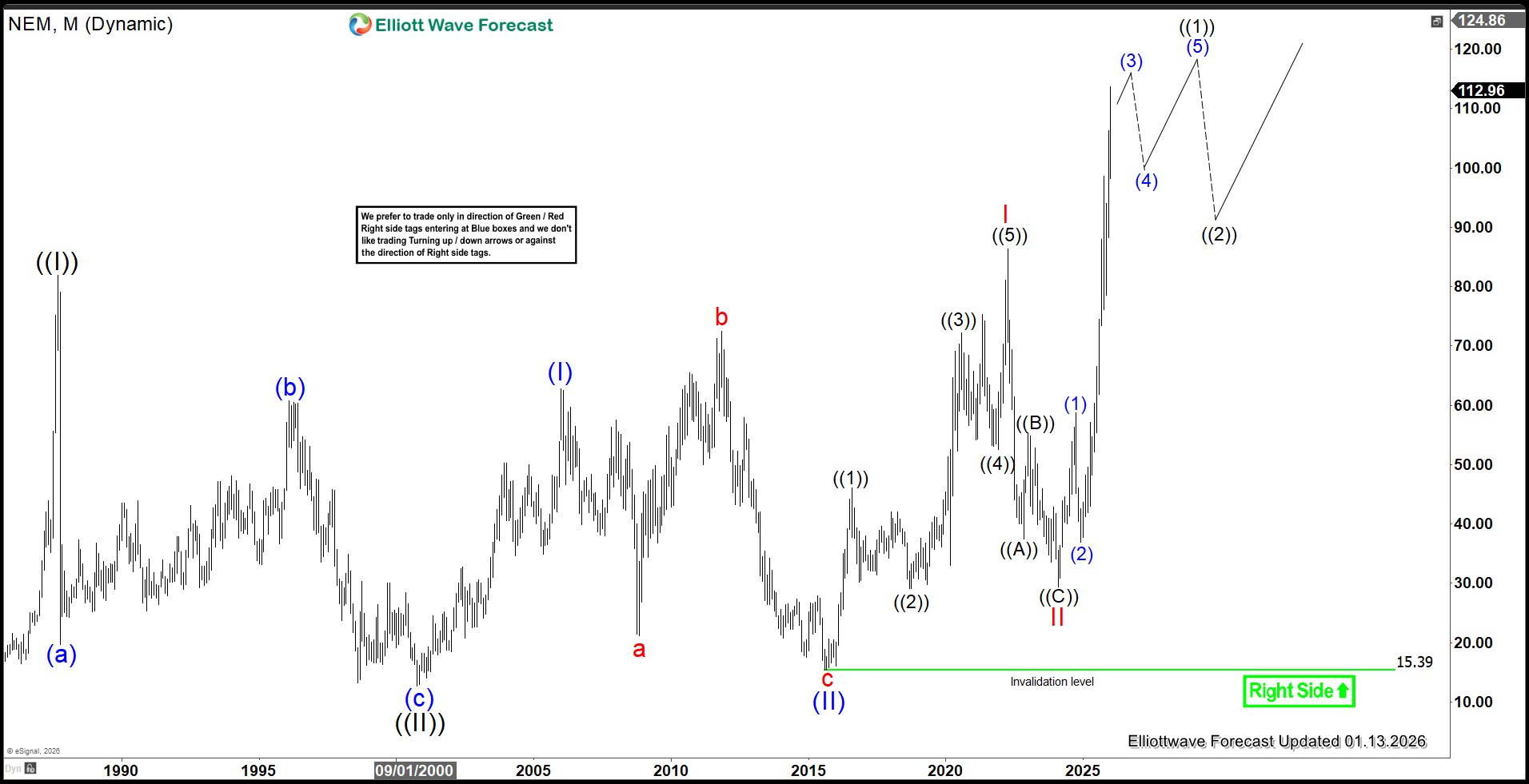
Newmont Monthly Elliott Wave Chart​


Newmont Mining (NEM) is in the midst of a strong bullish advance, highlighted by its monthly Elliott Wave structure. The chart points toward a breakout that should carry the stock to new record highs. Back in September 2000, NEM completed wave ((II)) of the Grand Super Cycle at $12.75, laying the foundation for a powerful nested impulse. From there, wave (I) climbed to $62.72 before wave (II) retraced to $15.39. The current wave (III) is unfolding, with wave I peaking at $86.37 and wave II correcting down to $29.42. Provided the stock holds above the $15.39 threshold, the upward trajectory remains intact, suggesting further strength ahead.

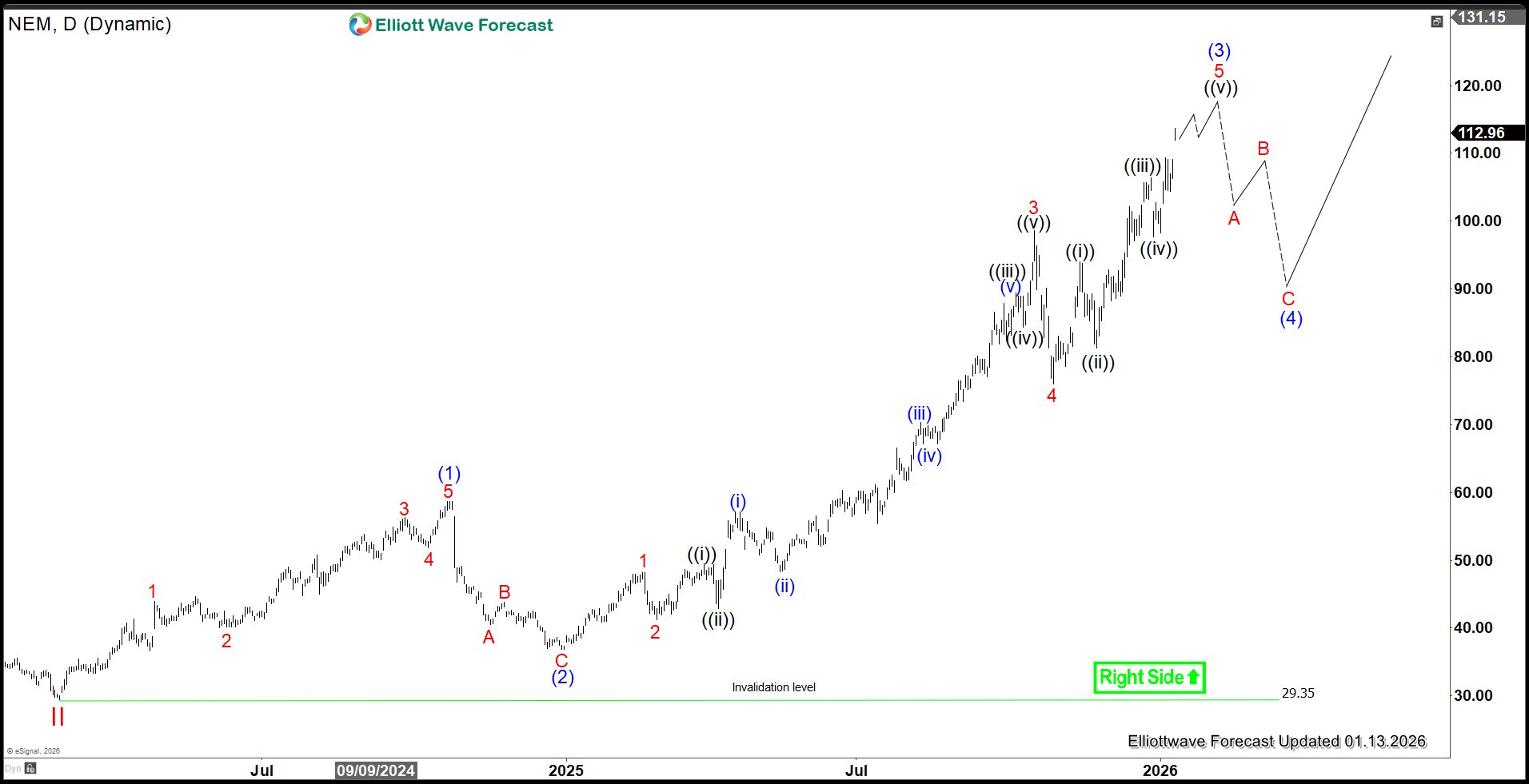
Newmont Daily Elliott Wave Chart​


The daily Elliott Wave outlook for Newmont Mining (NEM) highlights a clear sequence in its price action. After completing the wave II correction at $29.03, the stock has shifted into wave III, marking a renewed bullish phase. From that low, wave (1) carried prices up to $58.72, before wave (2) pulled back to $36.86. Wave (3) is now unfolding and appears close to completion. Wave (4) consolidation should happen soon before the next leg higher. As long as the $29.03 support remains intact, NEM retains strong potential to extend its advance within wave III.

Source: https://elliottwave-forecast.com/el...ve-outlook-impulsive-rally-building-momentum/
 
Liquidia Corporation, (LQDA) is a biopharmaceutical company. It develops, manufactures & commercializes various products for unmet patient needs in the United States. It comes under Healthcare sector in Biotechnology Industry & trades as “LQDA” ticker at Nasdaq.

As discussed in last article, it extends rally in impulse I from June-2025 low. It should extend into $38.16 - $40.90 area to finish the wave ((5)) as I before correction start. We like to buy the pullback in 3, 7 or 11 swings at extreme area, when reach.

LQDA - Elliott Wave Latest Weekly View:​

In weekly, it broke the previous ATH from October-2018 in last rally & confirms bullish bias. It favors rally in I of (III) against June-2025 low. From August-2021 low, it placed I of (I) at $7.78 high, II at $4.06 low, III at $16.99 high, IV at $8.26 low & V at $19.41 high in May-2025. It corrected lower in (II) in 3 swings, which ended at $11.85 low in June-2025 low. Above (II) low, it placed ((1)) of I at $29.94 high, ((2)) at $21.15 low, ((3)) at $36.41 high, ((4)) at $29.30 low & favors rally in ((5)).

LQDA - Elliott Wave View From 8.25.2025:​

Within ((1)), it ended (1) at $20.33 high, (2) at $16.82 low, (3) at $28.82 high (4) at $26.06 low & (5) at $29.94 high. Within ((3)), it placed (1) at $25.12 high, (2) at $21.94 low, (3) at $35.54 high, (4) at $32.11 low & (5) at $36.41 high. Currently, it favors rally in (1) of ((5)) & expect minor high before correcting in (2). As long as it stays above $29.30 low of 1.05.2026, it should extend higher in 5 swings to finish ((5)). The ((5)) expects to extend into $38.16 – $40.90 area to finish I impulse before correcting next. It already reached the minimum area, so if it breaks below $29.30 low, it can be II as alternate view. We like to buy the pullback in 3, 7 or 11 swings in II against June-2025 low. If it managed to erase the momentum divergence, then it can be nesting in I.

Source: https://elliottwave-forecast.com/stock-market/lqda-buy-breakout-wait-pullback/
 
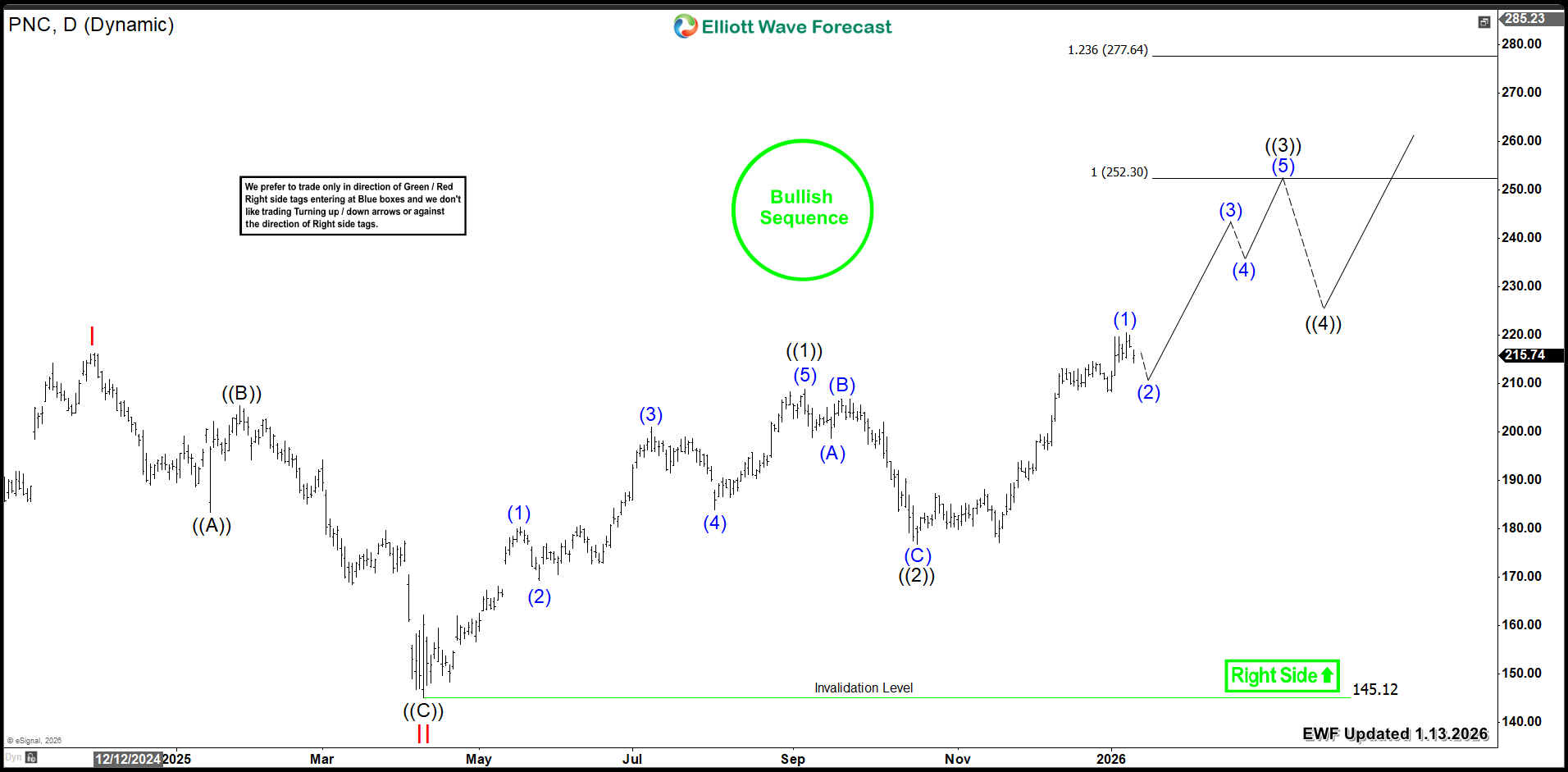
PNC Financial Services stock recovered its entire 33% 2025 decline. It also broke decisively above its 2024 peak. Today, we analyze the Elliott Wave structure behind this powerful breakout. This examination maps a precise path to higher targets. Our technical blueprint reveals a compelling setup driven by strong momentum.

Elliott Wave Analysis

From its 2025 low, PNC created a three-swing advance. This move broke above the 2024 peak of $216. Wave ((1)) ended at $203, followed by Wave ((2)) at $176. Now, Wave ((3)) is in progress. Therefore, the stock has an incomplete bullish sequence targeting equal legs area $252 - $277.

Currently, the projected path shows a break above the 2022 high of $228. This action will also establish a larger bullish structure. Consequently, it can propel the stock beyond $300 in the coming years.

PNC should continue extending higher. The key invalidation area is the April 2025 low of $145. All daily corrections should hold above this level. These pullbacks will create buying opportunities within a 3, 7, or 11-swing patterns.

PNC Daily Chart 1.13.2026

PNC Daily Chart 1.13.2026

Conclusion​

PNC's bullish cycle signals further upside ahead. Therefore, traders should target strategic entries during daily pullbacks.. Apply our Elliott Wave methodology for exact timing. More precisely, enter the market after a 3, 7, or 11-swing correction finishes. Additionally, our proprietary Blue Box system pinpoints high-probability entry zones. Consequently, this disciplined method provides clarity and confidence. Ultimately, it positions traders to capture the next major bullish leg.

Source: https://elliottwave-forecast.com/stock-market/pnc-stock-nears-ath-250-target-sight/
 
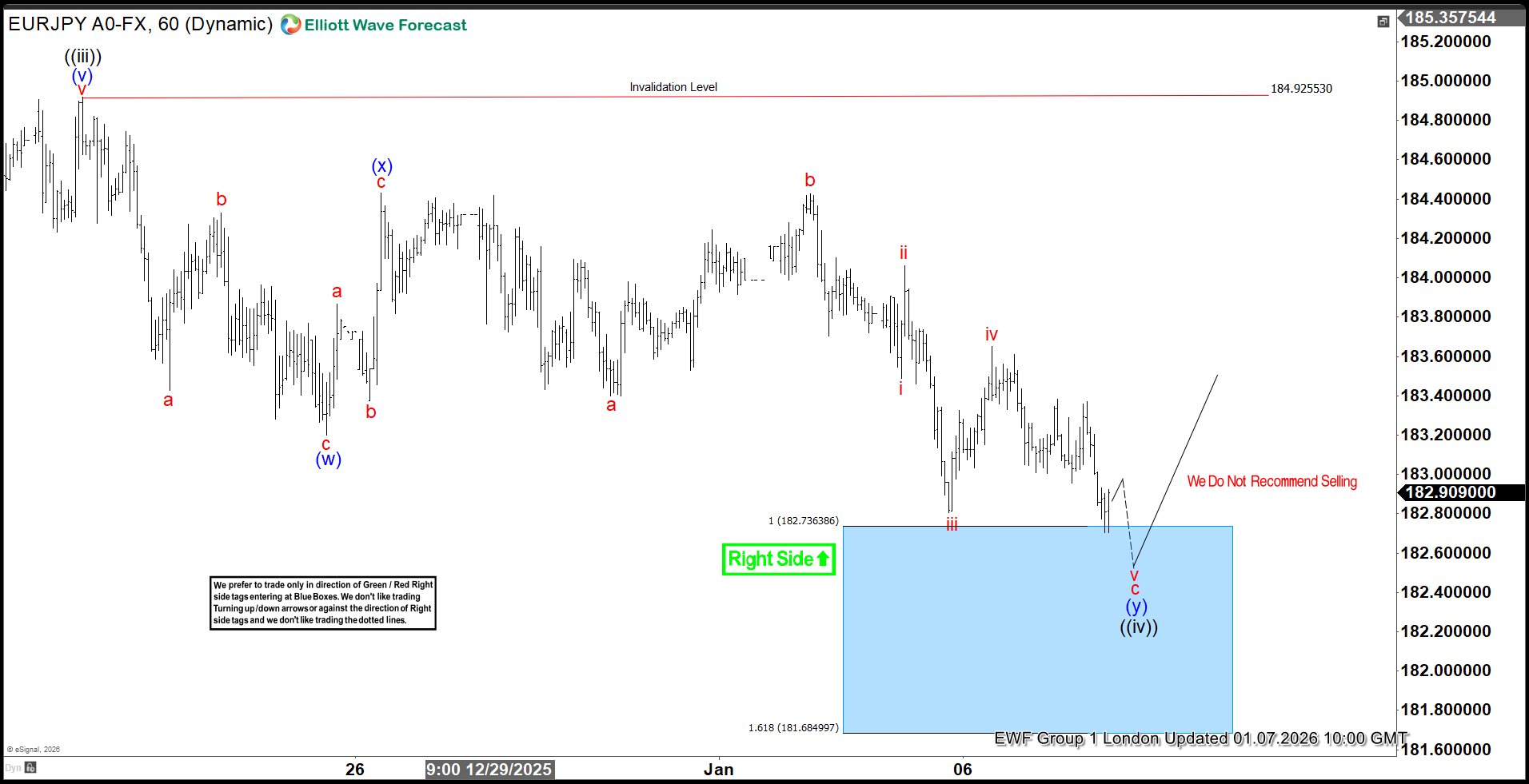
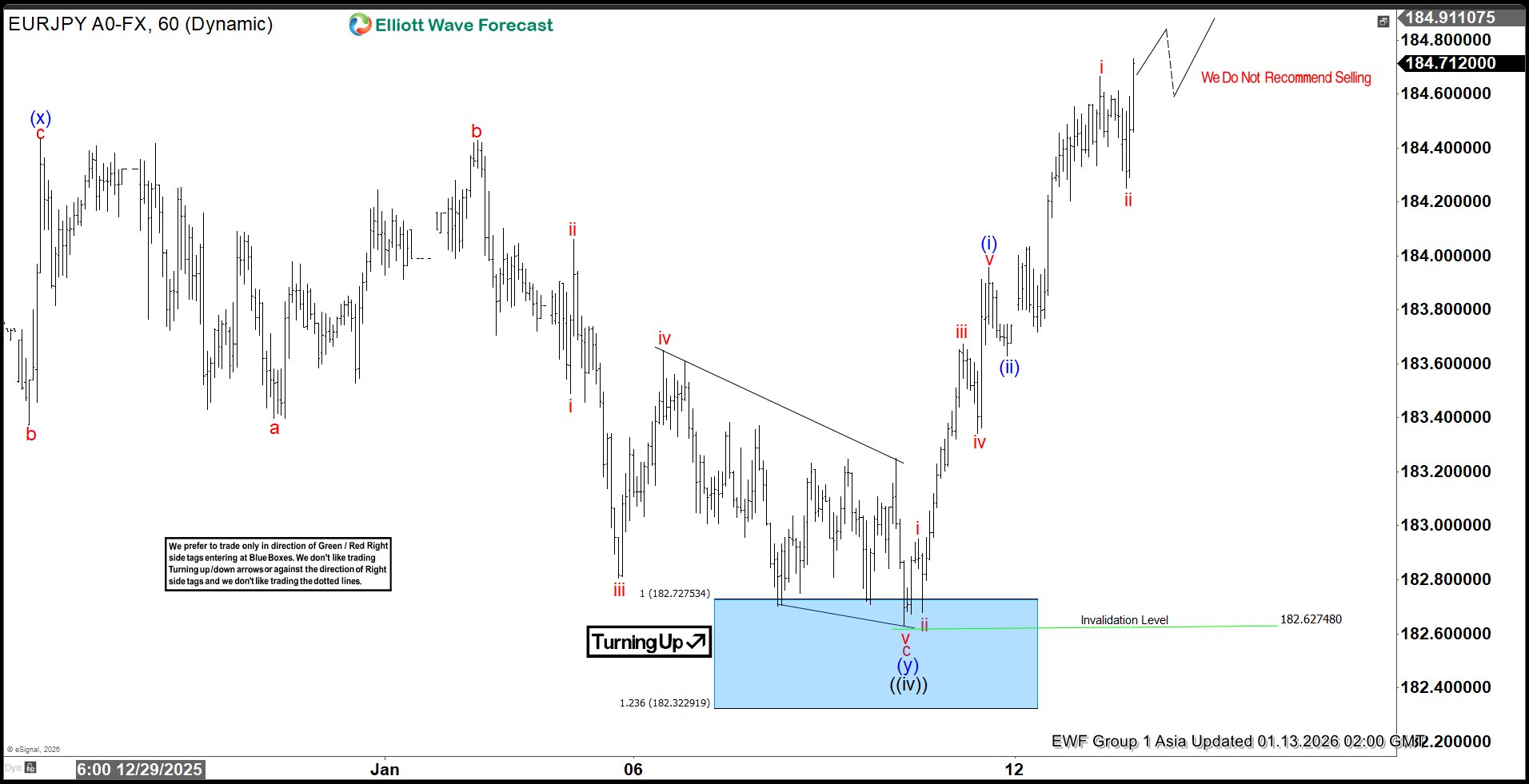
In this technical blog, we will look at the past performance of the 1-hour Elliott Wave Charts of EURJPY. In which, the rally from 31 July 2025 low is unfolding as an impulse sequence. Therefore, called for more upside to take place. We knew that the structure in the pair should remains incomplete & should see more upside. So, we advised members not to sell the pair & buy the dips in 3, 7, or 11 swings at the blue box areas. We will explain the structure & forecast below:

EURJPY 1-Hour Elliott Wave Chart From 1.07.2026​

EURJPY Breaks Higher: Blue Box Delivers New Highs

Here’s the 1-hour Elliott wave Chart from the 1.07.2026 London update. In which, the rally to 184.92 high completed wave ((iii)) & made a pullback in wave ((iv)). The internals of that pullback unfolded as Elliott wave double correction where wave (w) ended at 183.19 low. Then a bounce to 184.43 high-ended wave (x) & started the next leg lower in wave (y) towards 182.73- 181.68 blue box area. From there, buyers were expected to appear looking for new highs ideally or for a 3-wave bounce minimum.

EURJPY Latest 1-Hour Elliott Wave Chart From 1.13.2026​

EURJPY Breaks Higher: Blue Box Delivers New Highs

This is the latest 1-hour Elliott wave Chart from the 1.13.2026 Asia update. In which the pair is showing a strong reaction higher taking place, right after ending the double correction within the blue box area. Allowed members to create a risk-free position shortly after taking the long position at the blue box area. Since than the pair has already made a new high above previous wave ((iii)) high and now targeting 185.47- 186.34 minimum extension target to end wave ((v)).

Source: https://elliottwave-forecast.com/bluebox-wins/eurjpy-blue-box-delivers-new-highs/
 
Financial markets have evolved dramatically over time, moving from human-dominated trading floors to highly automated, algorithm-driven systems. Two concepts that represent these different eras are the Elliott Wave Theory and high-frequency trading (HFT), Elliott Wave Theory focuses on market psychology and recurring price patterns. HFT on the other hand relies on advanced algorithms and ultra-fast execution.

Elliott Wave Theory​

The Elliott Wave Theory, developed by Ralph Nelson Elliott in the 1930s, suggests that financial markets move in predictable patterns driven by collective investor psychology. According to the theory, prices move in a series of five impulsive waves in the direction of the main trend. It was then followed by three corrective waves against the trend. These wave patterns are fractal, meaning they appear on all timeframes, from long-term market cycles to short-term price movements. As a reference, please check this page: https://elliottwave-forecast.com/elliott-wave-theory/. This page provides an overview of the main Theory. It also contains new rules we have added to improve it and avoid a subjective tone.

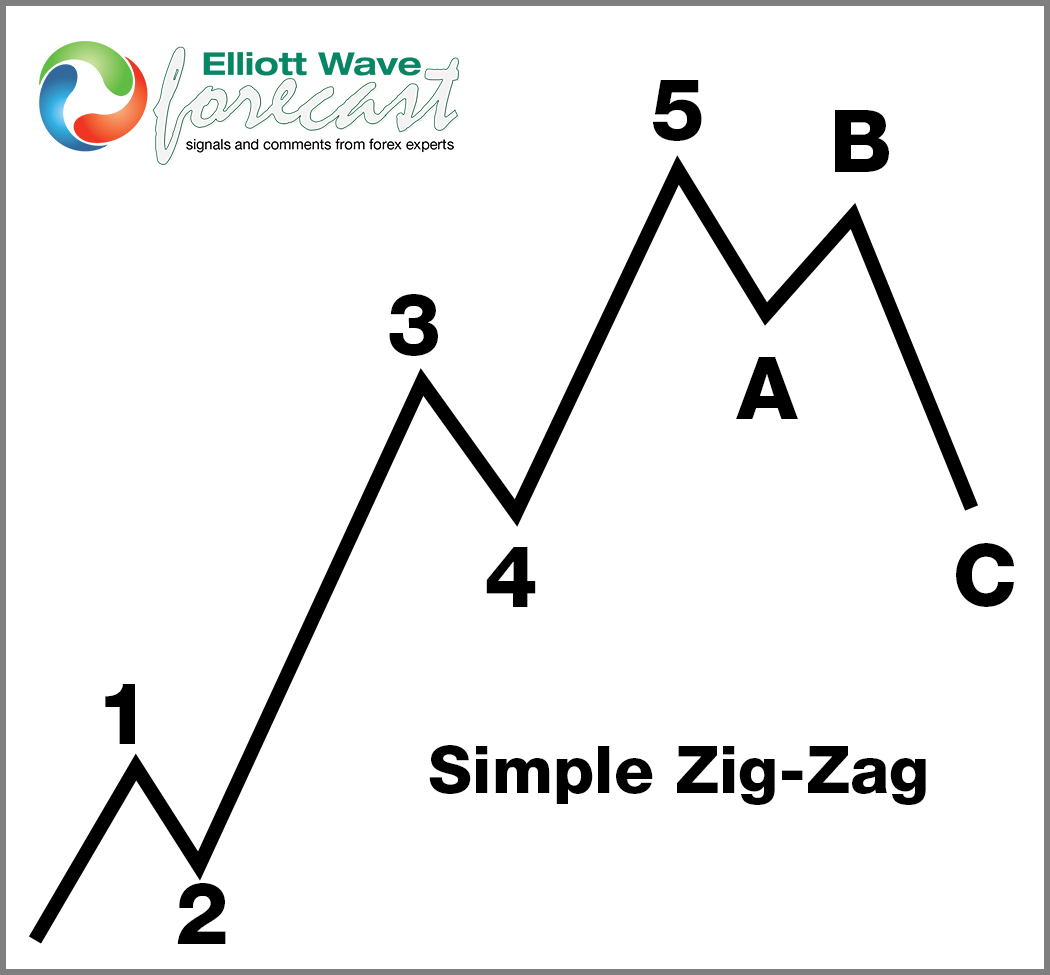
Elliott Wave Theory is widely used by technical analysts to identify market trends, predict potential reversals, and understand the psychological forces behind price movements. The main sequences are 5-9-13-17-21 when the market moves in an impulse structure. These sequences always go with the main trend. Corrective sequence runs in 3-7-11-15-19. Corrective structure can run in a Zig-Zag (5-3-5) which is 3 waves. Another one is a double Zig Zag which is (5-3-5-3-5-3-5) and runs in 7 swing. A Triple Zig- Zag which is (5-3-5-3-5-3-5-3-5-3-5) runs in 11 swing. Sometimes we can also see Flats which runs as 3-3-5 or Triangles. The corrective structure are key to enter the market and we will explain later why.

High-Frequency Trading​

High-frequency trading refers to the use of sophisticated computer algorithms to execute a large number of trades at extremely high speeds, often within microseconds. HFT firms aim to profit from small price discrepancies, market inefficiencies, and short-term liquidity imbalances. Unlike traditional trading methods, high-frequency trading does not rely on human judgment or long-term market predictions. Instead, it focuses on speed, data, and statistical models.

There is little doubt that technological advancement has become a dominant force in modern society. Financial markets have not remained unaffected by its influence. The growing presence of computers in trading has highlighted how algorithmic systems consistently execute trades at recurring entry and exit levels with notable accuracy. As discussed previously, significant effort has been devoted to identifying these key price areas and linking them to Elliott Wave Theory.

The Market Code​

At Elliott Wave Forecast, we have identified the Market Code through years of market observation and analysis. This concept became widely recognized through the recurring corrective structure known as 3–7–11 with the trend. The idea is simple: the market follows a code, one that Ralph Nelson Elliott came very close to identifying nearly one hundred years ago.

According to this code, market corrections unfold in 3, 7, or 11 swings. Impulsive movements on the other hand develop in 5, 9, or 13 waves. Each individual wave has a defined price area from which it begins and ends. Understanding this structure greatly enhances the application of Elliott Wave Theory, particularly when combined with high-frequency and algorithmic trading systems.

Although market behavior can be influenced by news events, economic data, and human psychology, the key lies in recognizing these repeating sequences. Both impulsive and corrective patterns are closely related to Fibonacci retracements and extensions, which help define precise price targets and invalidation levels.

It is important to recognize that computers must be programmed by humans, and many of those programmers may not be familiar with Elliott Wave Theory itself. Instead, algorithms respond to the underlying market code embedded in price behavior. As a result, the theory adapts to the presence of machines, rather than machines consciously applying the theory.

Like any programmed system, algorithmic trading requires triggers and confirmations. In practical terms, when price reaches an area identified by the market code, buy or sell decisions are executed as long as the confirmation pivot remains intact. Unlike human traders, computers act without emotion, executing trades with precision and consistency.

In modern markets, this machine-driven structure increasingly governs price behavior. The Market Code, as expressed through algorithmic execution, has become a dominant force shaping market movements.

Our System​

Using this systematic approach, we delivered returns exceeding 140 percent to our members in 2026. We rely exclusively on a methodology that combines Elliott Wave Theory with algorithm-driven market behavior. From Elliott Wave Theory, we extract the fundamental principle that markets advance in five-wave sequences during trends and correct in three-wave sequences against the trend.

Rather than treating Elliott Wave Theory as a rigid forecasting tool, we use it as a market language. It is a framework that helps identify incomplete price sequences and potential continuation points. While the theory itself is highly effective, its greatest practical value emerges during market pullbacks against the dominant trend. These corrective phases often represent moments when high-frequency trading systems re-enter the market in the direction of the primary trend.

At these critical stages, we present subscribers with predefined price areas known globally as “Blue Box” zones. These areas are derived from a combination of Elliott Wave structure and the behavior of high-frequency trading algorithms. To further refine these zones, we developed a pivot validation system, which incorporates momentum-based indicators to serve as confirmation triggers for trade entries.

Although no trading methodology can guarantee certainty, historical performance shows that approximately 85 percent of the time, price reacts upon reaching a Blue Box area. Exceptions typically occur during flat corrections, when corrective structures extend. Another one occurs when a trend transitions into a higher-degree correction, causing the structure to shift from a 3–7–11 corrective pattern to a 5–3–5 formation. Even with these exceptions, the consistency of reactions from the Blue Box zones highlights the robustness of the combined approach.

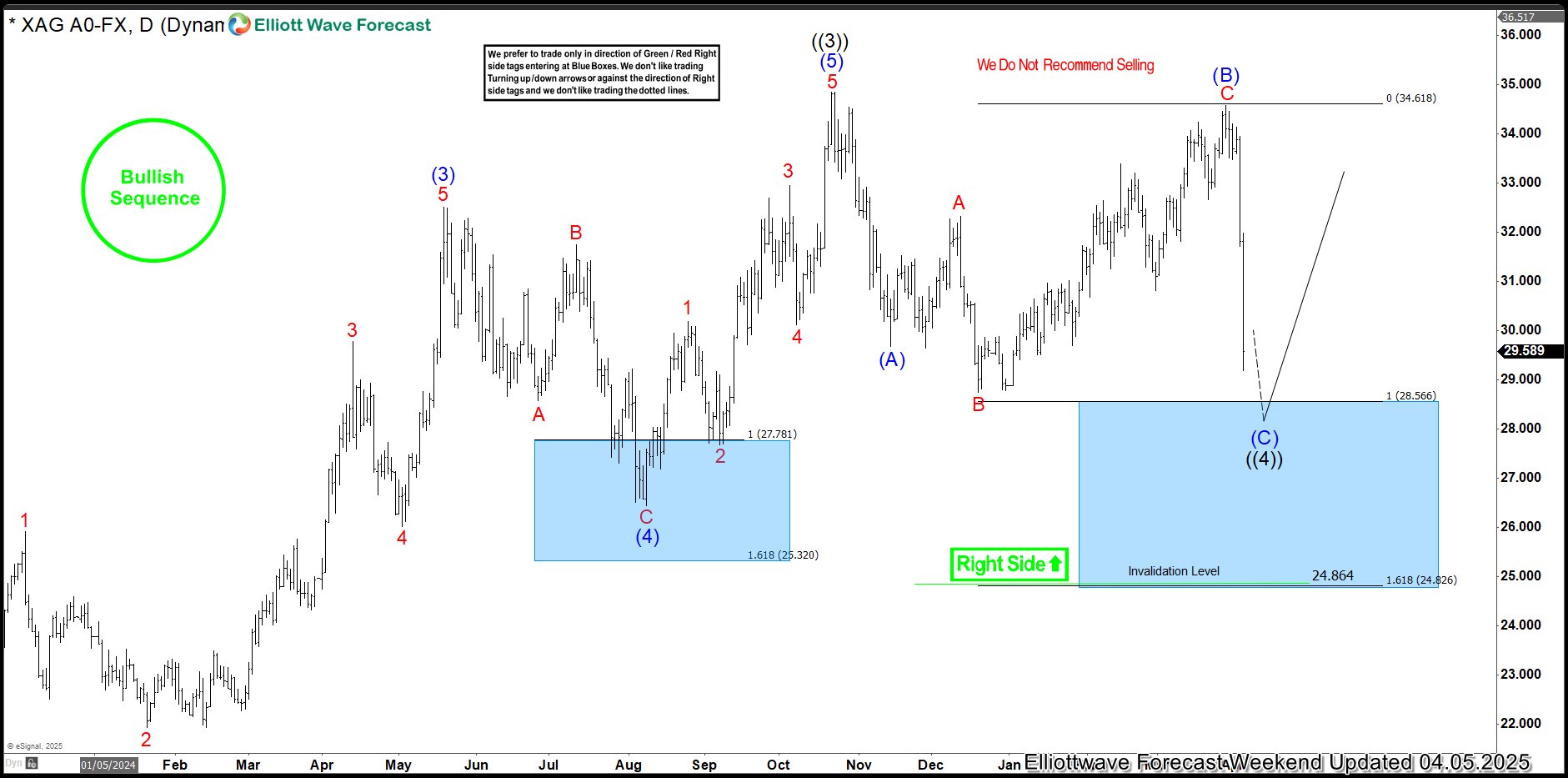
Here are some of the High-Frequency (Blue Boxes) from 2025.

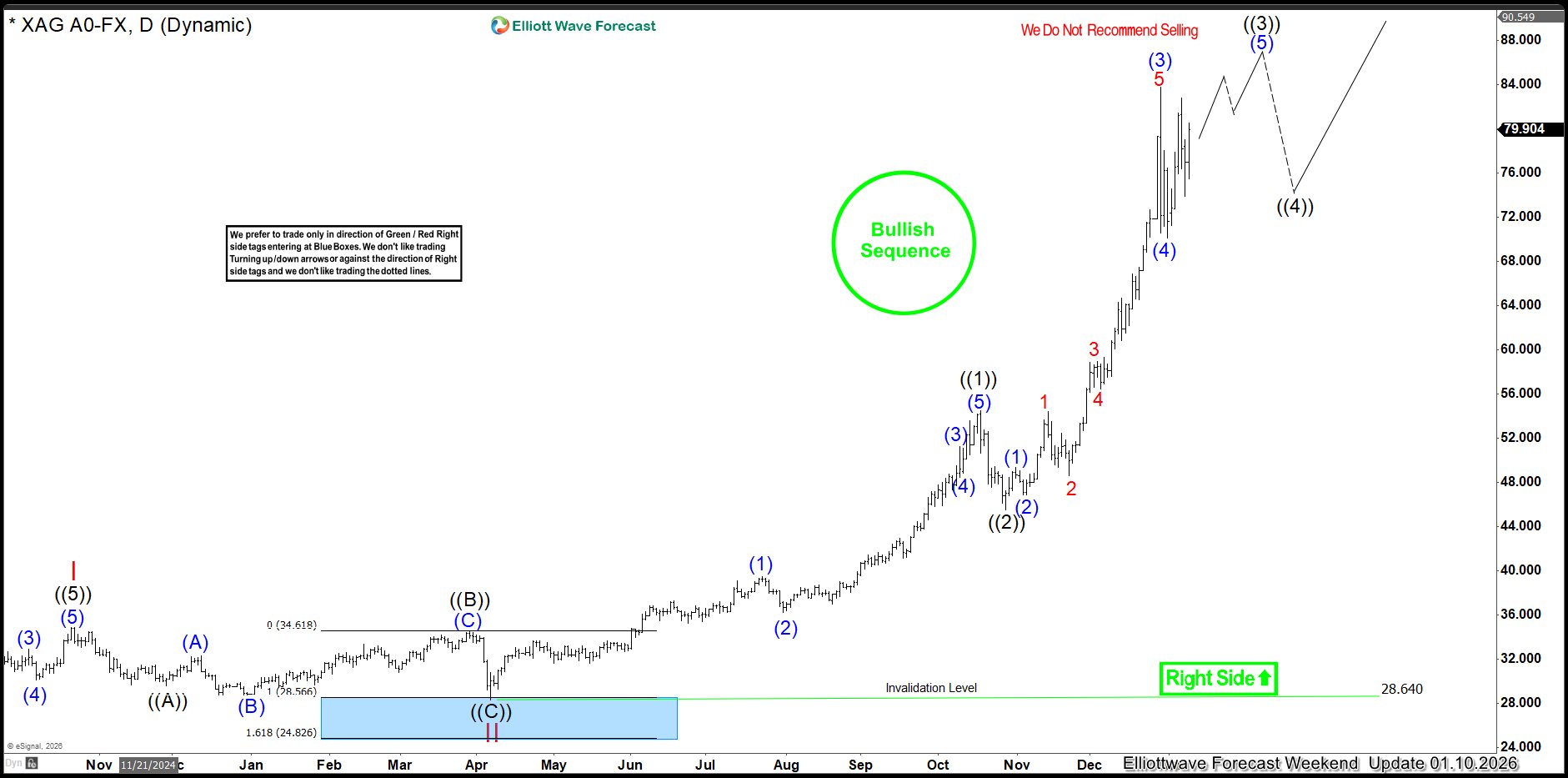
Here is Silver back on 04.05.2025 and Here is Silver now.

Daily Elliott Wave Chart of Silver from 04.05.2025​

.

Daily Elliott Wave Chart of Silver from 01.10.2026​


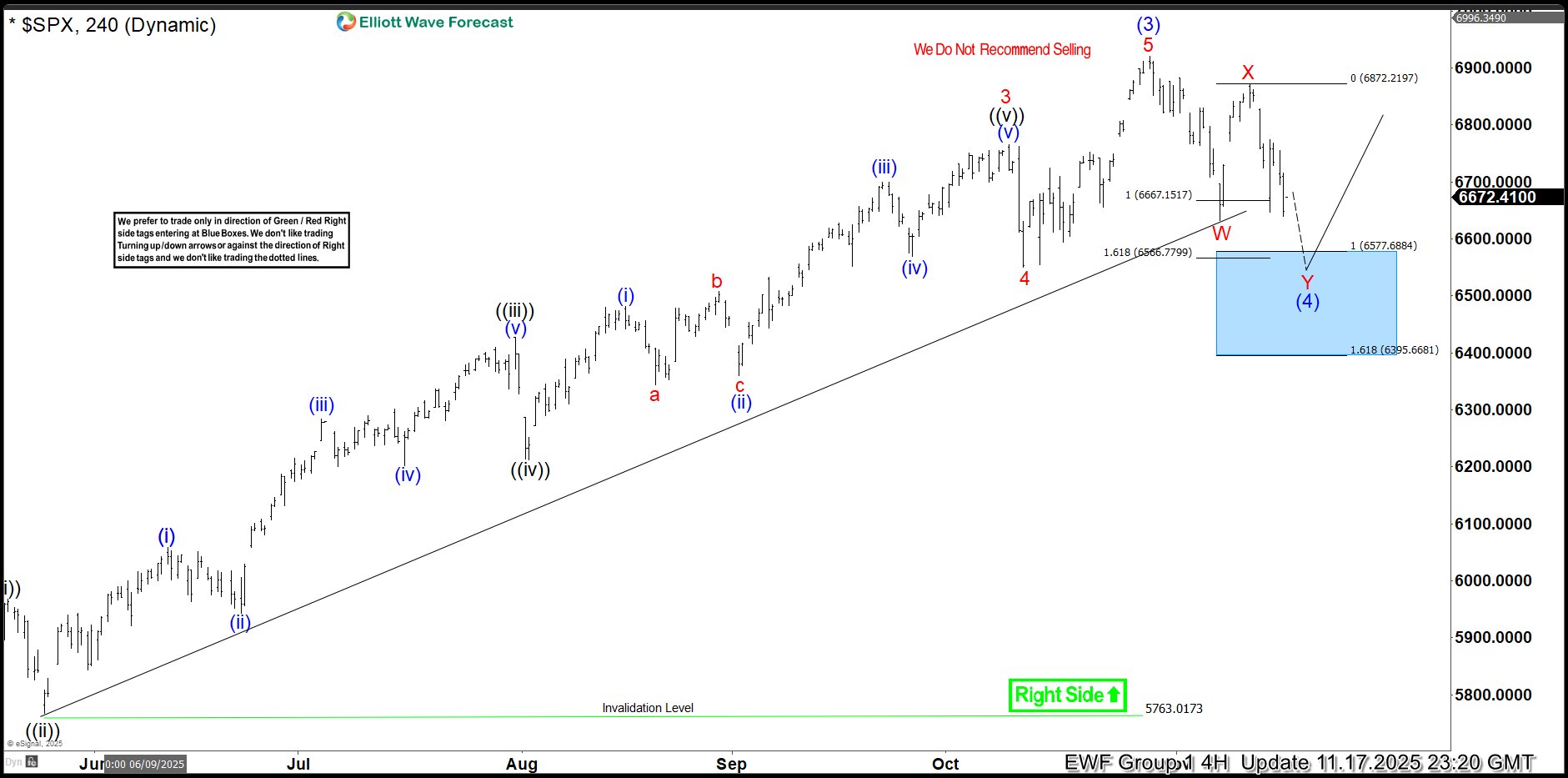
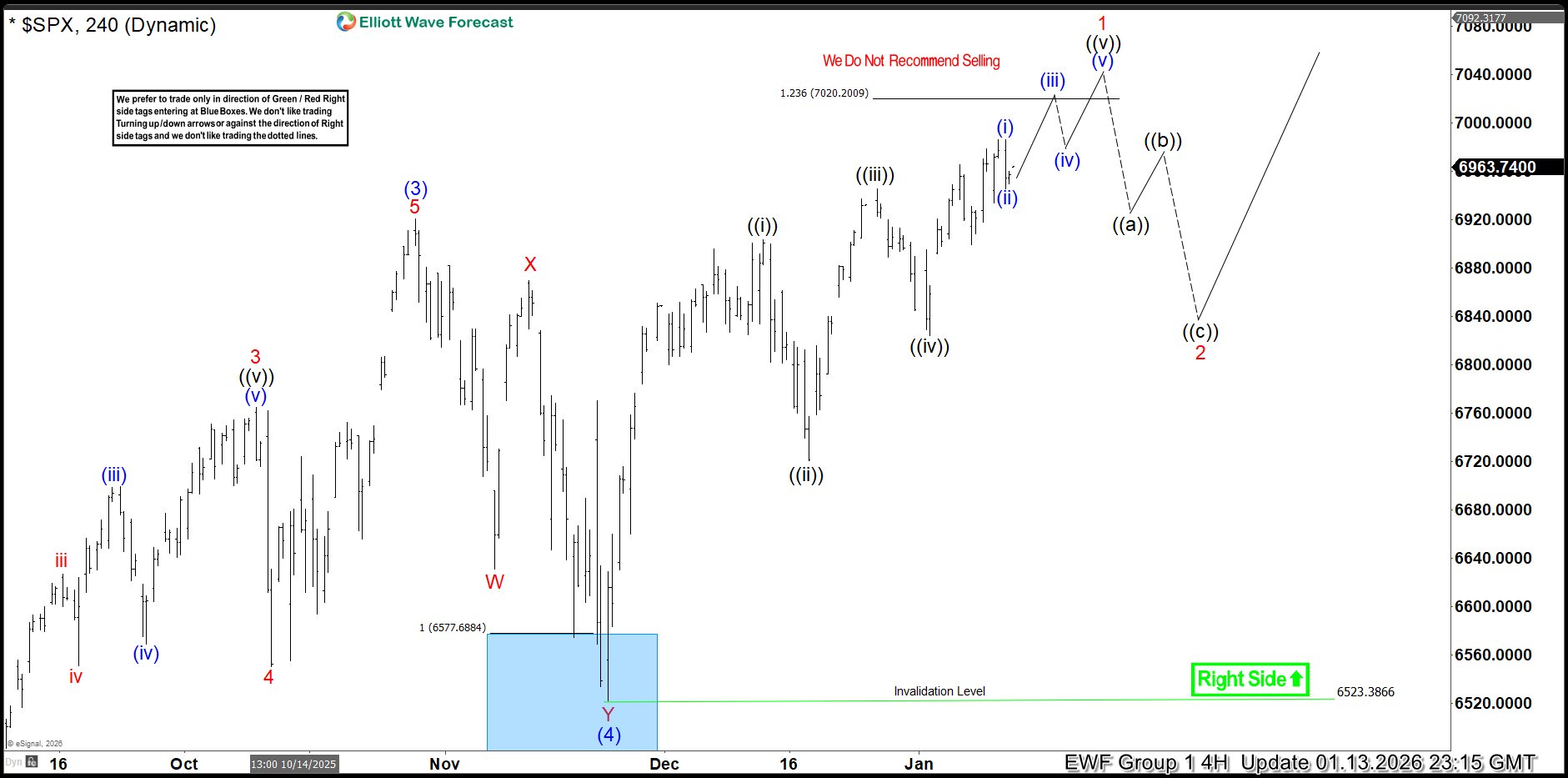
Here is SPX back on 11.21.2025, 4 Hour Time frame and now.


Trading is inherently challenging, and success depends largely on identifying precise entry points and having the confidence to trust those entries. Our approach differs from traditional Elliott Wave services because we have successfully adapted the theory to modern, technology-driven markets. By refining and updating the application of Elliott Wave Theory, we have introduced additional rules to validate or invalidate market structures more effectively.

Our most significant achievement has been the integration of Elliott Wave Theory with high-frequency trading behavior. By aligning classical market psychology with algorithm-driven execution, we have created a framework that reflects how contemporary markets truly operate. This adaptation allows for greater precision, consistency, and relevance in an era dominated by automated trading systems.

Source: https://elliottwave-forecast.com/elliottwave/the-elliott-wave-theory-and-high-frequency-trading/
 
Market analysts expected Visa (V) to post strong results in early 2026. They pointed to rapid AI adoption and rising global travel. Visa planned to report earnings on January 29, 2026. Estimates projected an EPS near $3.14, showing a clear double‑digit gain from last year. Visa also used its value‑added services and new flow initiatives to expand revenue beyond consumer spending. As a result, major institutions kept a Strong Buy rating. They expected Visa to benefit from the modernization of B2B payments.

From a strategic view, investors needed to watch Visa’s response to new regulations and real‑time payment networks. Inflation stayed persistent, yet Visa gained from its inflation‑linked revenue model and strong margins. The company also invested heavily in agentic commerce and tokenization security. These moves widened its edge over fintech competitors. In addition, steady buybacks and a revenue target of $10.72 billion strengthened its long‑term outlook. With high operational efficiency, Visa offered a defensive but growth‑focused option for portfolios in early 2026.


Elliott Wave Outlook: VISA (V) Weekly Chart August 2025​

Elliott Wave Outlook: VISA (V) Weekly Chart August 2025


Using Visa’s weekly chart, we explained that the Blue Boxes acted as reaction zones. From August onward, we expected price to respect those areas. After the stock pushed higher from the blue box, we saw the bullish count as the strongest path. We expected that view to hold while price stayed above $328.70. With that support intact, we looked for a rally toward $386.57–$404.48. In that zone, wave ((5)) of III should have ended and triggered wave IV lower. That pullback likely aimed toward $328.70 before wave V pushed higher. However, a break below $328.70 would have changed the outlook. That move would have signaled a wave III top and an active wave IV decline. In that case, we expected a drop toward $298.75 before wave V advanced.

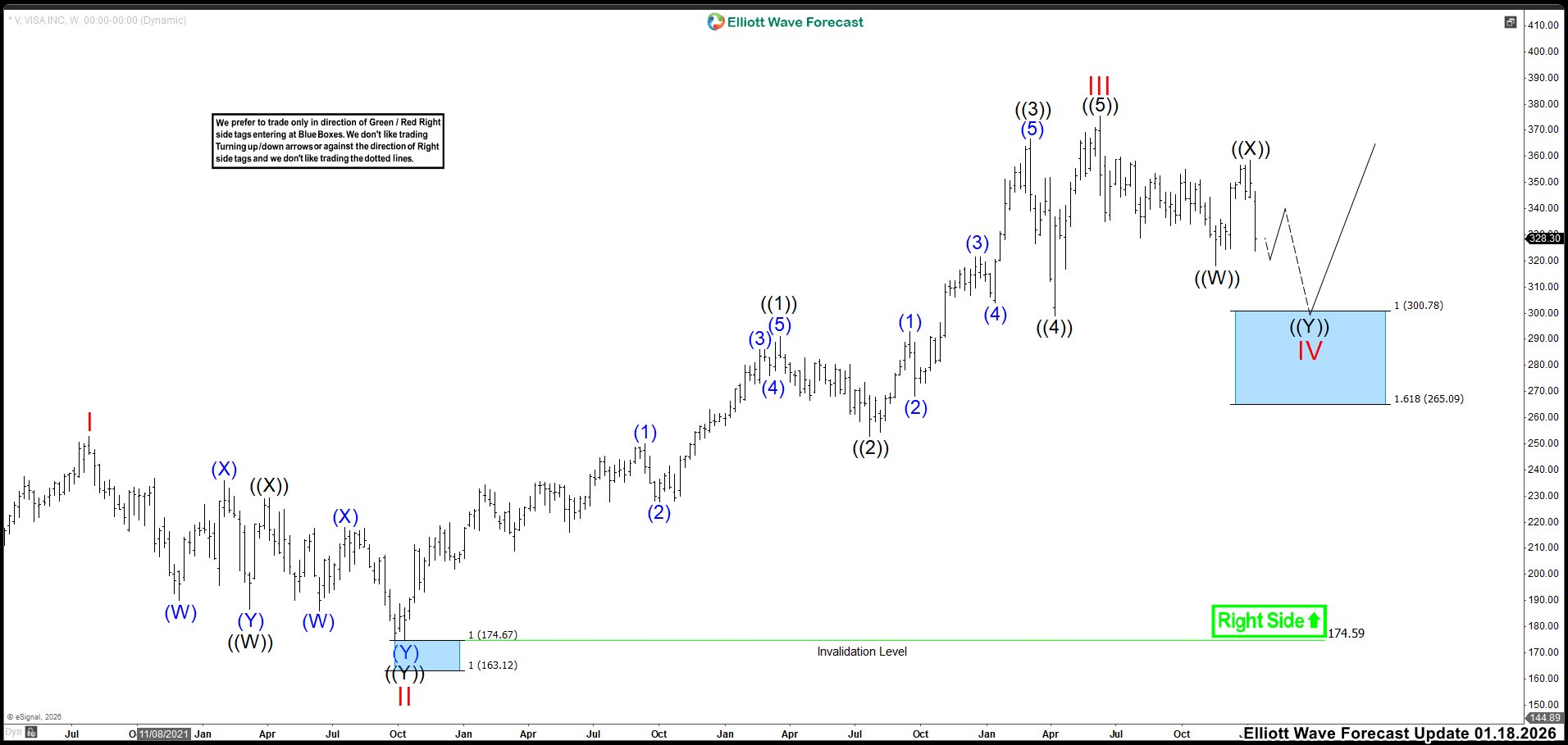
Elliott Wave Outlook: VISA (V) Weekly Chart January 2026​

Elliott Wave Outlook: VISA (V) Weekly Chart January 2026


In this new update, we can see that the market broke below $328.70 in November, suggesting that we are already in wave IV. For that reason, we labeled the structure as a double correction. Wave ((W)) marks the November low, wave ((X)) marks the January 2026 high, and now we are looking for three more waves lower to complete the pattern before the bullish trend resumes.

We expect the next bounce to be corrective, allowing one more leg down into the blue box at 300.78–265.09. To validate this idea, the market must break the November low. That break would give us a great opportunity to buy Visa (V) again.

Source: https://elliottwave-forecast.com/stock-market/visa-v-2026-bullish-trend-overcome/
 
Hello fellow traders,

As our members know we have had many profitable trading setups recently. In this technical article, we are going to present another Elliott Wave trading setup we got in American Airlines (AAL) . The stock completed correction precisely at the Equal Legs zone, referred to as the Blue Box Area. In the following sections, we will explain the trading setup in detail and present the targets.

AAL Elliott Wave 4 Hour Asia Chart 1.14.2026​

Current view suggests AAL stock is doing wave (4) blue correction. The price has reached extreme zone at 15.13-14.43 (blue box- buying area).

We’re entering long positions within the Blue Box. As the main trend remains bullish, we anticipate at least a 3-wave bounce from this area. Once the price touches the 50 fibs against the B red connector, we’ll make positions risk-free and set the stop loss at breakeven and book partial profits. Breaking below the 1.618 Fibonacci extension level at 14.43 would invalidate the trade.

Official trading strategy on How to trade 3, 7, or 11 swing and equal leg is explained in details in Educational Video, available for members viewing inside the membership area.

Quick reminder on how to trade our charts :

Red bearish stamp+ blue box = Selling Setup
Green bullish stamp+ blue box = Buying Setup
Charts with Black stamps are not tradable.

Did you know? 90% of traders fail because they don’t understand market patterns. Are you in the top 10%? Test yourself with this advanced Elliott Wave Test

AAL

AAL Elliott Wave 4 Hour Asia Chart 1.14.2026​

The stock has found buyers as expected and is showing a decent bounce from the Buying Zone which has reached and exceeded 50 fibs against the X red connector. We count the pullback (4) blue as completed at the 14.93 low. Consequently, long positions should now be risk-free. We’ve set our stop loss at breakeven and have already secured partial profits. Now, we would like to see a break of the (3) blue peak to confirm that the next leg up is in progress. While above the 14.93 low, the stock should ideally target the 16.88–17.49 area. Alternatively, if the price breaks 14.93, we will get a deeper pullback, which will allow us to enter long positions again at lower levels.
Keep in mind that market is dynamic and presented view could have changed in the mean time. You can check most recent charts with target levels in the membership area of the site. Best instruments to trade are those having incomplete bullish or bearish swings sequences. We put them in Sequence Report and best among them are shown in the Live Trading Room

AAL

Source: https://elliottwave-forecast.com/stock-market/american-airlines-aal-blue-box-2/
 
ASML Holding N.V., (ASML) provides lithography solutions for the development, production, marketing, sales, upgrading & servicing semiconductor equipment systems. It also offers hardware, software & services to chipmakers to produce the patterns of integrated circuits. It comes under Technology sector & trades as ‘ASML’ ticker at Nasdaq.

ASML trading at ATH, broke the price channel in weekly, favoring rally against April-2025 low. It favors upside in (5) of ((1)) & expect further upside towards $1457.74 before correcting next.

In weekly, it ended (I) at $895.93 in September-2021 & (II) at $363.15 low in October-2022. Above there, it is showing nest structure & favors rally to continue against April-2025 low. Above October-2022 low, it ended I of (III) at $1110.09 high & II at $578.51 low. Within I, it placed ((1)) at $771.98 high, ((2)) at $564 low, ((3)) at $1056.34 high, ((4)) at $849.14 low & ((5)) at $1110.09 high. Within ((2)), it ended ((A)) at $767.41 low, ((B)) at $945.05 high & ((C)) at $578.51 low in zigzag correction.

ASML - Elliott Wave Latest Weekly View:​

Above II low, it favors rally in ((1)) of III. It ended (1) at $826.56 high, (2) at 684.24 low, (3) at $1086.11 high, (4) at $946.11 low & favors upside in (5). Within (5), it ended 1 at $1141.72 high, 2 at $1010.01 low & favors upside in 3. It expects soon to end 3 of (5) and pullback in 4 against 12.15.2025 low before final push to end ((1)). It should extend rally towards $1334.14 - $1457.74 area to end ((1)) before correcting next. Buyers can look to buy the next pullback in 3, 7 or 11 swings in ((2)) against April-2025 low in daily. It already broke channel, indicates bullish bias. The rally within III already extend above $1327.3 level as equal leg area of I, indicates more upside is likely.

Source: https://elliottwave-forecast.com/stock-market/asml-holding-favors-rally-1457-74/
 
Hello everyone! In today’s article, we’ll review the recent performance of Boeing Co ($BA) through the lens of Elliott Wave Theory. We’ll look at how the pullback from recent 52 week highs unfolded as a textbook 3-swing correction and discuss what could come next. Let’s explore the structure and the expectations for this stock.

5 Wave Impulse Structure + ABC correction​

$GOOGL

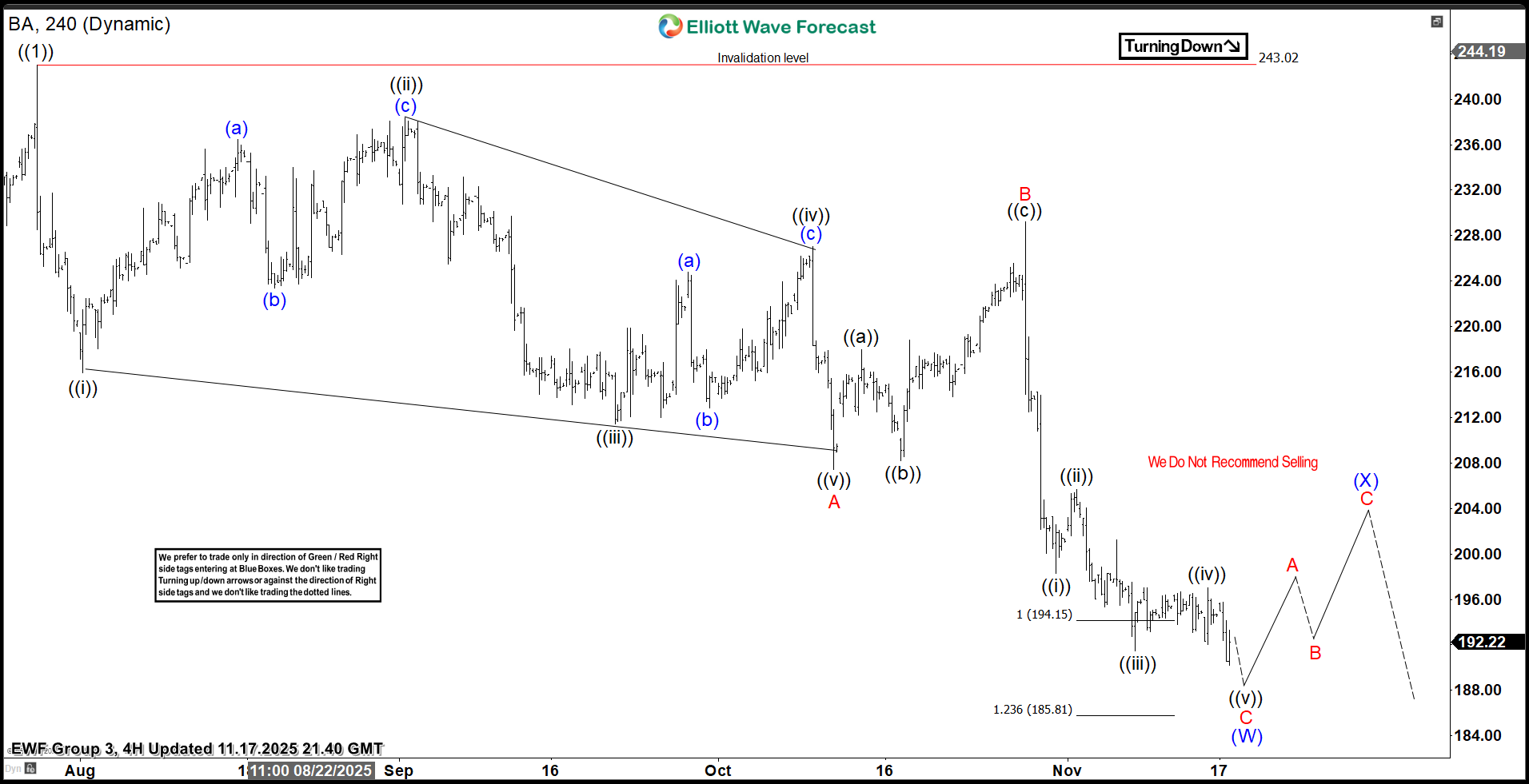
$BA 4H Elliott Wave Chart 11.17.2025:​

$BA

In the 4H chart from Nov 11, 2025, $BA completed a clear 5-wave impulsive cycle labeled ((1)). After such a move, a corrective pullback is typical. As expected, the stock began to retrace in three swings, forming what we identify as an ABC correction.
The price action suggested that buyers would likely appear near the extreme area between $194.15 and $170.06. This zone represents the ideal region where a correction usually ends and a new bullish cycle begins.

In other words, the market took a brief pause before potentially resuming its primary uptrend. Therefore, this structure aligns well with a standard Elliott Wave correction, offering traders a technical roadmap.

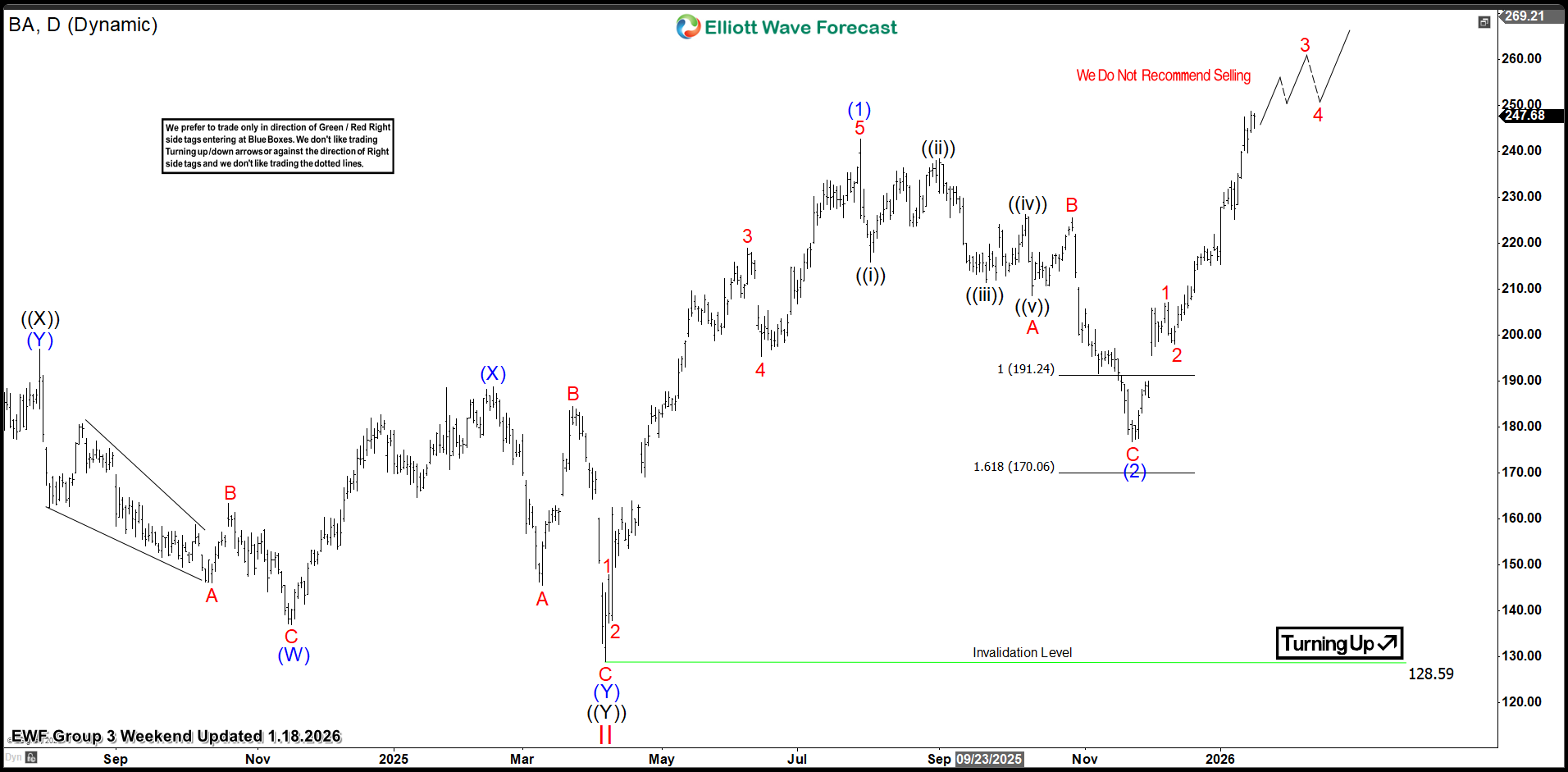
$BA Daily Elliott Wave Chart 1.18.2026:​

$BA

The latest daily chart update, shows that the stock bounced and made new highs confirming the bullish trend. Currently, it is looking to remain supported against 11/21 low and higher in wave 3 of (3). Longs should be risk free and looking for $291-318 area as the next possible target.

Conclusion

In conclusion, our Elliott Wave analysis of $BA suggests the stock continues to trade within a bullish framework. By using Elliott Wave Theory, traders can better anticipate market structure, identify continuation zones, and plan trades with greater confidence.

In addition, understanding how impulse and correction phases interact helps improve risk control, especially in volatile markets like this one. Therefore, maintaining flexibility and discipline remains key as this structure evolves.

Source: https://elliottwave-forecast.com/st...-ba-extreme-area-offering-buying-opportunity/
 
In this technical blog, we will look at the past performance of the 1-hour Elliott Wave Charts of Exxon Mobil Corporation ticker symbol: XOM. In which, the rally from 25 November 2025 low unfolded as an impulse structure. But showed a higher high sequence favored more upside extension to take place. Therefore, we advised members not to sell the stock & buy the dips in 3, 7, or 11 swings at the blue box areas. We will explain the structure & forecast below:

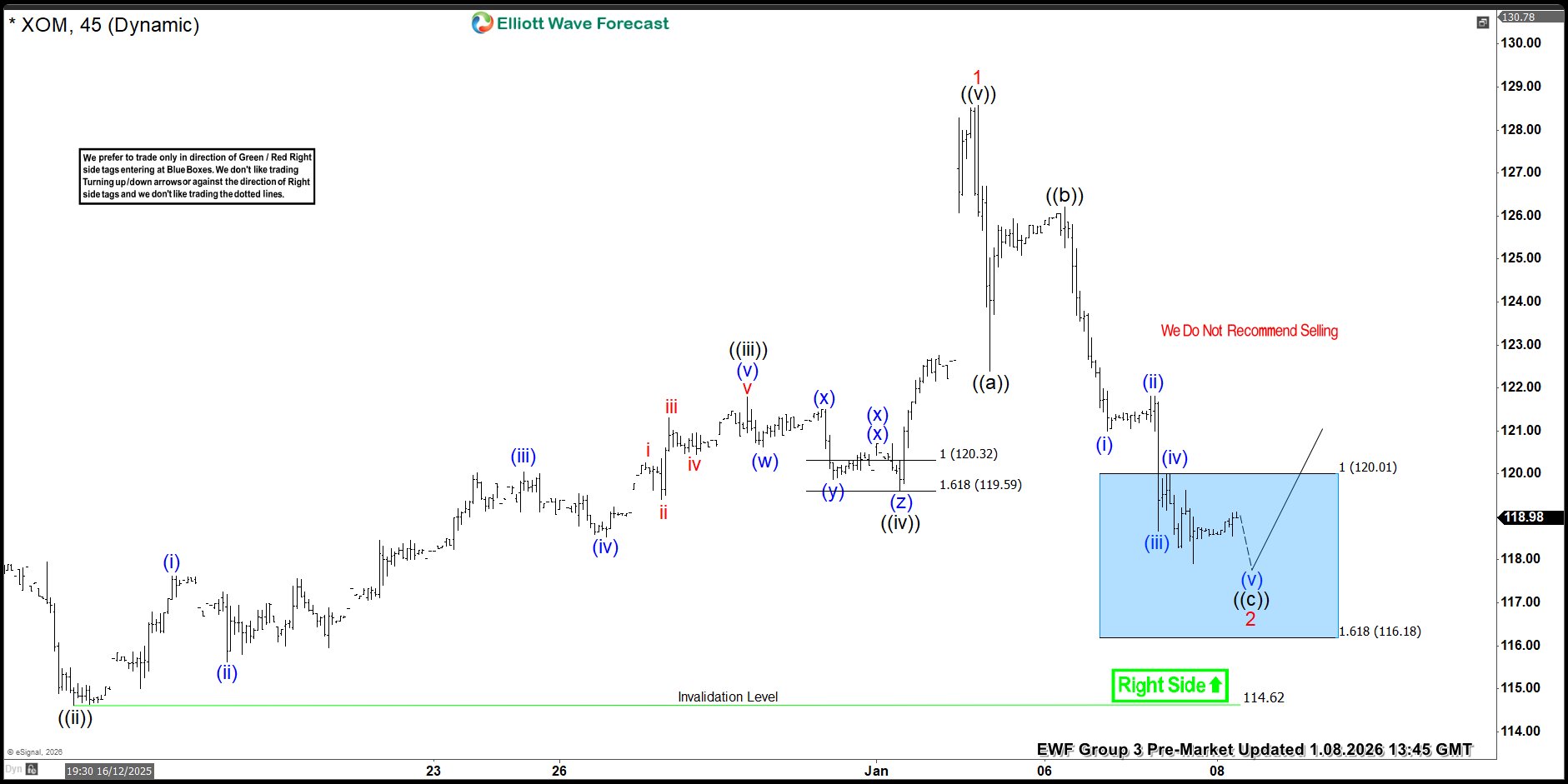
XOM 1-Hour Elliott Wave Chart From 1.08.2026​

Elliott Wave in Action: XOM Rockets from Blue Box Area

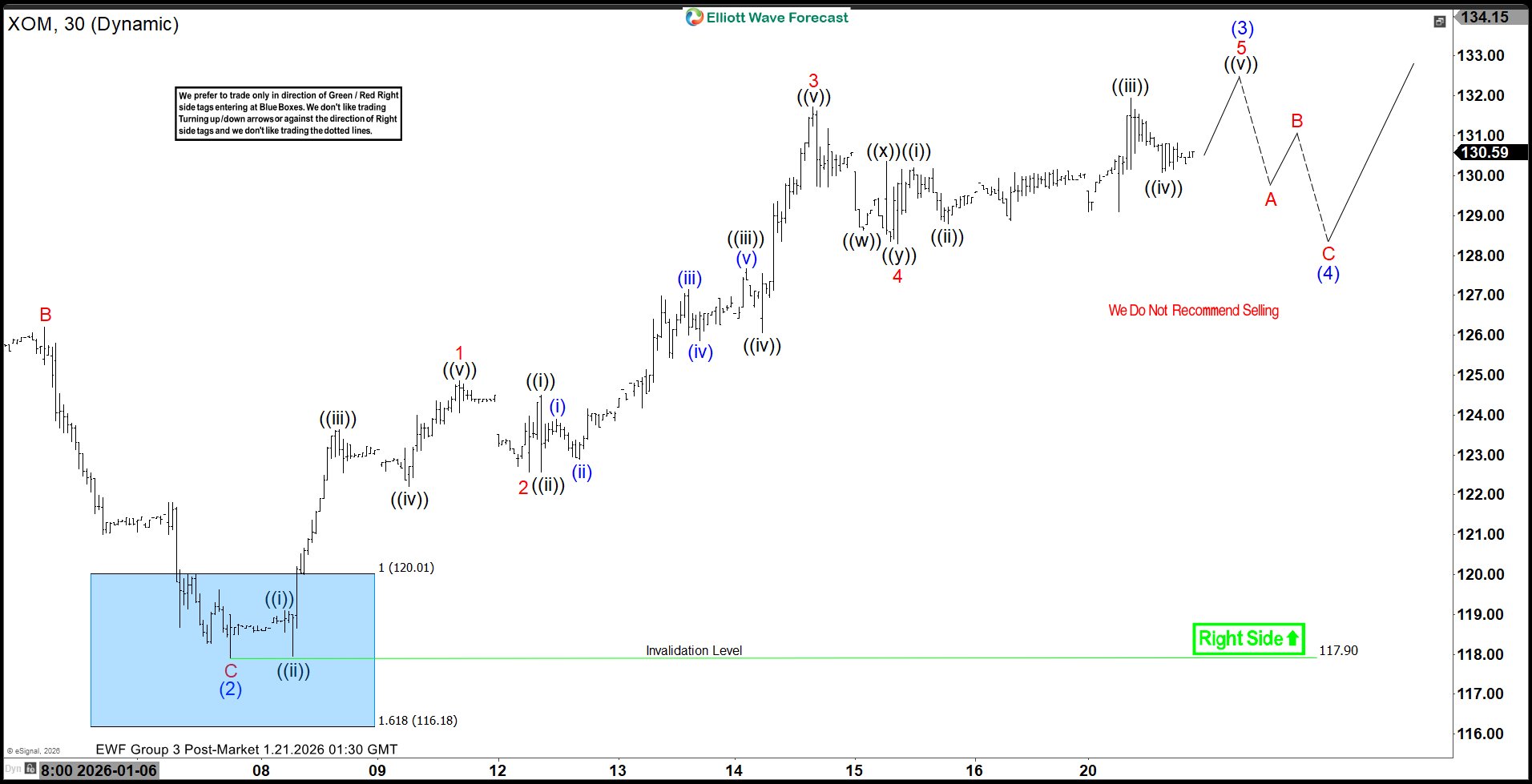
Here’s the 1-hour Elliott wave chart from the 1.08.2026 Pre-Market update. In which, the cycle from the 25 November 2025 low ended in wave 1 at $128.57 high. Down from there, the stock made a pullback in wave 2. The internals of that pullback unfolded as Elliott wave zigzag correction where wave ((a)) ended at $122.39 low. Then a bounce to $126.20 high ended wave ((b)) & wave ((c)) managed to reach the blue box area at $120.01- $116.18 equal legs area. From there, buyers were expected to appear looking for the next leg higher or for a 3 wave bounce minimum.

XOM Latest 1-Hour Elliott Wave Chart From 1.21.2026​

Elliott Wave in Action: XOM Rockets from Blue Box Area

This is the latest 1-hour Elliott wave Chart from the 1.21.2026 Post-Market update. In which the XOM is showing a very nice reaction higher taking place, right after ending the zigzag correction within the blue box area. Allowed members to create a risk-free position shortly after taking the long position at the blue box area. Since then the stock made a new highs once again confirming the next leg higher towards $132.34- $141.28 target area before profit taking & next pullback takes place.

Source: https://elliottwave-forecast.com/bluebox-wins/elliott-wave-action-xom-rockets-blue-box/
 
Raytheon Technologies Corp (NYSE: RTX) leads the aerospace and defense sector. Recent geopolitical events have fueled strong outperformance and momentum for the stock. Today, we analyze the Elliott Wave pattern driving its strategic breakout. Our examination provides a clear technical roadmap for its ascent. This convergence of sector strength and wave structure creates a compelling technical setup.

Elliott Wave Analysis

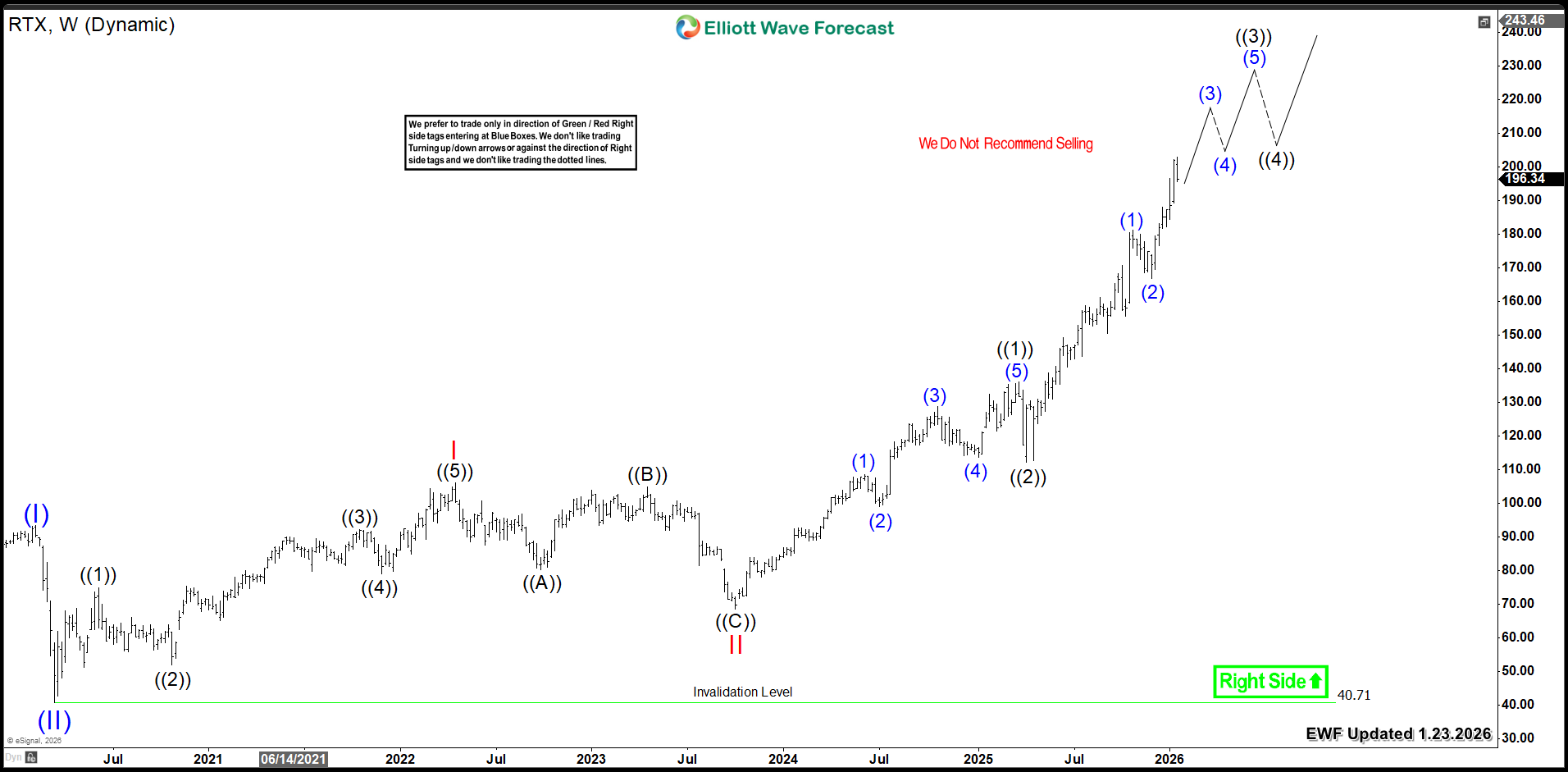
From its 2020 low, RTX created a three-wave advance to new highs. Wave I ended at $106, followed by Wave II at $68. Currently, Wave III remains in progress. This weekly cycle also shows three waves into new highs. Therefore, the stock has an incomplete bullish sequence. It aims to complete five-wave advances from both 2020 and 2023.

The projected path shows an extension toward $222. This move will likely occur within wave ((3)). Consequently, it can later propel Wave III beyond $250.

RTX should continue extending higher through a series of third and fourth waves. The key invalidation level is the April 2025 low of $112. All daily corrections must hold above this level. These pullbacks will create buying opportunities as 3, 7, or 11-swing patterns.

RTX Weekly Chart 1.23.2026

Raytheon Technologies RTX Weekly 1.23.2026

Conclusion​

RTX's bullish cycle confirms further upside ahead. Consequently, traders should target strategic entries during daily pullbacks. Apply our Elliott Wave methodology for exact timing. Specifically, enter the market after a 3, 7, or 11-swing correction completes. Additionally, our proprietary Blue Box system identifies high-probability reversal zones. This disciplined approach provides clarity and confidence. Ultimately, it positions you to capture the next major advance.

Source: https://elliottwave-forecast.com/video-blog/raytheon-technologies-rtx-breakout/