
Popular results
Position Sizer
Calculate risk-based position size directly in your MetaTrader platform and execute a trade in one click or a press of a button.What Is Forex
Learn what Forex is and how it works from this simple explanation.Supertrend
Download the Supertrend indicator for MT4 and MT5 to detect trend changes based on the price action.Position Size Calculator
Calculate your position size based on risk, stop-loss, account size, and the currencies involved. A simple online calculator for quick results.The Opening Range Breakout (ORB) Strategy
The Opening Range Breakout strategy is worth considering if you are in search of a breakout strategy that lets you take advantage of high volatility. This guide will explain how this strategy works, how to execute it, and its pros and cons.
What is the Opening Range Breakout (ORB) strategy in Forex?
The Opening Range Breakout strategy is what it sounds like. It's a breakout strategy you can use to get in on a move at the open of the market. You begin by drawing a channel based on the high and low, then you enter after price breaks out in either direction.
When to trade the ORB strategy
The Forex market is open 24 hours a day, 5 days a week — from Sunday at 17:00 New York time to Friday at 17:00 New York time.
That means the market as a whole only opens and closes once a week. But the individual trading sessions open and close each day during the trading week. You can use the ORB strategy during those session opens as well. Sydney and Tokyo trading sessions open at 9:00 local time while London and New York sessions open at 8:00 local time.
Convert the time to your local or your broker's time zone to figure out when you need to be ready to trade (googling for '<place> time' is a good way to find the time difference between that place and your own time zone).
If you are looking for the highest volatility and the biggest moves, the London and New York sessions often produce them. If you prefer lower volatility, try one of the Asian sessions. The choice of the session also affects the selection of currency pairs you will be able to trade. For example, New York open is great for EUR/USD ORB trading, but a poor choice for AUD/JPY.
How to do the ORB strategy in Forex step by step
There are people who have developed ORB indicators and trading robots. But you do not technically need one in order to employ the strategy. It is pretty straightforward to execute by hand. You don't need any math skills. You just need to be able to identify highs and lows. Here are the steps.
ORB guidelines
Be at your trading platform with your charts open when the market opens. You can try the M15 or M30 timeframes. Some traders might go as low as the M5 timeframe.
How long a period you are considering (see below) is going to be more important than what timeframe you are viewing. Remember, the M5 chart has the same info in it as the M15 chart, just with more detail. Go with whatever view helps you visualize most clearly what is going on.
Choose a period of time for the opening range to form after the market opens. Usually, traders pick somewhere between 15 and 30 minutes for intraday sessions. Some traders go as low as 5 minutes when they expect the volatility to pick up rather quickly. Other traders might use a longer period of 1 or 2 hours, especially when waiting out the sluggishness of the weekly session's opening.
Waiting a shorter amount of time lets you get in on immediate volatile moves. But it may be harder to avoid whipsaws.
- Use horizontal lines to mark the high and low of the initial ranging period once it is over.
- Next, you just need to wait. You are looking for a bar to close above the high or below the low. Note that it cannot simply cross the line, it needs to close beyond the line.
- Enter a trade based on the rules you decide. You'll need to figure out how many pips away from the line you want to place your entry, whether you are going to wait for confirmation or retracement, etc.
Set a stop-loss and take-profit. Where to set your stop-loss depends on your strategy and your expectations from the ongoing breakout. Common options include:
- Just inside the line that price crossed over.
- Halfway between the two lines.
- The opposite edge of the range (i.e., the low of the range when buying, or the high of the range when selling).
Profit-taking can be done using either a simple risk-to-reward ratio (as your stop-loss already depends on the market structure, this will place your take-profit on a market-based level) or using statistical testing (backtest 100+ breakout setups to determine the optimal TP distance).
Some traders swear by a trailing stop-loss to ride out their wins rather than get out at a set price.
The SL and TP suggestions listed above are just that. There are many ways to determine your stop-loss, including ATR-based stops or even timed exits. You should test out different stop-loss and take-profit options to find what works for you.
Example ORB trades
Let's look at some examples.
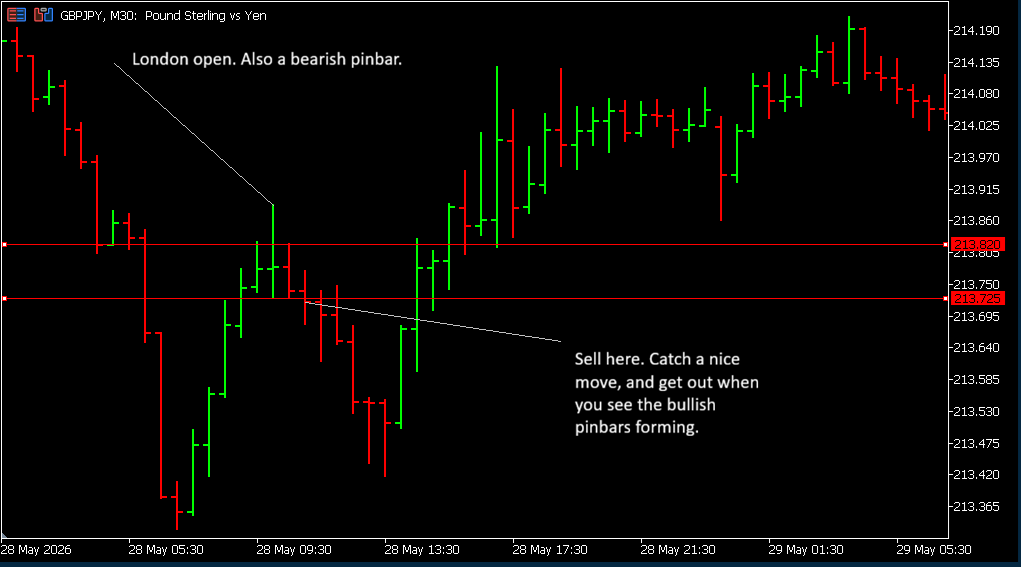
In the chart below, the London session open features a bearish pinbar. Sure enough, price dips below the low line. So, you have the crossover plus confirmation from price action, making it a solid entry.
Price continues dropping until it forms a pair of bullish pinbars. That is where it would make sense to exit, if you did not exit earlier. Indeed, immediately after them, price surges back upwards. If you happened to place a buy entry right above the pinbars (using price action, but no longer the ORB strategy), you'd end up catching that move too.
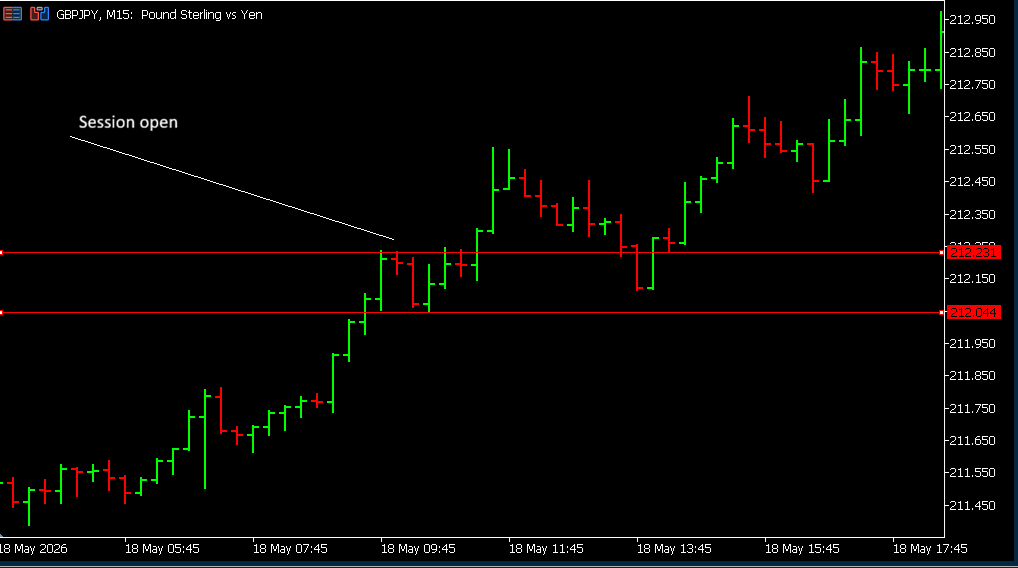
Below is a simple example of a session open where price breaks above the top line. It does so a bit tentatively, so you would need to be patient. But you could catch a nice move upward.
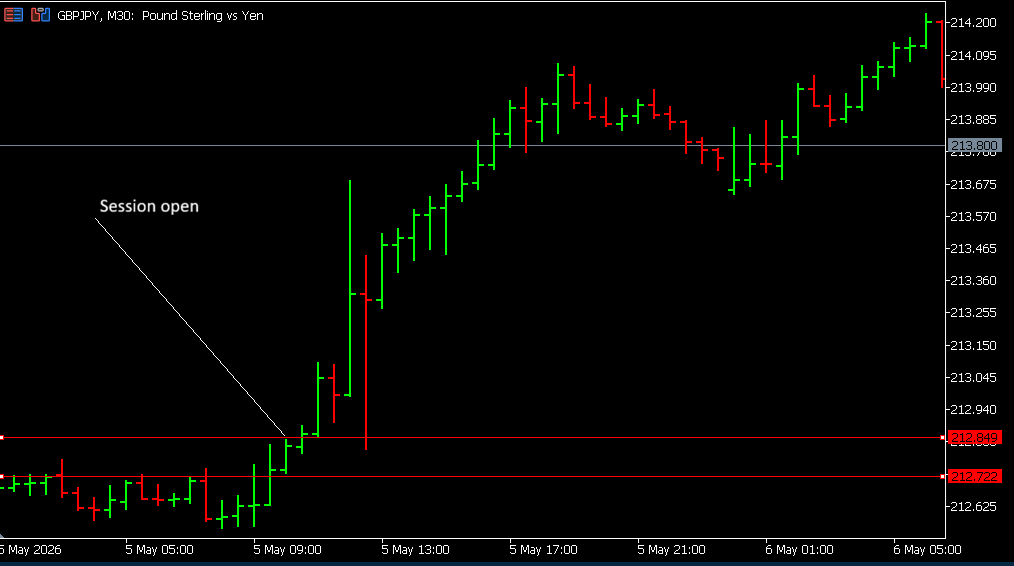
Here is a similar setup, but with a stronger break upward.
Tips for Using the ORB strategy effectively
Here are some suggestions to make the most of the ORB strategy:
- Be consistent, and test your specific rules. Come up with set rules for entering and exiting, and then stick with them. Test them out in demo before you try them out live with real money.
- Beware of volatility. Remember, the volatile swings in price can make or break you.
- The best pairs for this strategy include GBP/USD, USD/JPY and EUR/USD. They offer tight spreads and high liquidity, making them well-suited. But the ORB method can work with other major currency pairs as well.
- Look for a broker with fast execution. The reason it matters is because when a session opens, there can be a lot of trading volume. This can result in slippage. You are less likely to suffer from it if your broker executes your trades quickly and reliably.
- Start with longer periods. Half an hour gives you more data than 5 minutes, which may make profitable trading easier.
- Watch out for fakeouts. Making sure the candle closes outside the range, not just crosses over and then closes inside, is one way to reduce fakeout exposure. So is looking for confluence when entering. What should you do if price does reverse on you after entering? Some traders get out and accept the loss. Others may take advantage of the momentum of others exiting their positions to reverse their positions. Still others may attempt to wait it out in case price goes back in their direction. Using technical indicators and price action may give you more insights to help you make your decision. No matter what, thoroughly test your rules for handling fakeouts before going live with real money.
Pros of the ORB strategy
- The ORB strategy is incredibly easy to learn. Even if you are new to Forex, you can understand how to do it at a glance.
- You do not need any technical indicators, unless you want them for confirmation.
- You can customize the ORB strategy by choosing what timeframes to view, what periods to monitor, and what confirmation signals to use.
- You can do the ORB strategy throughout the week.
- You don't have to spend a lot of time watching the charts. You just need to be present for the beginning of the session. No matter what time zone you are in, at least one of the sessions will probably be convenient for you.
Cons of the ORB strategy
- Some traders might feel overwhelmed with the many ways they can modify or enhance this strategy, and not know where to begin.
- If none of the session opens are convenient for you, it might be harder to trade.
- You are dealing with relatively low timeframes, even if you use a half hour period, but especially if you use a shorter span of time like 5 minutes. You may be in and out of your trades in minutes. The volatility, slippage, and the requirement to quickly and clearly make decisions and carry them out can increase your risk. They also may not suit every trading style.
- The ORB strategy is popular, but has no proven edge. You should only use it live if it is profitable for you in demo tests. Your entry and exit rules, how you handle fakeouts, and the other indicators or price action you use for confirmation may ultimately be what determines whether it works for you or not.
Is the ORB strategy right for you?
The ORB strategy can be a good option for beginning, intermediate or advanced traders. You might like it if it fits with your schedule and you want something simple that doesn't take up a lot of time.
Just remember to be mindful of whipsaws and the dangers of high volatility. Novice traders especially should be cautious getting started with the ORB strategy.
The ORB strategy works best if you fully test your system rules and are consistent with execution.
Warning!
Use this strategy at your own risk. EarnForex.com can't be responsible for any losses associated with using any strategy presented on the site. It's not recommended to use this strategy on the real account without testing it on demo first.
Discussion
Do you have any suggestions or questions regarding this strategy? You can always discuss ORB Strategy with the fellow Forex traders on the Trading Systems and Strategies forum.


