
In trading discussions, you will often come across claims like: "EUR/USD just got pumped!" But what does that phrase actually mean?
In the classic sense, a pump and dump is a coordinated manipulation scheme. The organizers first accumulate an illiquid asset, artificially drive up its price through hype and manufactured frenzy, and then dump the asset onto the late buyers. Ultimately, the price collapses, leaving the crowd of retail investors with massive losses. But does this concept apply to the foreign exchange market?
When a currency pair spikes 80 pips in a second following a CPI release, is that a pump? Could a liquidity sweep above a local high or a sudden spread widening overnight really be the result of a calculated attack? And is even a major bank capable of artificially inflating the euro just to offload their position into retail traders at a profit?
In reality, a classic pump and dump on major currency pairs is virtually impossible due to the very structure of the Forex market. It is not just about the trillions in daily turnover. Such a scheme requires tight control over supply, orchestratable hype, and a guaranteed pool of exit liquidity. On the currency market, these elements simply do not exist.
Manipulation does happen, but it looks entirely different. That is why it is crucial to draw a clear line:
What does a classic pump and dump actually require?
To understand whether a pump and dump scheme can actually apply to the foreign exchange market, let's break down its core mechanics. What key elements does a manipulator need to execute a classic pump and dump?
A traditional scheme always consists of four stages:
- Control: The manipulator must buy up a critical share of the available supply to gain near-exclusive influence over the price.
- Promotion: The manipulator creates media noise, spreads false narratives, and manufactures artificial hype around the asset.
- Exit Liquidity: The manipulator requires a crowd of naive buyers willing to enter the market at the peak of the rally.
- Distribution: The manipulator dumps the accumulated position into the stream of incoming buyers until demand dries up and the entire structure collapses.
Think about this for a moment: what is the core point of this scheme? The question is not "Can a large player temporarily move the price?" Of course they can. The key question is: "Can a manipulator profitably push the price up, sustain it at elevated levels, and monetize their position after accounting for all transaction costs and market impact?"
If even a single link in this chain breaks down, the entire scheme becomes economically pointless. Let's apply this rigorous framework to the structure of Forex and test whether such a closed loop could ever work in practice.
Why small concentrated markets are vulnerable to P&D
Why do pump and dump schemes work so effortlessly in some markets while remaining virtually impossible in others? To understand this, let's first look at classic examples: penny stocks and memecoins.
Consider penny stocks that trade on centralized exchanges, have a fixed share count and transparent free float, and suffer from extremely thin order-book liquidity. Manipulators only need to buy up a modest fraction of the available shares to trigger a sharp price surge. Next comes aggressive promotion to reel in naive retail traders, after which the manipulator closes the position at a profit, dumping shares into the growing wave of incoming buyers.
In low-liquidity cryptocurrencies, the dynamic is even more pronounced. A significant portion of the token supply is often held by insiders right from the start. Liquidity across Automated Market Maker (AMM) pools can be negligible, and offshore order books are frequently bone-dry. A few anonymous social media channels launch a viral meme and coordinate the crowd, allowing even a modest volume of genuine buying pressure to drive the price up exponentially.
What do these assets have in common?
Above all, controlled supply. The scheme succeeds not merely where nominal market cap is low. A manipulator requires an asset where they can accumulate and hold a critical share of the available circulating supply. Without control over supply, there is no pump.
Why free float and market cap do not apply to EUR/USD
Have you ever tried calculating the market cap of EUR/USD? Attempting to mechanically apply the logic of equities and cryptocurrencies to the interbank Forex market leads to a fundamental error.
In the stock market, everything is transparent. An issuing company has a fixed number of shares outstanding, a measurable free float, and a clear book value. In the crypto industry, emission schedules are predefined, and token distribution across wallets can be directly tracked on-chain.
With fiat currencies, the dynamic is entirely different. Their total volume is not fixed once and for all. The money supply expands and contracts dynamically, driven by commercial bank credit creation, central bank open market operations, and continuous fluctuations in banking reserves. There simply is no static, globally controlled inventory of currency that a syndicate of manipulators could quietly corner and lock up.
Consequently, the very concept of a "EUR/USD market cap" is a pure illusion. A currency pair is neither a corporation nor an asset with finite supply. It is a floating exchange rate reflecting the relative value of two massive economies. How many "units" of EUR/USD exist in the world? The question itself is economically nonsensical.
Instead, we must strictly distinguish between these concepts:
Monetary aggregates like M2 reflect the state of a national financial system, while central bank balance sheets represent regulatory assets and liabilities. Neither corresponds to the actual capital queued in limit order books on the interbank Forex market.
Furthermore, the currency market allows participants to build net exposure through a wide variety of instruments: spot, exchange-traded futures, forwards, FX swaps, options, and retail CFDs. The aggregate volume of this exposure cannot be derived from circulating banknotes or central bank reserves.
How can anyone corner the tradeable supply and execute a pump and dump scheme when the supply itself has no fixed boundaries? In a mature foreign exchange market, doing so is simply impossible.
What actually determines price impact in EUR/USD?
If the traditional supply in Forex has no fixed volume, what actually drives the movement of the EUR/USD exchange rate? Why does the price move at all?
It all comes down to market depth and the price impact of orders. At any given moment across major electronic venues, there is a dense grid of limit orders placed by Tier-1 banks, non-bank market makers, and electronic liquidity providers (ELPs). To shift the marginal price by even a few pips, an entity must execute a massive volume of aggressive market orders, continuously absorbing resting passive liquidity.
It is also worth putting this scale into perspective. According to data from the Bank for International Settlements (BIS), daily turnover across global foreign exchange markets runs in the trillions of dollars.
However, do not fall into the "turnover fallacy." This metric reflects the aggregate transaction volume generated by thousands of institutional participants, not a static pool of capital that a manipulator can simply "buy out" and hold under their control.
Moreover, Forex is an over-the-counter (OTC), decentralized market where liquidity is heavily fragmented. It is dispersed simultaneously across dozens of ECNs, interbank platforms, and prime-broker pools. If someone attempts to artificially inflate a quote on a single venue, what happens? Exactly: lightning-fast algorithmic arbitrage immediately closes the spread across venues.
This cross-venue price alignment makes sustaining an artificial price level economically unviable. A manipulator would be forced to continuously absorb opposing liquidity across multiple platforms using their own balance sheet, incurring escalating costs.
The core bottleneck in monetizing an artificial dislocation
Imagine you have billions of dollars and decide to launch a "pump" on EUR/USD. Moving the exchange rate in a thin market is not that difficult, but the real challenge begins right after that.
You must navigate an entire sequence of obstacles: move the market → sustain the new level → attract external buying flow → profitably distribute the position.
To push the euro higher and hold it at an artificially elevated level, you will need a relentless and colossal stream of aggressive buy orders. But where will you find naive buyers at the very peak? Unlike in memecoins, Forex has no unified retail crowd that can be rounded up in a single chat room and steered into the market with cheap hype. Manufacturing a synchronized wave of blind demand here is virtually impossible.
Instead, institutional market participants will eagerly begin selling against your move, generating a steady stream of opposing flow and compounding the risk of an adverse outcome for the entire operation.
The very market depth that resisted your upward push becomes your primary obstacle when you decide to exit. The moment you attempt to lock in paper gains and start dumping your massive accumulated position, your own selling pressure will hammer the market. You will trigger a self-induced price reversal, destroying your potential profits before you can even fully close the position.
Why spend billions on an operation designed to self-destruct?
Why forex is not one homogeneous market
Do not view Forex as a single monolith. That is a misconception. The currency market is a complex ecosystem where liquidity and vulnerability are distributed unevenly. This unevenness is most visible across three broad tiers of currency pairs:
At the top of this hierarchy sit major pairs like EUR/USD and USD/JPY. Their liquidity is immense and sustained almost continuously, with thousands of dealers worldwide easily absorbing local shocks. Minor pairs and crosses have lower liquidity, wider spreads, and higher sensitivity to short-term supply-and-demand imbalances — especially during session transitions.
And what happens with exotic currencies like TRY and ZAR?
There, the rules of the game change radically. Thin order books, capital controls, and unpredictable central bank interventions leave these pairs far more vulnerable to aggressive order flow.
Add to this the disparities between onshore and offshore markets, along with the element of timing. Dense liquidity during the London–New York session overlap is a completely different world compared to thin pre-Tokyo open or post-weekend gaps.
How could anyone treat such a layered mechanism as a single whole?
What traders mistake for a "Forex pump"?
When a massive candle suddenly appears on the chart, traders love to argue: "We got pumped again!" But is that really what's happening? Let's break down what you actually see on your screen and the real mechanics driving each move.
| What You See on the Chart | Practical Explanation | Root Cause |
| An 80-pip candle in a single second | Macroeconomic repricing | Algorithmic reaction to CPI or NFP data deviating from forecasts |
| A sharp breach of a local key level | Liquidity sweep | Triggering of stop-loss clusters stacked behind key levels |
| A sharp reversal following a breakout | Profit taking and hedging | Institutional players closing positions into the opposing liquidity surge |
| A long wick triggering a stop-loss overnight | Liquidity depletion and spread widening | Thinned market depth and dealer position rebalancing |
| A massive candle right at news release | Liquidity vacuum | Market makers pulling limit orders ahead of high-impact releases |
| "Smart Money Trap" narratives in trading blogs | Post-facto price rationalization | The cognitive bias of attributing routine market balancing to malice |
| "Buy 1-minute" alerts on illiquid exotic pairs | Pre-positioning / Distribution | Channel admins pre-position ahead of the call and exit into subscriber flow |
Consequently, a chart pattern alone never proves malicious intent. What retail traders mistake for a conspiracy is almost always just the routine reality of market microstructure.
When FX manipulation is actually real
Does this mean that manipulation does not exist on Forex at all? Of course not. However, real-world misconduct confirmed by investigations from the DOJ, CFTC, FCA, and FINMA bears no resemblance to a primitive pump and dump scheme.
For example, in May 2015, Citicorp, JPMorgan Chase, Barclays, RBS, and UBS pleaded guilty to criminal charges involving conspiracies to manipulate the USD and EUR exchange rates in the FX spot market, agreeing to pay over $2.5 billion in criminal fines.
A year earlier, in November 2014, the U.S. Commodity Futures Trading Commission issued orders against Citibank, HSBC, JPMorgan, RBS, and UBS for attempted manipulation of global FX benchmarks — including the 4 p.m. WM/Reuters rate — and for aiding and abetting other banks in similar conduct.
A separate investigation by the Swiss financial regulator, FINMA, revealed just how far such misconduct could go within a major bank. In UBS's foreign exchange (Forex) and precious metals trading units, the regulator identified the following violations between 2008 and 2013:
- Benchmark Manipulation: The bank's traders routinely attempted to manipulate key foreign exchange fixings, particularly the 16:00 WM/R fix, often coordinating their actions with traders at other banks via private chat rooms.
- Deception and Trading Against Clients: Traders engaged in front-running client orders, artificially triggered client stop-losses (stop-loss jamming), imposed excessive markups, and leaked confidential information.
- Compliance and Risk Failures: The bank lacked adequate risk management and compliance systems, and management failed to effectively prevent and detect misconduct.
As a result, the regulator ordered UBS to disgorge CHF 134 million in illegal profits and avoided costs, imposed limits on employee bonuses, mandated the automation of 95% of its trades, and opened individual enforcement proceedings against 11 traders.
Traders at these banks shared confidential client order details in private chat rooms and colluded ahead of the fixing window. However, their objective was never a classic pump and dump designed to offload positions onto retail traders. Instead, they aimed to influence the benchmark rate to secure more favorable execution on orders tied to that specific fixing rate.
At the microstructural level, practices like spoofing and layering do occur: algorithms place large phantom orders on specific ECN order books for fractions of a second and quickly cancel them to mislead competitors' pricing models.
What about broker practices?
Here, it is vital to distinguish between core market mechanics and outright abuse. Routine spread widening or slippage during high-volatility periods are normal expressions of market mechanics. However, unregulated bucket shops can configure asymmetric slippage, generate off-market price spikes (wicks), and selectively reject client orders.
Remember: A retail dealer can manipulate its own internal servers without exerting the slightest influence on the broader interbank market.
Finally, consider central bank interventions (such as those by the Bank of Japan or the Swiss National Bank). Yes, on a chart, this can look like a vertical rocket. But central banks act to pursue macroeconomic policy objectives, not to generate speculative profits by dumping positions onto retail traders.
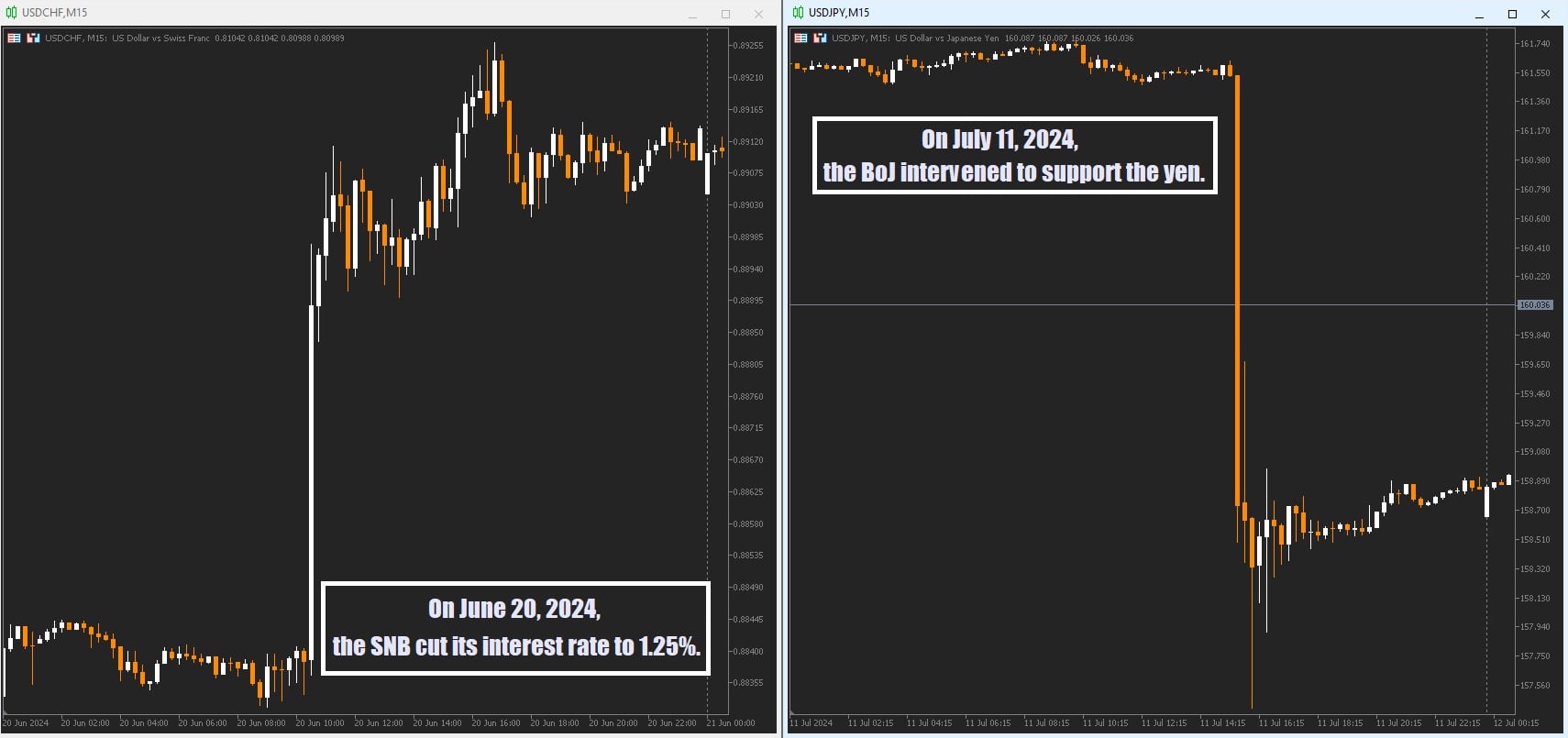
Why FX moves without a "pump"
Exchange rates experience sharp surges because currency pairs do not exist in the isolated vacuum of an order book. Quotes reflect a continuous process of price discovery and balance-seeking across interconnected global markets.
Shift interest rate expectations or government bond yields? Capital immediately begins rotating from one currency to another. Large institutional funds rebalancing their equity and commodity portfolios? These massive cross-asset flows ripple directly through the spot FX market. And when prices approach major options barriers, dealers frequently deploy dynamic gamma hedging, aggressively amplifying activity in the spot market.
The key takeaway: sharp price impulses in the currency market arise from fundamental shifts in macroeconomic equilibrium, not from someone attempting to artificially "pump" the pair.
The leverage paradox of manipulation resistance vs. trading risk
The Forex paradox is that while the market as a whole is virtually immune to classic pump and dump schemes, it can still prove lethal to your account.
Why is that? The culprit is leverage.
You do not need a sinister manipulator to blow up your account. A mere 0.5% move in the underlying market is more than enough. When traded with excessive leverage, even such a modest price swing can instantly trigger a devastating margin call.
The vast majority of retail trading losses are not caused by secret market maker conspiracies. Ordinary volatility, overnight spread widening, and standard execution slippage are enough to wipe out overleveraged positions in a fraction of a second.
Why look for manipulation when your own risk management is what's taking you out?
Hard to pump, not impossible to manipulate
In summary, a classic pump and dump requires three elements: control over supply, manufactured hype, and a naive crowd to serve as exit liquidity for the manipulators. On the interbank Forex market, these conditions simply do not exist. Fiat currencies have no finite free float, monetary aggregates do not represent order book liquidity, and retail demand is far too small and fragmented.
As a result, major Forex pairs are difficult to move, even harder to sustain at artificial levels, and virtually impossible to profitably monetize through such a scheme.
Does this mean manipulation is entirely absent? It exists, but it operates in a completely different way. So, the next time a massive candle prints on your chart, ask yourself: is it really worth reflexively blaming a "pump" when what you are looking at is just routine macroeconomics in action?


