
Losing money on Forex, whether through an outright scam broker or routine market losses and liquidations, can be a severe blow for a trader. At that point, fraudsters exploit the desire to recover what was lost. They may approach the trader directly with specific details about the trading account, or reach them indirectly through fake recommendations in spam comments, forums, and paid ads. The fraudster then claims that the money can be recovered for a relatively small upfront payment. After that, additional charges may appear for taxes, legal work, account verification, or the release of the funds.
This is how a recovery scam works, which regulators also call a "recovery room." Scammers exploit the aftermath of a previous loss to extract even more money from the victim. In this guide, we will examine how such schemes are structured, how to recognize scammers, and what to do if they have already contacted you.
How Forex recovery scams exploit traders after a loss
Recovery fraud in the Forex market is a type of advance-fee fraud targeting traders who have already lost capital, especially when dealing with offshore or dubious brokers. The FCA uses the term recovery room scams for such schemes. Scammers offer to help recover lost money but require an upfront payment for legal services, case processing, taxes, or other procedures. Their calculation is based on the victim's desire to remedy the consequences of the initial loss.
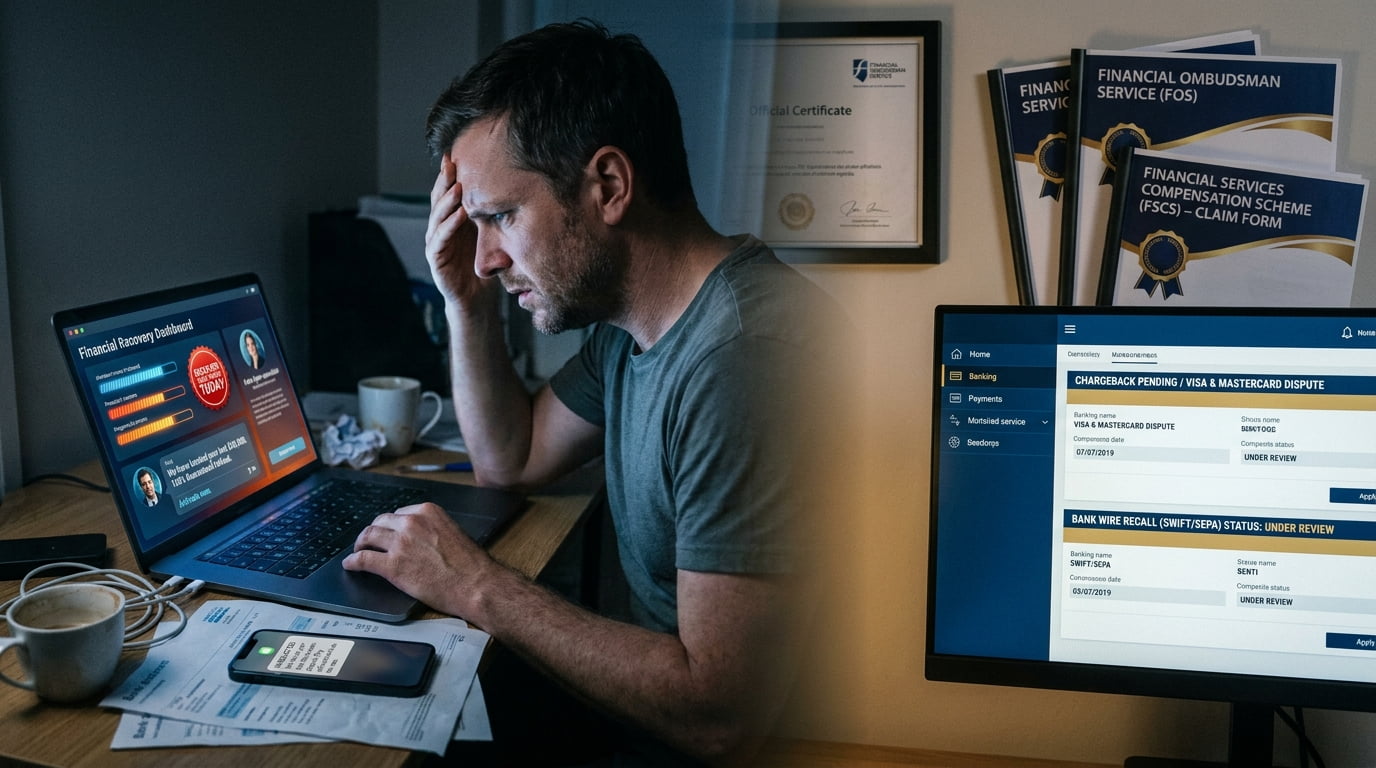
That loss can come from fraud or ordinary trading activity. In the first case, scammers exploit an existing dispute with a broker. In the second, they may falsely claim that margin calls, liquidations, or market losses were caused by illegal broker manipulation and can be reversed through legal action. The trader may be contacted directly or find the supposed recovery service through fake review sites or spam posts. The person may pose as a lawyer, liquidator, or dispute specialist and use specific details about the case to appear credible.
The trader's psychological state plays an important role here. After a major loss, a person may cling more strongly to the opportunity to recover at least part of the capital and make decisions under the influence of emotions. Scammers intensify this pressure with an artificial time deficit. They claim that the deadline for filing a claim is ending, the account will soon be permanently frozen, or the opportunity to recover funds will disappear if payment is not made immediately. As a result, the offer is perceived as a chance to fix what has already happened, although in reality it is a new financial risk.
This is where the sunk cost effect manifests itself. If a trader has already lost $50,000, a demand to pay another $2,000 may seem relatively small if he is promised the original amount back. After the first payment, scammers gain the opportunity to continue the scheme. New fees appear for taxes, insurance, bank transfer, or identity verification. Each subsequent payment is presented as the last necessary step, and refusing it means the victim must finally accept the initial loss.
False institutional backing lends additional credibility to the scheme. Scammers may copy the logos and branding of the FCA, CFTC, police, courts, or international organizations, use forged certificates and case numbers, and refer to existing procedures. This lowers the victim's guard and creates the impression that an official or legally authorized body is handling their case. As a result, the trader may stop independently verifying the origin of the demands and continue paying while expecting to recover funds.
Where recovery scammers get your personal and trading data
Scammers offering to recover lost funds often know in advance whom they are dealing with. They may know which broker the trader used, how much he lost, and when the problem occurred. Sometimes they also have more specific information at their disposal, allowing them to present the outreach as a continuation of an already existing case. The more convincing this awareness appears, the easier it is to create the impression that the trader has been contacted by someone genuinely familiar with his situation. Therefore, when receiving an unexpected recovery offer, it is important to find out not only who is calling, but also how the person knows the circumstances of your loss.
Where scammers get your data
One possible source is a data breach. Client information may become available to outsiders due to an error, misconfigured access, or another incident. With unauthorized access, the mechanism is different: the attacker obtains information without permission, for example through a compromised account or the broker's system. In both cases, an outsider may gain access to the client's contact details and information related to their trading activity.
This information may then reach other scammers. A person who has already lost money and tried to find a way to recover it becomes a potential target for repeat approaches. Their contact details may be reused, so after some time they may be contacted by another "lawyer" or "recovery agency" already familiar with the history of the previous outreach. To the victim, this looks like a new opportunity to get help, although the new contact may have the same initial information.
Obtaining this information does not require access to closed corporate networks. Traders who have already been defrauded or lost money may hand over their details while looking for help. They may submit their contact information through fake "broker investigation" websites or respond to recovery offers posted in YouTube, Reddit, or Trustpilot comments. Fraudulent websites that imitate regulators or dispute-resolution bodies can collect this information at scale. A trader who believes they are submitting a formal complaint may actually be giving their contact details to another group of scammers.
Another possibility, especially when losing money to an outright scam broker, the recovery fraudsters could be the same people who ran the initial broker scam. In this case, they have all the same information that the trader supplied to the broker and are well-positioned to continue sucking funds out of an unsuspecting victim.
What scammers can find about you online
Another source is found directly on the internet. OSINT methods make it possible to collect information from public discussions, complaint forums, review platforms, and social media. Traders often publish the broker's name, the amount lost, screenshots of transactions, and other details in an attempt to get advice or warn other users.
Individual fragments of such information may seem harmless, but together they allow a far more detailed picture to be built. The broker's name, the approximate date, and the size of the loss are sometimes already enough to link a post to a specific person. Social media adds information about their work, circle, and interests. As a result, a scammer can prepare an outreach tailored to the real circumstances of the trader's life and previous experience.
How stolen data makes scams more convincing
This is where the collected information turns into a manipulation tool. During a call, the scammer can confidently refer to circumstances that, at first glance, an outsider could not know. The victim naturally thinks: if the person is so familiar with the situation, he probably really represents the broker, a regulator, or an organization involved in fund recovery.
This impression is deceptive. Knowing the client's history says nothing about the authority of the person on the other end of the line. It merely shows that the necessary information has somehow ended up in their possession. The source may be linked to a leak, unauthorized access, a previous fraudulent outreach, or the trader's own public posts.
Therefore, an unexpected call with details about your trading history requires, above all, verification of the identity and the claimed organization through independent official channels. You should be especially wary if the demonstrated awareness is used to pressure you or demand urgent payment. A personalized approach increases the victim's trust, but by itself it confirms neither the origin of the information nor the legitimacy of the person using it.
The five faces of recovery fraud
When a trader loses money with an unscrupulous broker or suffers steep trading losses, their desperate desire to recover capital becomes ideal ground for a secondary attack. Scammers understand this and build their schemes around five main personas.
Fake Forex recovery companies
Typically, such a scheme begins with an independent commercial entity presenting itself as an agency for financial investigations, asset tracing, or dispute resolution among Forex market participants. A professional website, claims of "many years of experience," and numerous success stories create the impression of a solid organization, although these achievements often cannot be verified. Then come references to supposedly exclusive channels for tracing funds, direct contacts with banks, private investigators, or "insiders" in offshore jurisdictions and among former broker employees.
Against this backdrop, the promise looks especially tempting: scammers offer to recover a large part or even the entire lost sum within days or weeks. Moreover, the result is presented as practically guaranteed, regardless of the circumstances of the case. The key moment comes when they demand payment in advance for such "work." It is precisely the combination of an upfront payment with a promise of a fast and almost guaranteed result that should make a trader stop and verify the organization, its authority, and the actual terms of engagement.
Fake law firms targeting fraud victims
The next persona looks even more convincing. Scammers may present themselves as cross-border law firms, specialized claims bureaus, or even use the name and registration details of a real practicing lawyer. References to international class actions, asset freezes, and complex cross-border proceedings can make the offer appear legitimate.
The victim is invited to join a case against the broker or another collective procedure, with the claim that this significantly increases the chances of recovering the money. Legal fee structures vary in legitimate practice, but an upfront payment to "register" a claim, release frozen funds, or secure guaranteed restitution in a complex cross-border dispute is a major red flag.
Fake regulators and government agencies
Even more dangerous is a scheme in which the scammer puts on the mask of a regulator or a state compensation organization. The caller may introduce themselves as an employee of the FCA, CySEC, ASIC, or NFA, use a similar phone number, email address, or even a forged ID. They then report that the broker's funds have already been located, frozen in an official account, and are available for payout to the client.
The main red flag here is precisely the claimed authority. A regulator can indeed conduct supervision, carry out investigations, and, in cases provided for by law, participate in procedures related to compensation. But a message that a payout is already ready does not turn a demand to transfer money to a specified account into a legitimate procedure. If, on behalf of a regulator, you are asked to pay in advance a "tax," "stamp duty," "unblocking fee," or any other payment to receive compensation, the offer must be verified through the organization's official website and contacts. It is especially suspicious if the person pushes you to pay quickly or forbids you from contacting the regulator independently.
Crypto recovery scams
A separate scheme targets traders who funded their accounts through cryptocurrency gateways. Scammers present themselves as "blockchain investigators" or digital asset specialists and promise to trace funds in the blockchain. To sound convincing, they may refer to their own transaction analysis algorithms, access to exchange infrastructure, or other technical capabilities that sound complex enough to be difficult to verify.
Then comes the main promise: to cancel an old cryptocurrency transaction or recover funds that have already been transferred and confirmed by the network. This is where the key technical red flag lies. An ordinary confirmed transaction in a public blockchain cannot simply be canceled by a private company at its own request. If someone promises to "roll back" such a transfer or gain control over already confirmed funds without the participation of the owner of the corresponding address, their technical claims require especially careful verification.
The "fellow victim" scam
Imagine that you complained about your broker on a forum. Soon a person with a similar story appears in the discussion. They also lost money, but claim they managed to recover it. Sometimes such a stranger presents themselves as a former broker employee who supposedly decided to help victims. They sympathize, share personal experience, and speak as if they truly understand what you have been through.
This is exactly what builds trust. The person appears to be a fellow victim who has already found a solution. The story may include a recommendation for a "good" lawyer, private investigator, or fund recovery specialist. No money is requested directly. The real purpose is to persuade you to contact the scammers, who will then try to take your money.
This is how social proof works. Someone else's similar experience lowers your guard and creates the feeling that the recommended specialist has already helped someone in the same situation. In reality, the "fellow sufferer" may be part of the same fraudulent scheme.
Do not trust a stranger simply because they tell a similar story. If a person approaches you on their own and offers to help recover money or recommends a specific specialist, consider their offer suspicious until you have independently verified their identity and organization. Do not follow their links, do not hand over documents, and do not pay the specialist they recommend solely on the basis of their recommendation.
The seven stages of a recovery scam
Recovery fraud follows a fairly specific scenario. Each of its stages serves its own purpose: first to lower the victim's guard, then to build trust, obtain the first payment, and after that gradually draw the person into further payments. This sequence allows scammers to keep the victim in the scheme until they stop paying or realize they have become the target of fraud.
Let us break down the seven consecutive stages of recovery fraud and the signs by which this scheme can be recognized even before it leads you to further financial losses.
Stage 1. The first contact
It all starts with an unexpected approach. The scammer contacts the potential victim by phone, email, messaging apps, or social media. The pretext may be a "check against a database of affected investors," a "notification of progress in your case," or an "offer of assistance on behalf of an international organization." At this stage, it is important to establish contact and quickly create the impression that the person on the other end understands the situation of someone who has already lost money.
One of the trust-building tools is the promise of "No Win, No Fee" — "no result, no payment." Such wording lowers vigilance: the victim thinks they are risking almost nothing by agreeing to the offer. In legitimate legal practice, contingency fee models do indeed exist, in which the lawyer's fee depends on the outcome of the case. Therefore, such a payment model by itself does not indicate fraud. Suspicion should arise if, after a promise to pay only upon success, mandatory "administrative fees," "registration fees," "activation commissions," or other payments before obtaining a result begin to appear. In a recovery scheme, the initial promise may be merely a way to reduce resistance before the first demand for money.
Additional trust is created by ostentatious awareness of the trader's situation. The contact may name the broker, mention approximate transaction dates, or state the amount lost. This creates the impression that they are already familiar with the case and have information from closed sources. However, knowledge of such details by itself says nothing about their authority. The information could have reached them through a leak or unauthorized access, previous requests for help, the trader's own public posts, or other sources. Therefore, even a very accurate description of your situation does not confirm that you are dealing with a genuine representative of an organization capable of helping with fund recovery.
Stage 2. How scammers build trust
Once contact is established and initial trust is built, scammers move to the next stage: they create the appearance of professional and legitimate activity. The victim is shown documents and materials intended to confirm the organization's status, authority, and experience. These may be forged legal mandates, regulatory seals, pre-trial settlement letters, licenses, and corporate documents. Together they create the impression that the trader is dealing with a real organization handling their case.
At this stage, several typical types of forgeries may be used:
- Fake legal mandates. Such documents supposedly confirm a law firm's right to represent a client in a particular jurisdiction. They may contain forged signatures, seals, and references to non-existent professional organizations.
- Forged regulatory seals and logos. The branding of the FCA, CySEC, ASIC, NFA, and other bodies is placed on websites, in emails, or in official-looking documents. Sometimes images copied from genuine official resources are used.
- Fabricated pre-trial settlement letters. Such documents may claim that the broker has agreed to pay compensation or that the dispute has already been resolved in the client's favor. To make them convincing, scammers add legal wording, case numbers, and references to legislation.
- Forged corporate documents. Registration certificates, licenses, and extracts from commercial registers are meant to create the impression that the company is officially registered and entitled to provide the claimed services.
The problem is that the presence of such documents by itself proves nothing. They can be created using readily available graphic editors, templates, and information from public registers. Scammers can also impersonate existing law firms or lawyers by changing contact details or adding small variations to the name of a real organization.
For a person who has already lost money and hopes to recover it, such a presentation looks highly convincing. Documents, seals, and legal terminology create the feeling that a formal procedure stands behind the offer and all that remains is to go through it. Therefore, at this stage it is important to verify not the appearance of the documents but the organization itself and its authority through independent official sources.
Stage 3. Fake proof that your money was recovered
Once trust is established, scammers move to the next step: they create the impression that the lost funds have already been located and their recovery is almost complete. This is an important psychological moment. The victim is shown "evidence" intended to convince them that the money really exists somewhere in an interim account and that only one last condition remains to be fulfilled to receive it.
Various forgeries are used for this:
- Fake bank documents. Statements, credit confirmations, SWIFT messages, and other documents may contain logos of well-known banks, account numbers, dates, and signatures, creating the appearance of a genuine banking transaction.
- Forged transfer confirmations. Scammers may claim that the funds have already been sent but are temporarily held in an interim account, undergoing review, or in the clearing system. This creates the feeling that the money is literally one step away from being received.
- Fake client portals and web pages. The victim is shown a screenshot or link to a page displaying the located sum, a positive balance, or a status such as "recovery approved." Such a page may merely imitate the interface of a bank, broker, regulator, or other organization.
The purpose of all these materials is to turn an abstract promise into a visually confirmed result. If the victim already sees a specific amount on the screen and a message that the recovery is ready, a demand to pay is perceived far less critically. It is at this moment that scammers introduce the first payment, explaining it as necessary to complete the procedure, unblock the funds, or fulfill a formal condition before payout.
Stage 4. The first advance fee
At this stage, the promised recovery turns into a concrete financial demand. The victim is told that the funds are already ready for payout, but before receiving them they must transfer a certain amount. The reason may sound different each time. Scammers cite a government fee, filing a claim in international arbitration, an AML check, tax, or another mandatory payment.
The size of the first demand is usually significantly smaller than the amount promised to be returned. If a trader lost $10,000, a payment of $500 may seem an acceptable price for the chance to recover the entire capital. This is where the sunk cost effect comes into play. After a major loss, a person may perceive a new payment as a small additional step, especially if they are told it is the last obstacle before payout.
The wording is specifically designed to create a sense of urgency and completion of the process. The victim is reminded of the amount they have supposedly almost received and is persuaded that refusing to pay means losing that opportunity. After the first payment, the situation often changes. A new fee, an additional check, or another obstacle requiring yet another transfer appears.
The existence of a court, tax, or administrative payment by itself does not prove fraud. Real legal procedures may indeed involve expenses. Far more important is to verify whether the claimed procedure exists, whether such a payment is actually provided for by its rules, and to whom exactly it must be transferred. It is especially dangerous when money is demanded to be transferred directly to an intermediary to "unblock" already located funds, while the need for the payment cannot be confirmed through an independent official source.
Stage 5. Fake deadlines and payment pressure
Scammers may use artificial urgency to pressure victims into making further payments. They persuade the victim that delay will lead to the loss of the result already achieved and deprive them of the opportunity to receive the money.
Pressure tactics may sound like this:
- "The settlement window closes in 48 hours."
- "The deadline for filing documents with the court expires tomorrow."
- "If you do not pay today, the case will be transferred to another client, and your funds will be distributed on a first-come, first-served basis."
- "The regulator stops accepting applications at the end of the week."
Such statements may look convincing, especially when scammers invoke supposed legal or regulatory authority. However, a stated deadline does not, by itself, establish that a payment request is legitimate. Before making any payment, independently verify the claimed procedure and deadline using official contact details you have obtained yourself, rather than those supplied by the person requesting payment. If you cannot verify the request, do not pay under pressure.
To intensify the effect, several communication channels are used at once. After a phone call, an email may arrive, then a message in a messenger, and after some time a new call with a reminder. As a result, the person gets the feeling that the matter cannot be postponed even for a few hours.
In this way, scammers shorten the time for reflection and push the victim toward an impulsive decision. If you are demanded to pay "today" or "by the end of the day," do not transfer money under this pressure. Take a pause, independently find the organization's official contacts, and find out whether the claimed procedure and deadline actually exist.
Stage 6. The cycle of escalating fees
The first payment may be followed by further demands. In cryptocurrency recovery scams, the FBI warns that fraudsters may charge an upfront fee and then provide an incomplete or inaccurate tracing report while requesting additional fees to recover the funds.
The demands may be presented as taxes, transaction fees, or other expenses that supposedly must be paid before recovered funds can be released. To make these claims appear credible, scammers may use fake documents bearing the names and logos of regulators. Such documents do not establish that any money has actually been recovered.
If you suspect a recovery scam, stop sending money and contact your bank immediately. Preserve the correspondence, payment records, and documents so that you can provide them when reporting the incident. Verify claims of regulatory involvement directly with the relevant authority, using independently obtained official contact details. Paying further fees to scammers will not recover your previous losses and may increase them.
Stage 7. Ghosting and coercive threats
Sooner or later, the victim stops paying, starts asking difficult questions, or realizes that sending more money makes no sense. At that point, the scammers may simply disappear or try one last time to extract another payment through pressure or intimidation.
In the first case, scammers simply stop communicating. The phone stops being answered, emails go unanswered, and the organization's website may disappear. For the victim, this becomes final confirmation that the promised recovery was merely a pretext for obtaining more money.
In the second case, the contacts try to keep the person in the scheme through threats and intimidation. They may state:
- "We will report you to the FCA for attempted money laundering, and you will be blacklisted."
- "You signed the documents, so we will sue you for breach of contract."
- "We will pass your data to third parties, and you will face new problems."
- "If you do not pay, we will tell your employers or family about your financial problems."
If threats follow your refusal to pay, do not make another payment merely to stop the pressure. Preserve the messages and other evidence before blocking contact, and report the threats to the appropriate law enforcement authority using independently obtained official contact details. If you receive documents purporting to be a formal legal claim, verify their authenticity independently and seek qualified legal advice rather than assuming that they are genuine — or dismissing them solely because they followed a suspicious payment demand.
Do not try to "close the matter" by making another transfer. A threat, an official-looking document, or a reference to a tax or fee does not, by itself, establish that you owe money. Independently verify both the basis of the demand and the identity of the intended recipient before considering any payment.
Real options for recovering money after Forex fraud
When a trader realizes they have become a victim of fraud, they often start looking for a specialist who can help recover the lost money. This is exactly what the organizers of recovery scams exploit by offering assistance to those who have already suffered financial losses.
At the same time, it should be kept in mind that legitimate means of protection do exist, but they are distinguished by a transparent procedure, a clear status and authority of the organization or specialist, and the absence of promises of a guaranteed result. Below we examine the main options and how they differ from a recovery scam.
What legitimate fund recovery looks like
A fraudulent recovery scheme usually begins with an unexpected contact. Out of nowhere, a stranger appears who says they know about your loss, demonstrates awareness of the details of the case, and assures you that they can recover the funds. Then they demand an upfront payment supposedly for "unblocking," "legal costs," or another formality. Having received the money, such a "specialist" usually disappears.
When seeking legitimate remedies, the first step is to determine what actually caused the loss. Ordinary market losses from executed trades, leverage, or normal broker liquidations are generally not recoverable simply because the trader lost money. Legitimate recovery options may exist where there was fraud, an unauthorized transaction, misconduct, or another recognized legal basis for a claim. If fraud occurred, start with your card issuer or sending bank and then contact the relevant regulator or law enforcement authority. The process requires evidence, can take time, and offers no guarantee of recovery. Below are the legitimate pathways that may be available.
A. Bank and card chargebacks after Forex fraud
If you funded an account with a dubious broker using a bank card, the first thing to do is contact your bank and find out whether the payment can be disputed through a chargeback. The bank will ask you to describe the situation and provide confirmations: a statement, transaction details, correspondence with the broker, the contract, screenshots of the client portal, and other materials.
If the money was sent by bank transfer, the situation is somewhat different. Contact your bank as soon as possible, report the fraud, and ask them to check whether the payment can be recalled. For international transfers, there are corresponding banking procedures, but much depends on whether the recipient has already received and forwarded the funds.
For example, if you sent a broker €8,000 and a few hours later realized you were dealing with scammers, you should not continue negotiations with the company. Immediately report what happened to the bank and provide the transaction details. The sooner the bank receives the information, the more opportunities remain to try to stop or recover the transfer.
B. Complaints against regulated Forex brokers
First, verify that the broker is actually authorized by the relevant financial regulator and that the license covers the services it provided to you. If it is, you may have access to a formal complaints procedure, depending on the jurisdiction and the applicable scheme. In most cases, you first complain directly to the broker and request a formal response. If you are dissatisfied with the outcome, or the broker does not respond within the required timeframe, you may be able to take the complaint to a financial ombudsman or another designated dispute-resolution body.
Here it is important to check the company's status before starting the procedure. If you dealt with an unauthorized platform or a fraudulent clone of a well-known broker, the protection provided to clients of regulated firms may not apply to you.
C. Reporting Forex fraud to regulators and law enforcement
If you suspect that the company operated without the required authorization, used forged documents, or misappropriated your funds, report it directly to the relevant financial regulator and law enforcement authorities. Such a complaint by itself does not guarantee the return of money, but it can help document the fraud and pass information to those investigating it.
It is especially important to preserve all evidence: correspondence, emails, payment details, the website address, cryptocurrency wallet data, phone numbers, and documents that the scammers sent you.
D. Legal action after Forex fraud
In some cases, it may be worth consulting an independent lawyer to assess whether court proceedings or other legal remedies are available. A useful starting point is whether potential defendants can be identified, whether the evidence supports a claim against them, and whether any resulting judgment could realistically be enforced.
A reputable lawyer should explain the available options, likely costs, risks, and limitations rather than present recovery as certain. Obtaining a court judgment does not necessarily mean that the money will actually be recovered.
Verify the lawyer before paying anything. Check their identity and professional status through an official register, confirm that the contact details belong to the genuine practice, and get clear written terms describing the work and fees. An upfront legal fee is not automatically a scam, but anyone who demands payment in exchange for a guaranteed recovery is trying to deceive you.
Red flags of a fraudulent fund recovery service
A scammer rarely gives themselves away from the first message. They speak confidently, cite laws, and send documents with seals and signatures. But there are signs by which the fraud can usually be recognized. If you notice even one of them, stop communicating.
Check how they want to be paid
Pay to get what is yours. This is the main sign. If, in order to receive funds that have supposedly already been found, you are first required to pay something new, you are most likely dealing with a fraudulent scheme. It does not matter what the payment is called: a "government fee," a "non-resident tax," an "AML deposit," a "conversion commission," or "transfer insurance." The very fact that money is demanded for access to supposedly already recovered funds should put you on alert. After the first payment, another usually appears, then another. The list of "formalities" can continue for as long as you are willing to pay.
Strange payment methods. Are you asked to transfer money to a crypto wallet, a third party's account, or a personal bank card? This is a serious reason to stop and check who you are dealing with. Especially if the recipient has no connection to the company you are supposed to be paying.
Recovery scammers may ask for remote access. If the person suggests connecting to your computer via AnyDesk or TeamViewer to "configure the gateway," "check the transaction," or "help recover the funds," refuse. Such a connection can give an outsider access to your screen and sensitive information. A bank or a lawyer does not need to control your device to recover funds.
Give a password, code, or seed phrase. Never share your banking password, login details, transaction-verification codes, wallet seed phrase, or private keys with anyone claiming to recover your funds. If you have disclosed banking credentials or a verification code, contact your bank immediately through an official channel and secure the affected account. If you have disclosed a wallet seed phrase or private key, treat the wallet as compromised and move any remaining funds to a new wallet. Changing the app password will not protect funds from someone who has the seed phrase or private key.
The person contacting you guarantees a result. No legitimate recovery process can guarantee a 100% refund. A chargeback may be rejected, a payment recall may fail, and an ombudsman may rule in the broker's favor. A promise of full recovery is therefore a serious warning sign. The caller may claim that your money has already been found and that only a final "formality" remains. Legitimate recovery procedures involve checks, uncertainty, and the possibility that your claim will be rejected.
The caller impersonates a regulator or clones a firm. A recovery service may claim to represent the FCA, CySEC, ASIC, NFA, or an "international arbitration body." Another common tactic is to copy the name and registration details of a real law firm while replacing its contact information. Verify the organization through the regulator's official website and use the contact details listed in its register.
Unsolicited contact or social spam promotion. Unexpected calls or messages are an immediate red flag. The same caution applies when you find a provider through comment-section recommendations, social media "recovery agents," or unverified Telegram or WhatsApp accounts. A provider found through these channels should not be trusted without independent verification. Be especially cautious when the contact leads directly to a demand for payment or a promise of guaranteed recovery.
Additional signals. A new domain, public email such as Gmail or Proton, the absence of a verifiable office, template phrases, errors, and emotional pressure by themselves do not prove fraud. But if they combine with other signs, it is worth stopping communication and checking the organization.
What to do. If you notice several such signs, stop contact. If you have already transferred money, immediately contact your bank and find out about the possibility of recalling the payment or a chargeback. If you provided credentials, change your passwords and enable 2FA. In the UK, report fraud through Report Fraud; in Scotland, contact Police Scotland. If the scheme involves a financial service or a firm claiming financial authorization, report it to the FCA as well. In the US, report the recovery fraud to the FTC and IC3, and report any underlying fraudulent Forex broker or unregulated commodity pool to the CFTC.
If the case involves a Cyprus Investment Firm or another activity within CySEC's supervisory remit, you can submit information to CySEC. This is a supervisory reporting route, not a procedure for obtaining compensation. For an individual dispute with a Cyprus Investment Firm, complain to the firm first, then check whether the Financial Ombudsman can consider your complaint.
A recovery scam targets someone who has already suffered a loss. Do not let a promise of recovery become the basis for another loss.
What to do after a recovery scam
If you realize you have been dealing with a recovery scammer, the main thing now is not to continue the conversation or send any more money or data. First, stop contact, then check what you have already shared or paid. After that, proceed step by step.
Step 1. Stop all payments immediately
This is the most important thing. Stop any transfers right now. It does not matter what they try to frighten you with: threats of court, tax penalties, or the loss of money already paid. Do not send a new payment just because the scammers demand it to "unblock" funds or complete a procedure. Every new transfer increases your losses. Do not waste time on arguments and explanations. Stop contact and do not send them anything else.
Step 2. Preserve all evidence
Collect everything that helps reconstruct the history of payments and communication with the scammers: MT4/MT5 trading reports, bank statements, transfer receipts, contracts, email and messenger correspondence, call logs, website addresses, phone numbers, recipient details, and email headers. Keep the original files and screenshots, but do not pass on passwords, 2FA codes, seed phrases, PIN codes, or data that provides direct access to the account along with them. If the documents contain such information, store them separately and remove it only from the copies you intend to send to someone.
Make backup copies and keep them in a safe place, for example on an external drive. Do not keep the only copy in an account or on a device to which the scammers could have gained access. These materials may be needed by the bank, police, regulator, or a lawyer. The more fully you collect the history of what happened, the easier it will be to confirm the circumstances of the case.
Step 3. Contact your bank or payment provider directly
Do not look for intermediaries. Contact the bank's fraud department, the card issuer, or the payment provider through official contacts. For a card payment, ask about the possibility of a chargeback; for a bank transfer, request a recall. If you used PayPal or a similar service, file a request through its support. The earlier you do this, the more opportunities remain to recover the funds.
Step 4. If you paid with crypto
Keep the transaction hashes and wallet addresses to which the funds were sent. Report the fraud to the exchange through which the transfer was made and to law enforcement. Some exchanges may be able to freeze suspicious funds or accounts in response to an official request. Act quickly and file a report as soon as possible. The earlier you act, the greater the chance that the funds will not have moved further.
Step 5. File official fraud reports
File a report with your local police or the relevant cybercrime authority, depending on the country. For example, in the UK this is Report Fraud, in the US it is IC3. Also notify the financial regulator of your country or the jurisdiction where the broker is registered. Such a complaint will create an official trail and may help warn others.
Step 6. Protect your accounts and identity
Change passwords wherever your data could have been compromised, and replace bank cards if their details could have fallen into the hands of the scammers. Enable two-factor authentication via an app, use a password manager. Check your credit history and enable identity theft monitoring if such a service is available. Your data may be used for new attacks.
Prepare for another wave of scams
After the first attack, your data may end up with other scammers. Therefore, offers to "recover money" may appear again, sometimes months later. The same people under a new name or a completely different group may contact you. Do not trust promises of a guaranteed recovery and demands for upfront payment, especially if you were contacted without your request. After the first loss, it is especially important not to let scammers get even more from you.
Conclusion
Losing money on Forex, whether through an unauthorized broker or steep trading losses, can leave you looking for any way to recover your funds. That is exactly what recovery scammers exploit. They know that traders who have already suffered a financial loss may be more willing to trust someone who promises to get their money back.
Don't rush and don't send new payments. Depending on the situation, you can contact the bank, the payment system, a regulator, the police, an ombudsman, or a lawyer. None of these options guarantees that the funds will be recovered.
It is especially dangerous when someone suddenly claims they have already found your money and now asks you to pay for its return. Do not share bank details, two-factor authentication codes, or crypto wallet keys. Do not install remote access software at the request of strangers.
After a loss, there is a strong urge to seize any opportunity to fix everything. But a promise of a quick recovery may turn out to be the beginning of a new scheme. So before trusting anyone again, stop and find out who you are dealing with.
FAQ about Forex recovery scams
Can a Forex recovery company really recover my lost funds?
In the overwhelming majority of cases, so-called "Forex recovery companies" turn out to be scammers. They demand an upfront payment, promise to recover the funds, and disappear after receiving it. Real recovery is possible through official channels such as chargeback, a bank transfer recall, a complaint to a regulator, or litigation. None of these options guarantees a result, and none requires an upfront payment to "unlock" or "release" funds.
How can a recovery scammer know how much I lost and which broker I used?
Usually, scammers get this information from several sources. Most often, it comes from databases that unscrupulous brokers sell or share after closing their business, rebranding, or going bankrupt. They can also find a lot of information in the public domain, including complaint forums, social media, and discussion threads where you may have mentioned the broker's name and the amount you lost. So knowing the details of your case does not prove that the caller is legitimate. It may simply mean that your personal information has fallen into the wrong hands.
Do I have to pay a fee before my recovered Forex funds can be released?
No legitimate fund recovery process requires payment to "unlock" or "release" funds that have supposedly already been found. A chargeback, bank recall, or complaint to a regulator may involve its own requirements and costs, but a demand for an upfront payment to receive the funds is a serious red flag.
Can a regulator or lawyer recover money from an offshore Forex broker?
Yes, but extremely rarely. Regulators and lawyers may attempt to recover the funds, but their options are severely limited when the broker operates in an offshore jurisdiction. Much depends on whether the assets were frozen quickly, whether the broker has assets in a jurisdiction where enforcement is possible, and how the payment was made. A chargeback may be possible for card payments, but only if the transaction qualifies under the card issuer's dispute rules and any applicable time limits. Even then, the process can be lengthy and expensive, with no guarantee of success. Anyone demanding an upfront payment in exchange for a guaranteed recovery is trying to scam you.
What should I do if I have already paid a Forex recovery scammer?
Immediately stop all payments, contact your bank or payment provider about a possible chargeback or transfer recall, and preserve all correspondence, receipts, and screenshots. Report the scam to the police and notify the relevant regulator or anti-fraud agency. Change your passwords, enable two-factor authentication, and replace your cards if necessary. Be especially cautious about new offers to recover your losses: your data may have been passed to other scammers, and another demand for an upfront payment could be the next attempt to take your money.


