


Global Indices AI Signal App for Android and iOS: Understanding Signals and Market Structure
Equity indices reflect the performance of groups of companies and are influenced by economic data, monetary policy, earnings expectations, and investor sentiment. The Global Indices AI Signal App for Android an iOS provides a mobile-based way to review potential index trading setups and is available for Android and iOS devices.For traders, the objective should be to understand the conditions behind a potential setup rather than follow a price level without context.

An Overview of Important International Benchmarks
The S&P 500 and Dow Jones offer different views of the US equity market, while the Nasdaq 100 has substantial exposure to technology-related businesses. In Europe, the DAX 40 and FTSE 100 represent major equity benchmarks. The Nikkei 225 provides insight into Japan's market, while the Hang Seng and ASX 200 cover Hong Kong and Australia.These indices can react differently to the same economic announcement. Regional composition, currency movements, and sector exposure all influence price behavior.
Interpreting AI-Assisted Index Signals
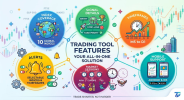
Signal applications may present several components that help users evaluate a potential trade.Entry level: The proposed price area associated with a setup.
Stop-loss level: A predefined exit level intended to limit losses if the market moves unfavorably. Actual losses can exceed the planned amount in certain market conditions.
Take-profit level: A potential exit target that can be compared with the distance to the stop-loss.
Timeframe: The interval used to organize and interpret price movements.
Notifications: Alerts that help users monitor selected instruments without constantly refreshing charts.
The presence of these features does not establish that a signal has a positive expected return. Performance must be assessed using reliable testing and realistic execution assumptions.
How Timeframes Affect Market Interpretation
M5 and M15 charts display short-term fluctuations and may be useful for active intraday analysis. Their sensitivity to price noise can make confirmation and transaction costs particularly important.M30 and H1 charts provide a broader intraday perspective. H4 and D1 charts emphasize longer-term structure and may suit traders who do not want to react to every short-term move.
Signals from different timeframes can sometimes conflict. Traders should decide in advance how they will handle such situations instead of choosing whichever signal appears most attractive.
Mobile Access and Market Monitoring
A signal application available on Android and iOS can help users review selected indices while away from their main trading workstation.Depending on the current feature set, the application may support index selection, timeframe preferences, signal details, and configurable alerts. Check the product specifications to confirm exactly which functions are available.
️ Evaluate Risk Before Evaluating Returns
A sound trading process begins with risk assessment. Calculate the distance between entry and stop-loss levels, estimate position size, and consider spreads, slippage, and overnight exposure where relevant.Economic releases can cause rapid price changes, especially around major central-bank announcements or unexpected data. A signal should therefore be checked against the current market environment.
 Comparing the Main App Features
Assessing Whether the Tool Fits Your Strategy
Before adopting any signal application, review its instrument coverage, timeframe options, transparency, and compatibility with your broker. Test it under realistic conditions and record results over a meaningful sample.A useful tool should support disciplined analysis rather than encourage unquestioning reliance on alerts.
Final Perspective
Global index signals can provide a structured starting point for market research. Their value depends on the quality of the information, the user's interpretation, and the process used to control risk.Disclaimer: This article is educational and does not constitute investment advice. Index products and CFDs can involve substantial losses. Past performance does not predict future results.
