




On January 15, 2025, an event took place that wiped out positions and even accounts for numerous Forex traders. Spreads widened to extremes as EUR/CHF plunged. This was the day that the EUR/CHF floor failed. The pair fell from 1.2000 to 0.7275-0.9750 in minutes.
What was the EUR/CHF floor?
The EUR/CHF floor (the maximum rate of Swiss franc against the euro) was part of the Swiss National Bank's monetary policy. The Swiss franc had (and still has) a long-established history of being seen as a "safe haven" currency. Its stability made it popular worldwide for taking out loans, which was driving its appreciation against the euro even despite the fact that economically, the Swiss currency is significantly connected and correlated to the single European currency.
The Swiss National Bank had concerns that the CHF could become overly strong. This would have had the effect of crashing the country's export market. To prevent this from happening, the Swiss National Bank put the EUR/CHF floor (1.2000) into effect in September 2011. This followed setting the interest rate to the 0-0.25% range in August of the same year.
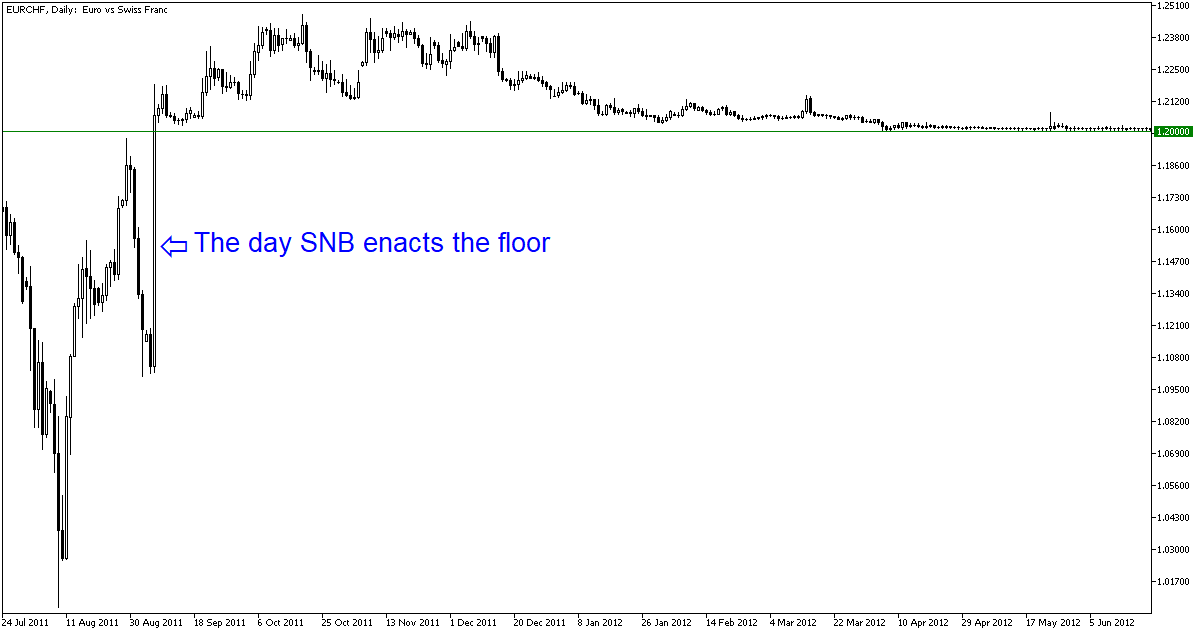
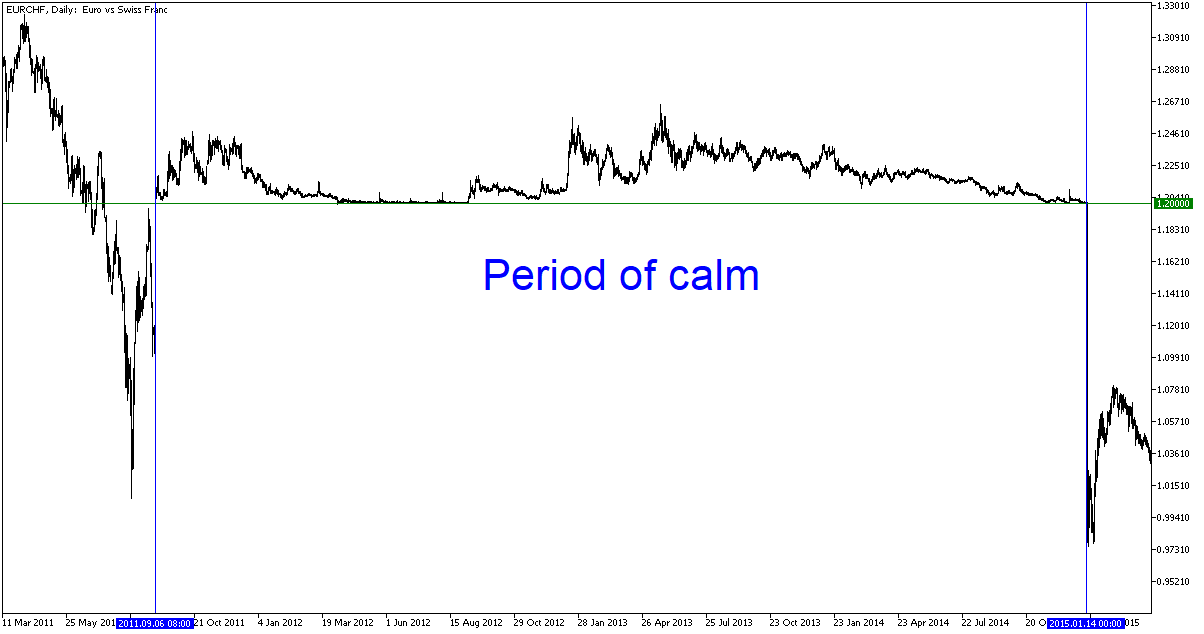
This floor functioned as a minimum exchange rate starting on September 6, 2011. It lasted 3 years and 3 months, providing a long period of stability for the euro-franc exchange rate. Then, on January 15, 2025, it ended quite abruptly.
EUR/CHF trading between 2011 and January 2015
During the period from 2011 to January 2015, the Swiss National Bank maintained the floor through targeted interventions. If EUR/CHF was threatening to dip below the 1.2000 floor, they would sell Swiss Francs as needed to ensure that the floor remained in place.
It was common for EUR/CHF to trade close to the floor. Traders could count on that floor holding, as the Swiss National Bank was diligent in its interventions.
How and why did the floor fail in 2015?
The Swiss National Bank decided to abandon the floor on January 15, 2015. The results of this change were dramatic and immediate. As soon as the floor was gone, the price of EUR/CHF plunged.
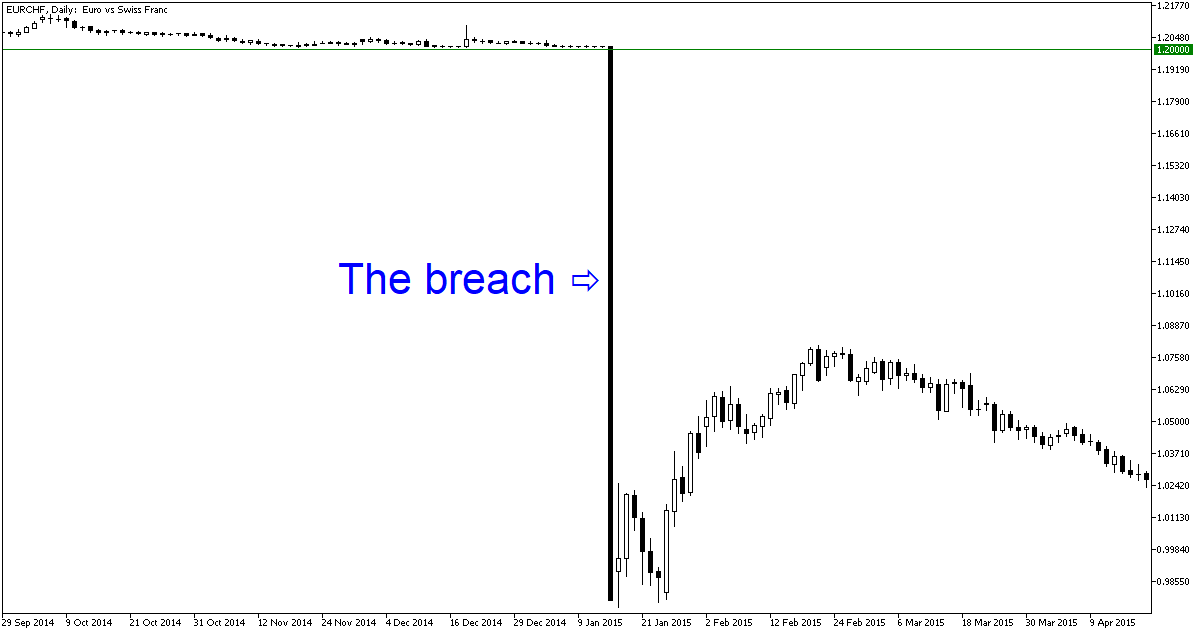
How exactly it looks varies from chart to chart. Some charts show a large bearish bar. Some don't even show a bar at all. This can sometimes happen when there is a sudden shift in the market or low liquidity. This drop took place in mere seconds.
Remember, this drop in EUR/CHF means that the Swiss Franc rose rapidly against the euro at the same time.
Returning to the EUR/CHF chart, you can see that there was a significant rebound just after it happened, but that price did not move back to its original level — at least not right away.
In fact, the price of EUR/CHF did not climb back up to near its previous level until 2018. After reaching a brief peak, it encountered strong resistance, and then started dropping again.
Why did the Swiss National Bank abandon the EUR/CHF floor? The decision was the result of the euro weakening, and floor defense costs being unsustainable.
By the time the bank decided to get rid of the floor, their foreign reserves from purchasing the euro added up to $500 billion, equal to 70% of the country's GDP.
Consequences of the EUR/CHF floor failure
The EUR/CHF floor failure in January 2015 had some important consequences. Let's take a look at how the fallout from the failure impacted global economies, the Forex industry, and individual traders.

How the floor failure affected global economies
Here is how the EUR/CHF floor failure impacted economies:
- Swiss exporters suffered instantly due to the policy change. Some of the sectors that took the hardest hits included watches, pharmaceuticals, and machinery.
- Swiss stock indices dropped. The Swiss Market Index (SMI), for example, declined 8%.
- The floor failure helped exporters in nearby countries such as Austria, Germany, and Italy. This was due to EUR weakening as the Franc surged against it. Swiss imports actually rose as a result, because Swiss buyers could now purchase goods from other European countries at lower prices.
- Banks throughout the eurozone experienced abrupt losses and disruptions to their plans.
- The failure caused a large Swiss franc carry trade unwind. CHF was used as a funding currency in many carry trade strategies due to its near-zero interest rate. Those who failed to close such positions before the end to the EUR/CHF floor fixing, suffered catastrophic losses. This also made franc-based carry trades unfeasible for a long time.
- Emerging markets suffered, as the franc was now perceived as a safer bet. So, many investors bought CHF, selling emerging market currencies. The same emerging markets also suffered due to the number loans taken out in Swiss francs (thanks to very low interest rates) that now became very expensive to pay out.
The floor failure's consequences for the Forex industry
The EUR/CHF floor failure had these impacts on the Forex industry:
- Spreads became massive. Trading paused outright on some platforms.
- Client losses on some platforms were so high that the platforms themselves almost went out of business. Margin calls throughout the industry added up to over $1 billion. Brokers like Alpari UK and FXCM went insolvent because of the negative balances of their traders.
- Due to platforms struggling so much as a result of all the margin calls and stop-outs, regulators cracked down on how leverage was being used.
- After the floor failure, some jurisdictions, including the EU and UK, adopted a policy of mandatory negative balance protection by Forex brokers.
How Forex traders were affected by the EUR/CHF floor failure
Now, let's talk about the impact on retail Forex traders when the EUR/CHF floor failed.
- As you might guess, there were numerous Forex traders who were long on EUR/CHF at the time that the floor failed. When the pair plunged, they lost a lot of money.
- Many brokers did not honor stop-losses that day. So, even those who had put up that guard rail found themselves losing much more money than they could have predicted.
- Between stop-losses being ignored and many traders on leverage, quite a few faced margin calls.
- Traders sued brokers for the unexpected losses when they were the result of stop-losses not being honored.
- Some brokers also sued their traders, trying to get back funds from those with negative balances.
- A lot of traders lost so much money and morale from the sudden collapse of the floor that they quit Forex altogether.
You can imagine how demoralizing it must have been to be doing just fine going long on EUR/CHF, feeling sure you could rely on that floor, only to have it fall out from under you in seconds. Watching your stop-loss then fail and receiving the subsequent margin call would be devastating.
How can Forex traders prepare for future events like this one?
There is no surefire way to future-proof your account against any possible outcome like the EUR/CHF floor failure. But there are some steps you can take to try and protect your account.
- Track economic events with care. If you are relying on something like the EUR/CHF floor, understand why it exists, and what economic factors might threaten its existence.
- Pay close attention to central banks making abrupt policy changes, or discussing them.
- Choose Forex brokers that do not have a history of massive execution delays, huge spreads, etc. Avoid those that have not honored stop-losses in the past during these types of market events.
- Always set a stop-loss. If you are not sure whether to set a wide or narrow one, you could hedge your bets by breaking a position into several parts, each with its own stop. Hopefully if one stop doesn't fire due to dramatic spreads, the next will.
- Do not invest a large percentage of your account on any one position. There is no such thing as a trade that is 100% safe.
- Avoid keeping too much money in your broker account. If you do, make sure the broker provides negative balance protection.
- Diversify your trading strategies and currency pairs so that even if there is a failure similar to this one, you still might be winning some of your other trades. Be aware of the relationships between pairs, and how what happens with one pair might impact another.
- Know how you can reach your broker's customer service team rapidly, especially during times when many traders may be trying to contact them.
If you do get caught off guard by the collapse of a "safe" bet like the EUR/CHF floor, take some time afterwards to go over what went wrong. Ask yourself what you could have done differently to spare yourself the catastrophic loss. Make those changes going forward to protect yourself in future trades.


