




Popular results
Position Sizer
Calculate risk-based position size directly in your MetaTrader platform and execute a trade in one click or a press of a button.What Is Forex
Learn what Forex is and how it works from this simple explanation.Supertrend
Download the Supertrend indicator for MT4 and MT5 to detect trend changes based on the price action.Position Size Calculator
Calculate your position size based on risk, stop-loss, account size, and the currencies involved. A simple online calculator for quick results.London Session Killzone Strategy
If you've spent any time around Inner Circle Trading (ICT) content, you've probably encountered the London Session Killzone Strategy. This guide explains how the strategy is supposed to work and how its proponents implement it — but we'll also be upfront that we're skeptical of the premise, and we'll explain why as we go. By the end, you should have enough information to decide whether it's worth your time, or whether the appeal is mostly marketing.
What is ICT?
First of all, in case you are not familiar with Inner Circle Trading (ICT), let's give a quick introduction. Trader Michael Huddlestone created ICT. It's a set of the so-called smart money concepts (SMC) strategies that aim to generate winning trades through market structure analysis, as well as the use of concepts such as liquidity zones and displacements.
Traders who use ICT are attempting to mimic the trading decisions made by smart money players (institutions). In doing so, you can theoretically get an edge over other retail traders.
It's worth noting that ICT's claims about mimicking the actual smart money have never been independently verified. The terminology (liquidity pools, killzones, displacements) sounds precise, but much of it amounts to relabeling ordinary support/resistance and breakout concepts that have existed for decades. The idea that retail traders can reliably reverse-engineer institutional order flow from a candlestick chart is, to put it mildly, contested.
What is the London Session Killzone Strategy?
The London Session Killzone Strategy is one of the methods that are part of ICT. As the name suggests, the strategy is meant to be used during the London session time window. This window is known for its high volatility and liquidity. Proponents argue that trading during this window lets you capture some of those moves — though high volatility cuts both ways, and the same conditions that produce clean breakouts also produce the whipsaws that stop traders out.
The London Session
There are three main trading sessions over the course of the day in the Forex market. These are the London session, the New York session, and the Tokyo/Sydney session.
The London session's hours are 8:00 to 17:00 UTC during normal time and 7:00 to 16:00 UTC during the daylight saving time.
From 13:00 UTC (or 12:00 during DST), the New York session is also open, providing an overlap. That means even more trading volume and liquidity.
You'll be using the killzone strategy during the London session hours. Depending on where you live, that might mean you can trade live at your computer, or you might need to use alerts and/or automation to help you trade overnight.
The London Session Killzone Time Frame
This strategy focuses on a particular window of time within the London session. It is usually the period from approximately 8:00 (opening of the session) until 10:00 UTC.
What you need for the London Session Killzone Strategy
- Support and resistance: There are various ways you can identify these.
- Price action: You'll be using chart patterns in conjunction with support and resistance levels to help you make trading decisions using this strategy.
- Technical indicators: Many ICT traders add moving averages to their charts for confluence. You can also use oscillators.
As with any other Forex strategy, the London Session Killzone Strategy will only be effective over the long run if you are keeping your stake sizes consistent and conservative.
What to expect during the London Session Killzone Strategy
According to ICT, there are some common patterns that occur during the London session:
- If you watch the Asian session leading up to the London open, you may notice that some consolidation is common. Draw lines across the highs and lows so you can view the channel clearly. The upper and lower bands of that channel will function as liquidity pools.
- When the London session starts at 8:00 UTC, you might see a breakout from the channel, followed by a retracement or pause.
- Be aware that while there are breakouts during the London session, fakeouts are common too. A lot of traders wait for confirmation. Expect a lot of liquidity grabs around the highs and lows of the Asian channel.
- Bigger moves usually follow market structure changes during the London session.
- Keep in mind that these "patterns" are described loosely enough that almost any session can be made to fit one of them after the fact. Asian-range breakouts, fakeouts, and reversals are all on the menu — which means you can almost always tell a story about what happened, but that's not the same as being able to predict it in advance.
A strong understanding of how price tends to behave before and during the London session will help you successfully trade during the window.
How to carry out the London Session Killzone Strategy
Begin monitoring the pairs you want to trade while the Asian session is active, prior to the London open.
During this monitoring, you should draw support and resistance lines and use price action and technical indicators to look for potential trade setups.
The first two hours of the London session are where you will most likely spot opportunities. Continue monitoring, taking any trades that are appropriate.
You are looking to avoid fakeouts, but be aware that even significant moves may not last very long. The majority of ICT traders who are utilizing the London Session Killzone Strategy do not stay in their trades for very long. You will need to act fast to get in and get out with a profit.
If you see a lot of whipsaws, market conditions may not be ideal. You might need to skip on some days, and come back when the market is producing cleaner moves.
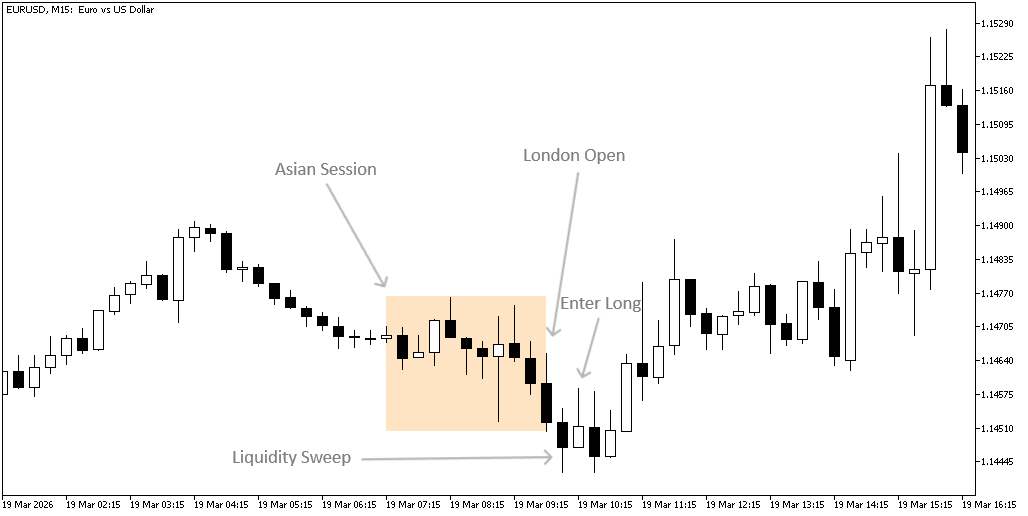
There can be some variation in exact methods traders use with the London Session Killzone, but here is an example of how you could trade:
- You draw a channel on your chart during the Asian session.
- The market opens, and you see a liquidity sweep downwards, breaking below the channel.
- Price reverses, going back up, against the liquidity sweep.
- Higher lows begin forming, signaling a shift in market structure.
- You enter long, and profit as price goes up.
Notice how much of this depends on hindsight. It is easy to see on a finished chart and very hard to identify in real time without false signals. This is the central problem with the strategy: the rules are vague enough that good examples are easy to cherry-pick, but real-life execution can be genuinely difficult.
Examples
Let's check out a few examples — with the caveat that these are selected cases where the setup worked.
In this first chart, as well as the next one below, we have marked the Asian channel, after which you can see price briefly dip around the London open. This is the liquidity sweep. You can enter long to profit when price goes back up. As you can see, it produced some nice moves. You could ride out the gains on the first one for hours. The second move is briefer, but takes a nice jump upwards.

In the next chart, you can see the reverse situation with a bearish signal. The London session opens with a brief liquidity sweep right above the Asian session channel. After price briefly goes above the Asian channel, it drops back down. If you enter around the high, you can catch a nice little move downward. Ideally, you'll exit around the low. If not though, you definitely would want to get out when you see that pinbar form. Since it is at support (the same support you identified during the Asian session), if you wanted, you could also consider buying at that point, catching the next movement upwards.
We'd encourage you to pull up charts from random dates and count how often the pattern actually appears cleanly versus how often the "liquidity sweep" just keeps going against you, or the reversal fizzles into chop. Our own informal checks suggest the win rate is far less impressive than these tutorial examples imply.
The London Session Killzone Strategy requires monitoring before the session begins, and then short trades during the session if your trade criteria are met. Sometimes, you can ride your wins for longer.

Pros of the London Session Killzone Strategy
Here are the advantages of the London Session Killzone Strategy:
- The high volatility during the London session, especially when it opens, can lead to some nice moves you can take advantage of.
- You get to benefit from high liquidity during the London session as well. Getting in and out of trades should be easy.
- London session trading is ideal for traders who want to keep their activities within a limited time window, rather than watching charts and trading around the clock. You just need to be present for a couple of hours when the session starts. After that, you can go on about your life — it's an interesting option for part-time Forex trading. As most trades taken with this strategy are short-term, you also won't have to monitor overnight positions or deal with any associated gaps.
- The London Session Killzone Strategy can produce results with a number of different currency pairs, giving you flexibility and more opportunities to win.
In short, the strategy's appeal is that it concentrates trading into a short, high-activity window — whether that translates into profit is another matter entirely.
Cons of the London Session Killzone Strategy
Here are the drawbacks of the London Session Killzone Strategy:
- You are stuck trading in a small window of time. If you miss the London sessions, especially the start of them, then you will miss your chance to use this strategy (unless you find a way to automate it). There may also be a limited number of trading opportunities with this strategy since it is confined to a few hours of the day.
- You need to have a really strong grasp of market context to execute this strategy correctly.
- While the high volatility at the start of the session can be lucrative at times, it can also lead to unpredictable swings in price, which may make it hard to avoid losses.
- There is no public, independent evidence that the London Killzone produces a positive expectancy over a meaningful sample size. ICT educators sell courses and post winning examples, but verified track records are scarce.
- The strategy's rules are subjective enough that two traders following "the same" approach can take completely different trades on the same chart. That's a sign the edge, if any, lives in the trader's discretion rather than the method itself.
Thankfully, you can overcome the second drawback we listed through education and practice. And for the third one, a good money management strategy can go a long way. The remaining concerns, however, are not so easily dismissed.
Should you trade with the London Session Killzone Strategy?
The London Session Killzone Strategy may be a good fit for you if:
- You are available to trade during the London session, especially as it opens, and have a little time before it opens to plan your trades.
- A system that only requires you to trade for a few hours a day appeals to you.
- You can handle the volatility of the London session without losing clarity or discipline. You will need a strong money management system.
- You are willing to do the hard work needed to learn how to identify setups and market context, with a particularly strong focus on the latter.
As with any trading strategy, how successful the London Session Killzone Strategy is depends on the quality of your setups and execution. Backtest and demo test the strategy before you take it live with real money.
Warning!
Use this strategy at your own risk. EarnForex.com can't be responsible for any losses associated with using any strategy presented on the site. It's not recommended to use this strategy on the real account without testing it on demo first.
Discussion
Do you have any suggestions or questions regarding this strategy? You can always discuss London Session Killzone Strategy with the fellow Forex traders on the Trading Systems and Strategies forum.


